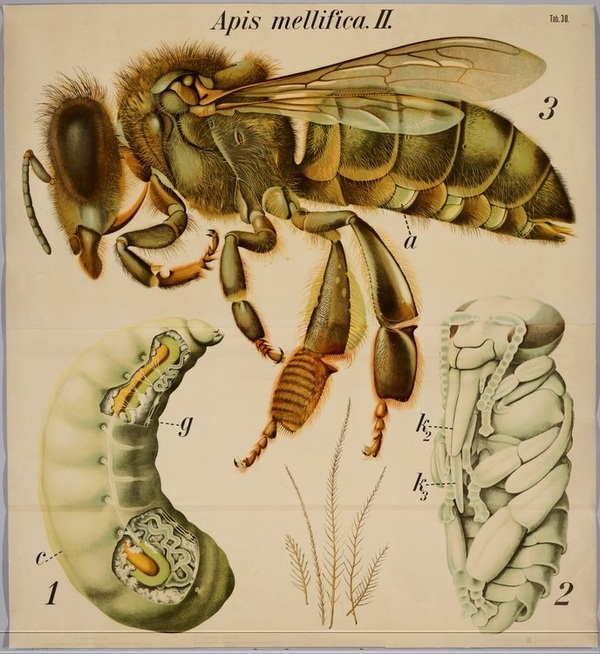
Apis mellifica
Apis mellifera · Honey bee. · Animal
Homeopaths easily recognize people likely to benefit from Apis because, in some ways, their behavior echoes that of bees. They tend to be fussy, restless, irritable types who are hard to please. Frantic hours spent cleaning and sorting, sometimes clumsily, often accomplish little. A vulnerable side reveals oversensitivity, sadness, weepiness, and an aversion to being alone. This need for company gives this type of person a reputation as a “queen bee” who organizes everyone. They reserve a sting in their tails for those who upset them. Fiercely territorial, they can be highly jealous or suspicious of newcomers.
Apis is prescribed generally for symptoms that start on the right side and move to the left side. Ailments treated with Apis include urticaria (hives), insect bites or stings, and burns. It is used for urinary infections such as cystitis, and for edema or urine retention, especially in newborn babies. Inflammation of the eyes, mouth, or throat, and fever may also be helped.
Key symptoms
- burning, stinging pains
- swelling of affected areas
- allergic reactions
- anxious restlessness
- jealousy
Worse (aggravation)
- Heat in any form; hot room
- Touch; slightest touch
- Afternoon aggravation
- Pressure; constriction
- Lying down
- Right side
Better (amelioration)
- Cold; cold applications
- Open air
- Uncovering
- Better on pressure (head)

The Honey-Bee
Acts on cellular tissues causing œdema of skin and mucous membranes.
The very characteristic effects of the sting of the bee furnish unerring indications for its employment in disease. Swelling or puffing up of various parts, œdema, red rosy hue, stinging pains, soreness, intolerance of heat, and slightest touch, and afternoon aggravation are some of the general guiding symptoms. Erysipelatous inflammations, dropsical effusions and anasarca, acute, inflammation of kidneys, and other perenchymatous tissues are characteristic pathological states corresponding to Apis. Apis acts especially on outer parts, skin, coatings of inner organs, serous membranes. It produces serous inflammation with effusion, membranes of brain, heart, pleuritic effusion, etc. Extreme sensitiveness to touch and general soreness is marked. Constricted sensations. Sensation of stiffness and as of something torn off in the interior of the body. Much prostration.
Mind
Apathy, indifference, and unconsciousness. Awkward; drops things readily. Stupor, with sudden sharp cries and startings. Stupor alternating with erotic mania. Sensation of dying. Listless; cannot think clearly. Jealous, fidgety, hard to please. Sudden shrill, piercing screams. Whining. Tearfulness. Jealously, fright, rage, vexation, grief. Cannot concentrate mind when attempting to read or study.
Head
Whole brain feels very tired. Vertigo with sneezing, worse on lying or closing eyes. Heat, throbbing, distensive pains, better on pressure, and worse on motion. Sudden stabbing pains. Dull, heavy sensation in occiput, as from a blow, extending to neck (better on pressure), accompanied with sexual excitement. Bores head into pillow and screams out.
Eyes
Lids swollen, red, œdematous, everted, inflamed; burn and sting. Conjunctiva bright red, puffy. Lachrymation hot. Photophobia. Sudden piercing pains. Pain around orbits. Serous exudation, œdema, and sharp pains. Suppurative inflammation of eyes. Keratitis with intense chemosis of ocular conjunctiva. Staphyloma of cornea following suppurative inflammation. Styes, also prevents their recurrence.
Ears
External ear red, inflamed, sore; stinging pains.
Nose
Coldness of tips of nose. Red, swollen, inflamed, with sharp pains.
Face
Swollen, red, with piercing pain. Waxy, pale, œdematous. Erysipelas with stinging burning œdema. Extends from right to left.
Mouth
Tongue fiery red, swollen, sore, and raw, with vesicles. Scalding in mouth and throat. Tongue feels scalded, red hot, trembling. Gums swollen. Lips swollen, especially upper. Membrane of mouth and throat glossy, as if varnished. Red, shining, and puffy, like erysipelas. Cancer of the tongue.
Throat
Constricted, stinging pains. Uvula swollen, sac-like. Throat swollen, inside and out; tonsils swollen, puffy, fiery red. Ulcers on tonsils. Fiery red margin around leathery membrane. Sensation of fishbone in throat.
Stomach
Sore feeling. Thirstless. Vomiting of food. Craving for milk (Rhus).
Abdomen
Sore, bruised on pressure, when sneezing. Extremely tender. Dropsy of abdomen. Peritonitis. Swelling in right groin.
Stool
Involuntary on every motion; anus seems open. Bloody, painless. Anus feels raw. Hæmorrhoids, with stinging pain, after confinement. Diarrhœa watery, yellow; cholera infantum type. Cannot urinate without a stool. Dark, fetid, worse after eating. Constipation; feels as if something would break on straining.
Urine
Burning and soreness when urinating. Suppressed, loaded with casts; frequent and involuntary; stinging pain and strangury; scanty, high colored. Incontinence. Last drops burn and smart.
Female
Œdema of labia; relieved by cold water. Soreness and stinging pains; ovaritis; worse in right ovary. Menses suppressed, with cerebral and head symptoms, especially in young girls. Dysmenorrhœa, with severe ovarian pains. Metrorrhagia profuse, with heavy abdomen, faintness, stinging pain. Sense of tightness. Bearing-down, as if menses were to appear. Ovarian tumors, metritis with stinging pains. Great tenderness over abdomen and uterine region.
Respiratory
Hoarseness; dyspnœa, breathing hurried and difficult. Œdema of larynx. Feels as if he could not draw another breath. Suffocation; short, dry cough, suprasternal. Hydrothorax.
Extremities
Œdematous. Synovitis. Felon in beginning. Knee swollen, shiny, sensitive, sore, with stinging pain. Feet swollen and stiff. Feel too large. Rheumatic pain in back and limbs; Tired, bruised feeling. Numbness of hands and tips of fingers. Hives with intolerable itching. Œdematous swellings.
Skin
Swellings after bites; sore, sensitive. Stinging. Erysipelas, with sensitiveness and swelling, rosy hue. Carbuncles, with burning, stinging pain (Ars; Anthrac). Sudden puffing up of whole body.
Sleep
Very drowsy. Dreams full of care and toil. Screams and sudden starting during sleep.
Fever
Afternoon chill, with thirst; worse on motion and heat. External heat, with smothering feeling. Sweat slight, with sleepiness. Perspiration breaks out and dries up frequently. Sleeps after the fever paroxysm. After perspiration, nettle rash, also with shuddering.
Modalities
Worse, heat in any form; touch; pressure; late in afternoon; after sleeping; in closed and heated rooms. Right side. Better, in open air, uncovering, and cold bathing.
Relationship
Complementary.: Nat mur. The "chronic", Apis; also Baryta carb, if lymphatics are involved. Inimical. Rhus.
Compare: Apium virus (auto-toxæmia, with pus products); Zinc; Canth; Vespa; Lachesis.
Dose
Tincture to thirtieth potency. In œdematous conditions the lower potencies. Sometimes action is slow; so several days elapse before it is seen to act, and then urine is increased. Apium virus, sixth trituration.

Skin
This remedy has so many symptoms on the surface of the body we will study the outer aspect first. All over the body is found a thick rash, sometimes of a rose color.
It is rough and can be felt as a rough rash under the fingers. The patient at this time is greatly distressed by heat and the skin is sensitive to touch with the rash or without it. Nodular swellings here and there come and go.
Then comes an erysipelatous inflammatory condition, in patches, here and there, about the head, with great tumefaction about the face, eyes and eye-lids.
Erysipelas may occur anywhere, but it more commonly belongs to the face and runs to a high degree of inflammatory action, with stinging, burning and oedema. In the extremities we have a marked dropsy, swelling with pitting upon pressure.

Apium virus. Honey-bee poison. N. O. Insecta. Tinctures are made of the whole bee; and of dilutions of the poison with alcohol.
Clinical
Abscess. Ankles, swelling of. Apoplexy. Asthma. Bladder, affections of. Carbuncle. Chancre. Constipation; of sucklings. Diarrhœa. Diphtheria. Dissection wounds. Dropsy. Ear, erysipelas of. Erysipelas. Erythema nodosum. Eyes, affections of; optic neuritis. Feet, burning of. Gangrene. Gout. Hands, swelling of. Heart, affections of. Heat-spots. Housemaid's knee. Hydrocephalus. Hydrothorax. Injuries. Intermittent fever. Irritation. Jealousy, effects of. Joints*, synovitis. Kidney, Bright's disease of. Labia, inflammation of. Laryngitis. Lichen. Meningitis*. Menstruation, derangements of. Nettle-rash. Nose, redness of. Operations, effects of. Ovaries pain in; inflammation of; tumours of. Panaritium. Pannus. Peritonitis. Phlebitis. Pleurisy. Prostatitis. Punctured wounds. Red-gum. Rheumatism. Scarlatina. Self-abuse. Suppressed eruptions, effects of. Sycosis. Syphilis. …

Poison of the Honey Bee (Apium virus.)
Adapted to the strumous constitution; glands enlarged, indurated; scirrhus or open cancer. Women, specially widows; children and girls who, though generally careful, become awkward, and let things fall while handling them (Bov.). Bad effects of acute exanthema imperfectly developed or suppressed (Zinc.); measles, scarlatina, urticaria. Ailments from jealousy, fright, rage, vexation, bad news. Irritable; nervous; fidgety; hard to please. Weeping disposition; cannot help crying; discouraged, despondent (Puls.). Sudden shrill, piercing screams from children while waking or sleeping (Hellebore). Oedema; bag-like, puffy swelling under the eyes (over the eyes, Kali c.); of the hands and feet, dropsy, without thirst (with thirst, Acet. ac., Apoc.). Extreme sensitiveness to touch (Bell., Lach.). Pain: burning, stinging, sore; suddenly migrating from one part to another (Kali bi., Lac c., Puls.). Thirstlessness: in anasarca; acites (Acetic acid, but face more waxy and great thirst). …

Mind
Sudden, shrill, piercing screams (awake or sleeping).
Mind
Very busy; restless; changing the kind of work with awkwardness, dropping and breaking things.
Head
Child lies in a torpor; delirium; sudden, shrill cries, squinting, grinding teeth, boring head in pillows; on half of body twitching, the other, lame; head wet from sweating; urine scanty.
General Face
Oedema of the face; eyelids puffed, feel stiff.
General Face
Erysipelas, face intensely red and hot, or only pink, puffy shining; either sore to touch or stinging pains.
Sight and Eyes
Keratitis with dreadful pains shooting through the eye, with swollen lids and conjunctiva, but lachrymation gushing out on opening the eyes, photophobia.
-
Child lies in torpor; delirium; sudden shrilling cries; squinting; grinding teeth; boring head in pillow; one side twitching, the other paralyzed; head wet from sweating; urine scanty, milky.
-
Redness and swelling, with stinging burning pain in the eyes, eyelids, ears, face, lips, tongue, throat, anus, testicles.
-
Very busy, restless; changing kind of work, with awkwardness; breaking things.
-
Enlargement of right ovary, with pain in pectoral region, and cough.
-
Burning, stinging pains like bee stings, occurring occasionally.
-
Great soreness when touched on pit of stomach, under the ribs, on the abdomen.
-
Absence of thirst, with scanty urination.

Phatak's chapter on Apis mellifica is available in the app.
Read Phatak in the appClassical texts are in the public domain. Educational reference only — not medical advice.
