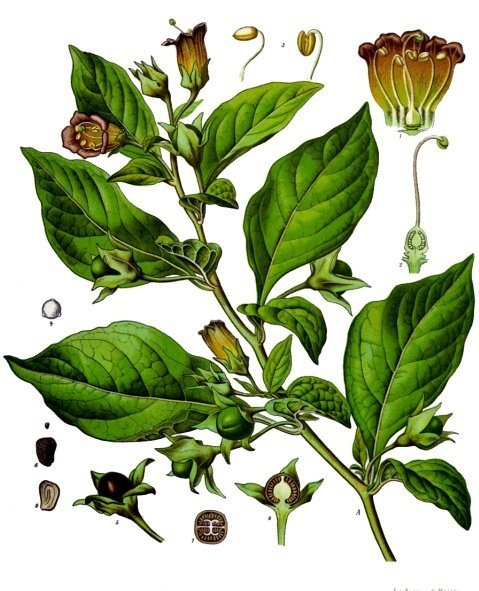
Belladonna
Atropa belladonna · Deadly nightshade, belladonna, dwale, devil’s cherries, sorcerer’s cherry, witches’ berry. · Plant · Solanaceae
Belladonna is a major remedy for acute illnesses of sudden, violent onset. It is usually given to people who are generally fit and energetic, but restless and agitated when ill. They are prone to sudden, explosive anger, marked by the desire to strike out or even to bite.
Typical symptoms linked with Belladonna include high fever, dilated pupils, flushed, dry skin, and throbbing pain, particularly in the head, due to rapid blood circulation. There is often hypersensitivity to light, noise, and touch, and also to rapid temperature changes.
Belladonna is typically given for acute pain, inflammation, or infection, chiefly of the upper respiratory tract. It may also be used to treat menstrual pain, sunstroke, febrile convulsions, cystitis, nephritis (inflamed kidneys), teething pain, and mastitis during breast-feeding.
Key symptoms
- hot, flushed, red face
- high fever
- delirium
- desire for sour things
- sensitivity to light,
- noise, and movement
Worse (aggravation)
- Touch and jarring aggravate
- Noise and light aggravate
- Draught of cold air aggravates
- Afternoon, especially after 3 pm, aggravates
- Motion aggravates
Better (amelioration)
- Rest ameliorates
- Semi-erect posture ameliorates
- Warmth ameliorates

Deadly Nightshade
Belladonna acts upon every part of the nervous system, producing active congestion, furious excitement, perverted special senses, twitching, convulsions and pain. It has a marked action on the vascular system, skin and glands. Belladonna always is associated with hot, red skin, flushed face, glaring eyes, throbbing carotids, excited mental state, hyperæsthesia of all senses, delirium, restless sleep, convulsive movements, dryness of mouth and throat with aversion to water, neuralgic pains that come and go suddenly (Oxytropis). Heat, redness, throbbing and burning. Great children's remedy. Epileptic spasms followed by nausea and vomiting. Scarlet fever and also prophylactic. Here use the thirtieth potency. Exophthalmic goitre. Corresponds to the symptoms of "air-sickness" in aviators. Give as preventive. No thirst, anxiety or fear. Belladonna stands for violence of attack and suddenness of onset. Bell for the extreme of thyroid toxæmia. Use 1x (Beebe).
Mind
Patient lives in a world of his own, engrossed by specters and visions and oblivious to surrounding realities. While the retina is insensible to actual objects, a host of visual hallucinations throng about him and come to him from within. He is acutely alive and crazed by a flood of subjective visual impressions and fantastic illusions. Hallucinations; sees monsters, hideous faces. Delirium; frightful images; furious; rages, bites, strikes; desire to escape. Loss of consciousness. Disinclined to talk. Perversity, with tears. Acuteness of all senses. Changeableness.
Head
Vertigo, with falling to left side or backwards. Sensitive to least contact. Much throbbing and heat. Palpitation reverberating in head with labored breathing. Pain; fullness, especially in forehead, also occiput, and temples. Headache from suppressed catarrhal flow. Sudden outcries. Pain worse light, noise, jar, lying down and in afternoon; better by pressure and semi-erect posture. Boring of head into pillow; drawn backward and rolls from side to side. Constant moaning. Hair splits; is dry and comes out. Headache worse on right side and when lying down; ill effects, colds, etc; from having hair cut.
Face
Red, bluish-red, hot, swollen, shining; convulsive motion of muscles of face. Swelling of upper lip. Facial neuralgia with twitching muscles and flushed face.
Eyes
Throbbing deep in eyes on lying down. Pupils dilated (Agnus). Eyes feel swollen and protruding, staring, brilliant; conjunctiva red; dry, burn; photophobia; shooting in eyes. Exophthalmus. Ocular illusions; fiery appearance. Diplopia, squinting, spasms of lids. Sensation as if eyes were half closed. Eyelids swollen. Fundus congested.
Ears
Tearing pain in middle and external ear. Humming noises. Membrana tympani bulges and injected. Parotid gland swollen. Sensitive to loud tones. Hearing very acute. Otitis media. Pain causes delirium. Child cries out in sleep; throbbing and beating pain deep in ear, synchronous with heart beat. Hematoma auris. Acute and sub-acute conditions of Eustachian tube. Autophony-hearing one's voice in ear.
Nose
Imaginary odors. Tingling in tip of nose. Red and swollen. Bleeding of nose, with red face. Coryza; mucus mixed with blood.
Mouth
Dry. Throbbing pain in teeth. Gumboil. Tongue red on edges. Strawberry tongue. Grinding of teeth. Tongue swollen and painful. Stammering.
Throat
Dry, as if glazed; angry-looking congestion (Ginseng); red, worse on right side. Tonsils enlarged; throat feels constricted; difficult deglutition; worse, liquids. Sensation of a lump. Œsophagus dry; feels contracted. Spasms in throat. Continual inclination to swallow. Scraping sensation. Muscles of deglutition very sensitive. Hypertrophy of mucous membrane.
Stomach
Loss of appetite. Averse to meat and milk. Spasmodic pain in epigastrium. Constriction; pain runs to spine. Nausea and vomiting. Great thirst for cold water. Spasms of stomach. Empty retching. Abhorrence of liquids. Spasmodic hiccough. Dread of drinking. Uncontrollable vomiting.
Abdomen
Distended, hot. Transverse colon protrudes like a pad. Tender, swollen. Pain as if clutched by a hand; worse, jar, pressure. Cutting pain across; stitches in left side of abdomen, when coughing, sneezing, or touching it. Extreme sensitiveness to touch, bed-clothes, etc (Laches).
Stools
Thin, green, dysenteric; in lumps like chalk. Shuddering during stool. Stinging pain in rectum; spasmodic stricture. Piles more sensitive with backache. Prolapsus ani (Ignatia; Podoph).
Urine
Retention. Acute urinary infections. Sensation of motion in bladder as of a worm. Urine scanty, with tenesmus; dark and turbid, loaded with phosphates. Vesical region sensitive. Incontinence, continuous dropping. Frequent and profuse. Hæmaturia where no pathological condition can be found. Prostatic hypertrophy.
Male
Testicles hard, drawn up, inflamed. Nocturnal sweat of genitals. Flow of prostatic fluid. Desire diminished.
Female
Sensitive forcing downwards, as if all the viscera would protrude at genitals. Dryness and heat of vagina. Dragging around loins. Pain in sacrum. Menses increased; bright red, too early, too profuse. Hæmorrhage hot. Cutting pain from hip to hip. Menses and lochia very offensive and hot. Labor-pains come and go suddenly. Mastitis pain, throbbing, redness, streaks radiate from nipple. Breasts feel heavy; are hard and red. Tumors of breast, pain worse lying down. Badly smelling hæmorrhages, hot gushes of blood. Diminished lochia.
Respiratory
Drying in nose, fauces, larynx, and trachea. Tickling, short, dry cough; worse at night. Larynx feels sore. Respiration oppressed, quick, unequal. Cheyne-Stokes respiration (Cocaine; Opium). Hoarse; loss of voice. Painless hoarseness. Cough with pain in left hip. Barking cough, whooping cough, with pain in stomach before attack, with expectoration of blood. Stitches in chest when coughing. Larynx very painful; feels as if a foreign body were in it, with cough. High, piping voice. Moaning at every breath.
Heart
Violent palpitation, reverberating in head, with labored breathing. Palpitation from least exertion. Throbbing all through body. Dichrotism. Heart seemed too large. Rapid but weakened pulse.
Extremities
Shooting pains along limbs. Joints swollen, red, shining, with red streaks radiating. Tottering gait. Shifting rheumatic pains. Phlegmasia alba dolens. Jerking limbs. Spasms. Involuntary limping. Cold extremities.
Back
Stiff neck. Swelling of glands of neck. Pain in nape, as if it would break. Pressure on dorsal region most painful. Lumbago, with pain in hips and thighs.
Skin
Dry and hot; swollen, sensitive; burns scarlet, smooth. Eruption like scarlatina, suddenly spreading. Erythema; pustules on face. Glands swollen, tender, red. Boils. Acne rosacea. Suppurative wounds. Alternate redness and paleness of the skin. Indurations after inflammations. Erysipelas.
Fever
A high feverish state with comparative absence of toxæmia. Burning, pungent, steaming, heat. Feet icy cold. Superficial blood-vessels, distended. Perspiration dry only on head. No thirst with fever.
Sleep
Restless, crying out, gritting of teeth. Kept awake by pulsation of blood-vessels. Screams out in sleep. Sleeplessness, with drowsiness. Starting when closing the eyes or during sleep. Sleeps with hands under head (Ars; Plat).
Modalities
Worse, touch, jar, noise, draught, after noon, lying down. Better, semi-erect.
Relationship
Compare: Sanguisorba officinals 2x-6x, a member of the Rosaceæ family, (Profuse, long-lasting menses, especially in nervous patients with congestive symptoms to head and limbs. Passive hæmorrhages at climacteric. Chronic metritis. Hæmorrhage from lungs. Varices and ulcers). Mandragora--(Mandrake). A narcotic of the ancients-Restless excitability and bodily weakness. Desire for sleep. Has antiperiodic properties like China and Aranea. Useful in epilepsy and hydrophobia, also Cetonia (A. E. Lavine). Hyos (less fever, more agitation); Stram (more sensorial excitement, frenzy); Hoitzia-A Mexican drug, similar in action to Bellad (Useful in fever, scarlatinal eruption, measles, urticaria, etc. High fever with eruptive fevers. Dry mouth and throat, red face, injected eyes, delirium). Calcar is often required after Bell; Atropia. Alkaloid of Belladonna covers more the neurotic sphere of the Belladonna action (Great dryness of throat, almost impossible to swallow. Chronic stomach affections, with great pain and vomiting of all food. Peritonitis. All kind of illusions of sight. Everything appears large. Platina opposite). Hypochlorhydria; pyrosis. Motes over everything. On reading, words run together; double vision, all objects seem to be elongated. Eustachian tube and tympanic congestion. Affinity for the pancreas. Hyperacidity of stomach. Paroxysms of gastric pain; ovarian neuralgia.
Non-Homeopathic Uses
Atropia and its salts are used for ophthalmic purposes, to dilate the pupil and paralyze the accommodation.
Given internally or hypodermically, it is antagonistic to Opium and Morphine. Physostigma and Prussic Acid. Narcotic poisons and mushroom poisoning. Renal colic 1-200 of a grain hypodermically.
Atropin injected subcutaneously in doses from a milligram upwards for intestinal obstruction threatening life.
Hypodermically 1-80 gr night sweats in phthisis.
Atropia 1-20 gr is antagonistic to 1 gr. Morphine.
Also used as a local anæsthetic, antispasmodic, and to dry up secretions, milk, etc. Hypodermically 1-80 gr night sweats in phthisis.
Dose
Atropia Sulph, 1-120 to 1-60 grain.
Antidotes to Belladonna: Camph; Coff; Opium; Acon.
Complementary: Calc. Bellad (contains lime). Especially in semi-chronic and constitutional diseases.
Incompatible: Acet ac.
Dose
First to thirtieth potency and higher. Must be repeated frequently in acute diseases.
Generalities and modalities
: Belladonna is a remedy that takes hold of the system with great violence. It is especially suitable to plethoric, vigorous individual, and intellectual people brainy people have complaints coming on suddenly, providing they are in a substantial state of health, and are reasonably plethoric and vascular.
The complaints of Belladonna come on suddenly, run a regular course, and subside suddenly. The pains and suffering come on suddenly and with great violence, and subside suddenly.
Colds ultimate rapidly, run a sharp course, a course of great violence, and subside sudden. Belladonna especially affects the whole vascular system, the heart, lungs, brain and nervous system.

Atropa Belladonna. Deadly Nightshade. (Greece, Italy, Britain.) N. O. Solanaceæ. Tincture of whole plant when beginning to flower.
Clinical
Abscess. Acne. Amaurosis. Apoplexy. Bladder weakness. Boils. Brain, affections of. Bronchial glands, disease of. Carbuncle. Colic. Constipation. Convulsions. Cough. Croup. Delirium tremens. Depression. Diarrhœa. Dysentery. Ear, affections of. Enteric fever. Epilepsy. Erysipelas. Erythema. Excitement. Eye, affections of. Fear, effects of. Glandular swellings. Goître. Gout. Hæmorrhoids. Headache. Heart, affections of. Hydrocephalus. Hydrophobia. Hyperæmia. Influenza. Kidney, affections of. Lung, affections of. Malignant pustule. Mania. Measles. Meningitis. Menstruation. Mouth affections. Mumps. Neuralgia. Nose, affections of. Nyctalopia. Nymphomania. Paralysis. Parametritis. Perichondritis. Perimetritis. Peritonitis. Phlegmasia alba dolens. Pleurisy. Pneumogastric paralysis. Pneumonia. Pregnancy, disorders of. Puerperal mania. Rheumatism. *Roseola. Scarlatina. …
Deadly Nightshade. (Solanaceae)
Adapted to bilious, lymphatic, plethoric constitutions; persons who are lively and entertaining when well, but violent and often delerious when sick. Women and children with light hair and blue eyes, find complexion, delicate skin; sensitive, nervous, threatened with convulsions; tuberculous patients. Great liability to take cold; sensitive to drafts of air, especially when uncovering the head; from having the hair cut; tonsils become inflamed after riding in a cold wind (Acon., Hep., Rhus - takes cold from exposure of feet, Con., Cup., Sil.). Quick sensation and motion; eyes snap and move quickly; pains come suddenly, last indefinitely and cease suddenly (Mag. p.). Pains usually in short attacks; cause redness of face and eyes; fulness of head and throbbing of carotids. Imagines he sees ghosts, hideous faces, and various insects (Stram.); black animals, dogs, wolves. Fear of imaginary things, wants to run away from them; hallucinations. Violent delirium; disposition to bite, …
Mind
Fear of imaginary things, wants to run away from them.
Head
Headache worse from leaning forward; better when bending backward.
Head
Vertigo when stooping, or when rising from stooping, falling to left or backward with vanishing of sight, or flickering before the eyes.
Head
Headache with sense of constriction around the neck as from a string.
Head
Vertigo; falling forward after stooping, riding or looking high up; rising from the neck into the back; with nausea.
Head
Throbbing in the temporal and carotid arteries; vertigo, noises in the ears, flushed face, dilated pupils.
General Face
Visible throbbing of temporal and carotid arteries.
General Face
Face either very red and hot, or very pale, one side swollen or the whole.
-
Fear of imaginary things, wants to run away from them.
-
Vertigo when stooping, or when rising after stooping falling to the left or backwards, with vanishing of sight and flickering before the eyes.
-
Intense throbbing headache, worse from noise light or jarring, and from leaning forward, better when bending backward.
-
Face glowing red, hot and swollen.
-
Tonsilitis, worse on right side, parts bright red, worse on swallowing liquids.
-
Pharyngitis, and other throat affections characterized by intense hyperaemia and dryness of the parts, and tendency to spasmodic contraction.
-
Pains, particularly in the abdomen and pelvis, come on suddenly, continue violently a longer or shorter time, and disappear as suddenly as they came.

Phatak's chapter on Belladonna is available in the app.
Read Phatak in the appClassical texts are in the public domain. Educational reference only — not medical advice.
