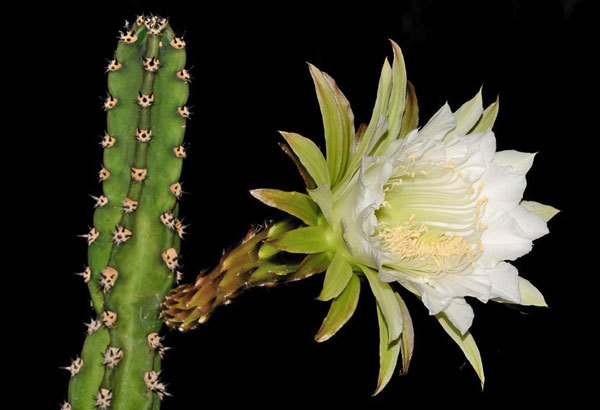
Cereus bonplandii
Harrisia bonplandii (syn. Cereus bonplandii) · Night-blooming cereus,Selenicereus grandiflorus · Plant · Cactaceae
Sad, distracted people who tend to be anxious about their health are most likely to respond well to Cactus grand.
Classic symptoms associated with Cactus grand. include constriction in the muscle fibers, and a painful feeling of the body being caged and twisted. The remedy is especially associated with pains in the heart, such as those triggered by angina. Heart conditions relieved by Cactus grand. are typified by severe pain in the chest, as if it is being confined and squeezed by an iron band around the torso. The pain may extend into the left arm or hand and be accompanied by numbness.
Key symptoms
- Convulsive pains in heart; feels transfixed
- Pain through heart running toward spleen
- Sensation of great weight on heart with pricking pain
- Occipital headache with pain through globe of eyes and orbits
- Sighing respiration from compression of chest
- Hypertrophy of heart
- Itching of skin
Worse (aggravation)
Better (amelioration)

A Night-blooming Cereus
Mind
Great desire to work and to be doing something useful.
Head
Occipital headache and pain through the globe of the eyes and orbits (Cedron; Onos). Pain across the brain from left to right. Pain along right malar bone running to temple.
Chest
Convulsive pains at the heart; feels as if transfixed. Pain in chest through heart, with pain running toward spleen. Pain in left pectoral muscle and cartilages of left lower ribs. Sensation of a great weight on heart, and pricking pain. Hypertrophy of heart. Difficult, sighing respiration, as from some compression of chest.
Skin
Itching of skin (Dolich; Sulph).
Extremities
Pain in neck, back, shoulders, down arms, hands and fingers. Pain in knees and joints of lower extremities.
Relationship
Compare: Cactus; Spigel; Kalmia; Cereus serpentinus (Very irritable with tendency to swear; wild anger and low morals. Disturbance in speech; in writing leaves off the last syllable. Paralyzed feeling. Pains in heart, and dwindling of sexual organs. Emissions, followed by pain in testicles).
Dose
Third to sixth attenuation.

A variety of Cactus grandiflorus. N. O. Cactaceæ. Tincture of stems.
Clinical
Eczema. Emaciation. Eyes, neuralgia of. Heart, affections of. Insanity. Kidneys, affections of. Neuralgia.
Characteristics
The principal symptoms of Cer. bon. are in connection with the heart, as in the case of Cactus, with which it must he compared. The symptoms are < at night; < from pressure of clothing, > undressing. Cer. bon. was proved by John H. Fitch in substantial doses (H. P., xii. 533). The prover lost 7 1/2 lbs. in weight. He felt weighed down by an incubus. When mental symptoms subsided, bodily symptoms increased and vice versâ. Could not bear contact of clothes; felt better on undressing. Among the marked symptoms were: Wants to be at work; on something useful. Pains through globe of eyes and orbit. Pain through heart; in left great pectoral muscle; left side of chest. Expanding sensation in chest followed by sudden collapse. The effect on the nervous system passed off in four or five days. The pains of *Cer. …
Classical texts are in the public domain. Educational reference only — not medical advice.
