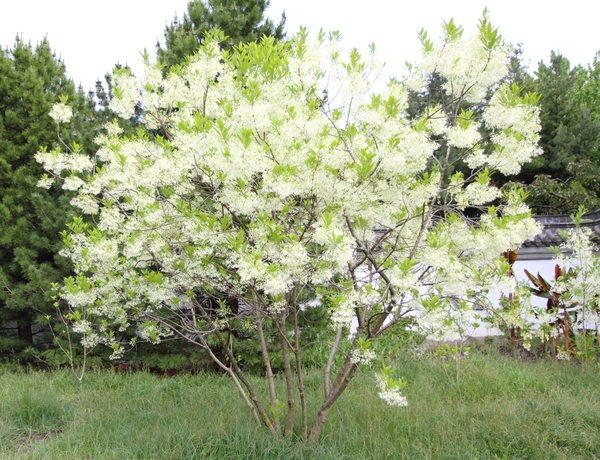
Chionanthus virginica
Chionanthus virginicus · Fringe tree. · Plant · Oleaceae
Chionanthus is most appropriate for those who are insular, melancholic, and gloomy, with hypochondriac tendencies. They feel “played out,” apathetic, and listless, and may develop nervous exhaustion.
The remedy is generally used for liver problems such as jaundice, gallstones, and biliary colic, with the characteristic fatigue. Liver pain is usually accompanied by colic, cramps, vomiting, and the feeling that the intestines are being spasmodically squeezed. The stools may be pale due to lack of bile. Another key use of Chionanthus is for headaches, especially those associated with nervous tension or menstruation, or accompanied by digestive upsets.
Key symptoms
- Jaundice with enlarged liver and clay-colored stools
- Dull frontal headache over root of nose and over eyes
- Gallstones with bilious colic; hepatic region tender
- Diabetes mellitus with bile and sugar in urine
- Enlarged spleen; arrested menses with jaundice
- Yellow conjunctiva; sallow, greenish skin
- Paroxysmal abdominal pain as if intestines suddenly tied tight
Worse (aggravation)
Better (amelioration)

Fringe-tree (CHIONANTHUS)
This remedy is often of service in many types of headaches, neurasthenic, periodical sick, menstrual and bilious. Taken for several weeks, drop doses, will often break up the sick headache habit. The pain in the forehead, chiefly over eyes. Eyeballs very painful, with pressure over root of nose. Hepatic derangements. Jaundice. Enlarged spleen (Ceanoth). Jaundice with arrest of menses. A prominent liver remedy. Gallstones (Berberis; Cholest; Calc). Diabetes mellitus. Paroxysmal, abdominal pain.
Head
Listless, apathetic. Dull frontal headache, over root of nose, over eyes, through temples, worse stooping, motion, jar. Yellow conjunctiva.
Tongue
Broad with thick yellow fur.
Mouth
Dry sensation not relieved by water, also profuse saliva.
Abdomen and Liver
Aching in umbilical region, griping. Feels as if a string were tied in a "slip-knot" around intestines which was suddenly drawn tight and then gradually loosened. Sore; enlarged, with jaundice and constipation. Clay-colored stool, also soft, yellow and pasty. Tongue heavily coated. No appetite. Bilious colic. Hepatic region tender. Pancreatic disease and other glandular disorders.
Urine
Large amount of high specific gravity; frequent urination; bile and sugar in urine. Urine very dark.
Skin
Yellow; marked moisture of skin. Sallow, greenish, itching.
Relationship
Compare: Cinchona; Ceanoth; Chelidon; Carduus; Podophyl; Lept.
Dose
Tincture and first attenuation.

Fringe Tree. Oleaceæ, The bark, which is the part employed, contains Saponin. Tincture.
Clinical
Constipation. Debility. Emaciation with liver-disorder. Gall-stone colic. Headache. Jaundice. Liver, disease of; hypertrophy of. Malaria. Neurasthenia. Nursing women, complaints of.
Characteristics
Chion. acts powerfully on the liver and is indicated in hypertrophy; obstructed liver in malarious districts. The following are the leading indications: Enormous liver, constipation, clay-coloured stool, jaundice, and high-coloured urine. Liver region sore. Chronic jaundice. Jaundice recurring every summer. Sensation of contraction of stomach as if something alive moving in it; with uneasy sensation in liver and spleen. Rheumatic pains in left ankle and tarsal bone. A proving of Chionanth. was made by Dr. John Z. Lawshe, and was communicated, with additions, to the Southern Journal of Homœopathy by H. C. Morrow. Chion. is suited to so-called bilious temperaments. One observer (H. Recorder, xii. 369), who gave …

Phatak's chapter on Chionanthus virginica is available in the app.
Read Phatak in the appClassical texts are in the public domain. Educational reference only — not medical advice.
