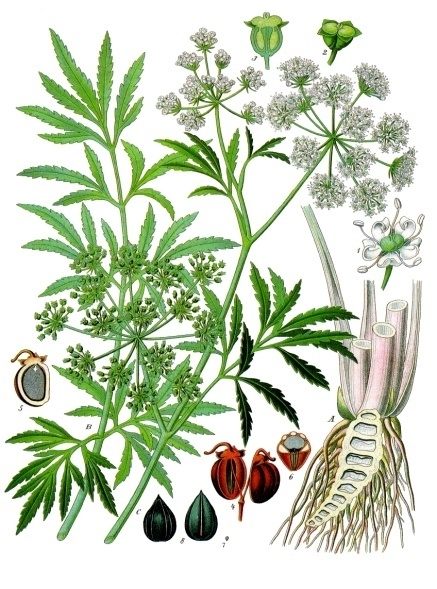
Cicuta virosa
Water hemlock, cowbane. · Plant · Apiaceae
Cicuta has an affinity with the nervous system and is used both for nervous temperamental conditions and for physical disorders of the nervous system. It is generally given to people who behave childishly and do absurd things. They may be wild, delirious, and overexcited, or exhibit great sensitivity to sad stories and to the happiness of other people. Alternatively, they may be distrustful, despise other people, and have an aversion to society. Their memories can go blank for long periods. Classic physical symptoms associated with Cicuta focus on spasmodic effects on the nervous system, ranging from stammering and hiccups to sudden, strong jerks and spasms. Petit mal fits with long absences may be treated with the remedy, as may epilepsy or violent convulsions accompanied by facial contortions and severe backward twisting and arching of the head and neck.
The remedy may also be used for some skin disorders, often involving pustules that leave yellowish scabs, such as eczema or impetigo. The head and face may be most affected, or the whole body may develop chronic eruptions that itch, burn, and crust. A craving for chalk may occur, as may an inability to distinguish what is edible.
Key symptoms
- Violent convulsions with bending of head, neck and spine backward
- Head turned or twisted to one side; cervical muscles contracted
- Pupils dilated and insensible; strabismus
- Thick yellow scabs on head and face
- Delirium with singing, dancing and funny gestures
- Sensation that everything appears strange and terrible
- Convulsions from concussion of brain
Worse (aggravation)
Better (amelioration)

Water Hemlock
The action on the nervous system, producing spasmodic affections, viz, hiccough, trismus, tetanus, and convulsions, give the pathological picture calling especially for this remedy, whenever this is further characterized, by the more individual symptoms of the drug. Among these, are the bending of the head, neck, and spine backwards, and the general action of the patient is violent, with frightful distortions. Violent, strange desires. Sensation of internal chill. Moaning and howling. Does absurd things. Marked action on the skin.
Mind
Delirium, with singing, dancing and funny gestures. Everything appears strange and terrible. Confounds present with the past; feels like a child. Stupid feeling. Melancholy, with indifference. Mistrustful. Epilepsy; moaning and whining. Vivid dreams.
Head
Head turned or twisted to one side. Cerebro-spinal meningitis. Cervical muscles contracted. Vertigo, with gastralgia, and muscular spasms. Sudden, violent shocks through head. Stares persistently at objects. Convulsions from concussion of brain. Thick, yellow scabs on head. Head symptoms relieved by emission of flatus.
Eyes
When reading, letters disappear. Pupils dilated, insensible strabismus. Objects recede, approach, and seem double. Eyes stare. Pupils get behind upper lids as head inclines. Effects of exposure to snow. Spasmodic affections of eyes and its appendages. Strabismus; periodic, spasmodic after a fall or a blow.
Ears
Difficult hearing. Sudden detonations especially on swallowing. Hæmorrhage from ears.
Face
Pustules which run together forming thick, yellow scabs on face and head, corners of mouth and chin, with burning pain. Red face. Trismus; disposition to grind teeth.
Throat
Dry. Feels as if grown together. Spasms of œsophagus; cannot swallow. Effects on œsophagus from swallowing sharp piece of bone.
Stomach
Thirst; burning pressure; hiccough. Throbbing in pit of stomach, which has become raised to size of fist. Desire for unnatural things, like coal (Alum; Calc). Indigestion, with insensibility, frothing at mouth.
Abdomen
Flatulence with anxiety and crossness. Rumbling in. Distended and painful. Colic with convulsions.
Rectum
Diarrhœa in morning, with irresistible desire to urinate. Itching in rectum.
Respiratory
Chest feels tight; can hardly breathe. Tonic spasm in pectoral muscles. Heat in chest.
Back and extremities
Spasms and cramps in muscles of nape of neck, and spasmodic drawing backward of head. Curved limbs cannot be straightened nor straight ones bent. Back bent backward like an arch. Jerking, tearing in coccyx, especially during menses.
Skin
Eczema; no itching, exudation forms into a hard, lemon-colored crust. Suppressed eruption causes brain disease. Elevated eruptions, as large as peas. Chronic impetigo.
Modalities
Worse, from touch, draughts, concussion, tobacco smoke.
Relationship
Antidotes: Opium; Arn.
Compare: Cicuta Maculata-Water Hemlock--(Effects very similar; the most prominent symptoms being; Falls unconscious, tetanic or clonic convulsions. Body covered with sweat. Consider in epilepsy and tetanus. Tincture and lower potencies). Hydrocy acid; Con; Oenanth; Strychnia; Bellad.
Dose
Sixth to two hundredth attenuation.

This remedy is of interest because of its convulsive tendency. It puts the whole nervous system in such a state of increased irritability that pressure on a part causes convulsions. The convulsions extend from center to circumference; the head, face and eyes are first affected.
Convulsions
An aura in the stomach gives warning of the convulsion. Some complaints spread from the chest, especially from the heart; the rigors and chills begin in the chest; and there is a sensation of coldness about the heart; and from there it extends to other parts.
Convulsions often begin about the head and throat and extend downward. The whole body is in such a state of tension that, after excitement, a fire rages throughout the economy and causes convulsions. Any irritation in the throat or oesophagus will cause violent convulsions in this region.

Cow-bane. Water Hemlock. N. O. Umbelliferæ. Tincture of fresh root gathered at time of flowering.
Clinical
Bladder, paralysis of. Cancer. Catalepsy. Cerebro-spinal meningitis. Coccygodynia. Concussions. Convulsions. Eczema. Epilepsy. Epithelioma. Eyes, inflammation of. Face, eruption on. Hiccough. Hysteria. Impetigo. Meningitis. Myelitis. Numbness. Œsophagus, stricture of. Paralysis. Psoriasis. Puerperal convulsions. Screaming. Strabismus. Stuttering. Tetanus. Trismus. Waking, weeping on. Worm complaints.
Characteristics
Cicuta v. is one of the most active of the poisonous Umbelliferæ. Its chief influence is excited on the medulla oblongata, the gastro-intestinal tract, and the skin. Twitching and spasmodic jerks are a keynote of Cicuta. "Bending the head backward" is very characteristic. The remedy has cured many cases of cerebro-spinal meningitis, the opisthotonos being the leading indication. Violence is a leading feature: violent spasms; moans and howls; great agitation; makes …

Water Hemlock (Umbelliferae)
Women subject to epileptic and choreic convulsions; spasms of teething children, or from worms. Convulsions: violent, with frightful distortions of limbs and whole body; with loss of consciousness; opisthotonos; renewed from slightest touch, noise or jar. Puerperal convulsions: frequent suspension of breathing for a few moments, as if dead; upper part of the body most affected; continue after delivery. Epilepsy: with swelling of the stomach as from violent spasms of the diaphragm; screaming; red or bluish face; lockjaw, loss of consciousness and distortion of limbs; frequent during the night; recurring, first at short, then at long intervals. When reading, the letters seem to turn, go up or down or disappear (Coc.). During dentition, grinding of teeth or gums; compression of the jaws as in lockjaw. Abnormal appetite for chalk and indigestible things; for coal or charcoal; child eats them with apparent relish (Alum., Psor.). Suffer violent shocks through head, stomach, arms, legs, which …
- Convulsion with loss of consciousness; opisthotonos; frightful distortions of the face, limbs and whole body.

Phatak's chapter on Cicuta virosa is available in the app.
Read Phatak in the appClassical texts are in the public domain. Educational reference only — not medical advice.
