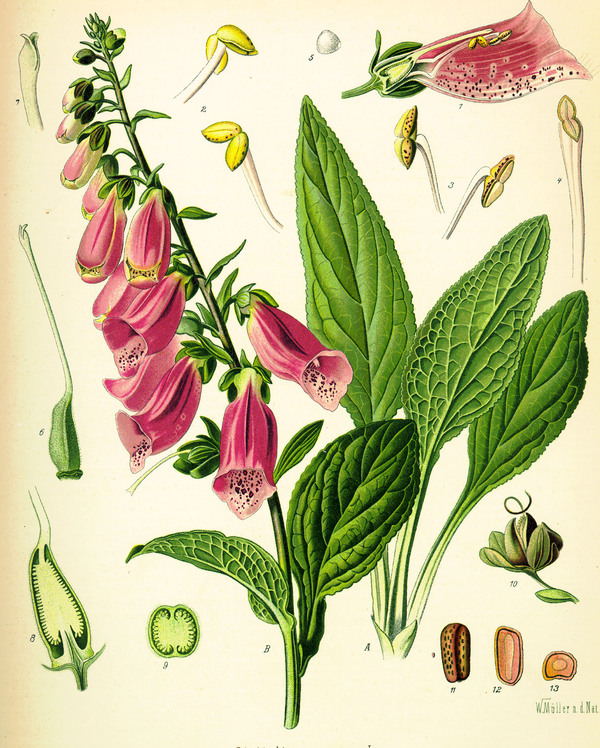
Digitalis purpurea
Common foxglove, purple foxglove. · Plant · Plantaginaceae
Digitalis is associated primarily with the heart. It is prescribed for people who are prone to heart and circulatory disorders. The remedy is considered particularly appropriate if symptoms are accompanied by a fear of death, or a fear that moving—especially walking—may cause the heart to stop beating. There is a desire for bitter things and often visual disturbance. Heart disorders that respond well to treatment with Digitalis are typically accompanied by pains in the region of the heart, a slow pulse, faintness, and nausea. The remedy is also used for liver problems, particularly if they occur in conjunction with heart symptoms.
Key symptoms
- weak, irregular, intermittent
- abnormally slow
- Weakness and dilatation of the myocardium
- hypertrophy of the liver
- Cardiac muscular failure
- anxious
Worse (aggravation)
Better (amelioration)

Foxglove (DIGITALIS)
Comes into play in all diseases where the heart is primarily involved, where the pulse is weak, irregular, intermittent, abnormally slow, and dropsy of external and internal parts. Weakness and dilatation of the myocardium. Its greatest indication is in failure of compensation and especially when auricular fibrillation has set in. Slow pulse in recumbent posture, but irregular and dicrotic on sitting up. Auricular flutter and fibrillation especially when subsequent to rheumatic fever. Heart block, very slow pulse. Other symptoms of organic heart disease, such as great weakness and sinking of strength, faintness, coldness of skin, and irregular respiration; cardiac irritability and ocular troubles after tobacco; jaundice from induration and hypertrophy of the liver, frequently call for Digitalis. Jaundice with heart disease. Faint, as if dying. Bluish appearance of face. Cardiac muscular failure when asystole is present. Stimulates the heart's muscles, increases force of systole, increases length. Prostration from slight exertion. Collapse.
Mind
Despondency; fearful; anxious about the future. Dullness of sense. Every shock strikes in epigastrium. Melancholia, dull lethargic with slow pulse.
Head
Vertigo, when walking and on rising, in cardiac and hepatic affections. Sharp, shooting frontal pain, extending into nose, after drinking cold water or eating ice-cream. Heaviness of head, with sensation as if it would fall backward. Face bluish. Confusion, fullness and noise in head. Cracking sounds during a nap. Blue tongue and lips.
Eyes
Blueness of eyelids. Dark bodies, like flies, before eyes. Change in acuteness of perception of shades of green. Objects, appear green and yellow. Mydriasis; lid margins red, swollen, agglutinated in morning. Detachment of retina. Dim vision, irregular pupils, diplopia.
Stomach
Sweet taste with constant ptyalism. Excessive nausea, not relieved by vomiting. Faintness, great weakness in stomach. Burning in stomach extending to œsophagus. After cold water or ice-cream, sharp pain in forehead, extending to nose. Faintness and vomiting from motion. Discomfort, even after a small quantity of food, or from mere sight or smell. Tenderness of epigastrium. Copious salivation. Neuralgic pain in stomach, unconnected with taking food.
Abdomen
Pain in left side apparently in descending colon and under false ribs. Severe abdominal pains, pulsation in abdominal aorta, and epigastric constriction. Enlarged, sore, painful liver.
Stool
White, chalk-like, ashy, pasty stools. Diarrhœa during jaundice.
Urine
Continued urging, in drops, dark, hot, burning, with sharp cutting or throbbing pain at neck of bladder, as if a straw was being thrust back and forth; worse at night. Suppressed. Ammoniacal, and turbid. Urethritis, phimosis, strangury. Full feeling after urination. Constriction and burning, as if urethra was too small. Brick-dust sediment.
Female
Labor-like pains in abdomen and back before menses. Uterine hæmorrhage.
Male
Nightly emission (Digitalin), with great weakness of genitals after coitus. Hydrocele; scrotum enlarged like a bladder. Gonorrhœa, balanitis (Merc), with œdema of prepuce. Dropsical swelling of genitals (Sulph). Enlarged prostate.
Respiratory
Desire to take a deep breath. Breathing irregular, difficult; deep sighing. Cough, with raw, sore feeling in chest. Expectoration sweetish. Senile pneumonia. Great weakness in chest. Dyspnœa, constant desire to breathe deeply, lungs feel compressed. Chronic bronchitis; passive congestion of the lungs, giving bloody sputum due to failing myocardium. Cannot bear to talk. Hæmoptysis with weak heart.
Heart
The least movement causes violent palpitation, and sensation as if it would cease beating, if he moves (Opposite; Gels). Frequent stitches in heart. Irregular heart especially of mitral disease. Very slow pulse. Intermits; weak. Cyanosis. Inequality of pulse; it varies. Sudden sensation as if heart stood still. Pulse weak, and quickened by least movement. Pericarditis, copious serous exudation. Dilated heart, tired, irregular, with slow and feeble pulse. Hypertrophy with dilatation. Cardiac failure following fevers. Cardiac dropsy.
Extremities
Swelling of the feet. Fingers go to sleep easily. Coldness of hands and feet. Rheumatic pain in joints. Shining, white swelling of joints. Muscular debility. Nocturnal swelling of fingers. Sensation in legs as if a red hot wire suddenly darted through them (Dudgeon).
Sleep
Starts from sleep in alarm that he is falling from a height. Continuous sleepiness.
Fever
Sudden flushes of heat, followed by great nervous weakness.
Skin
Erythema, deep red, worse on back, like measles. Blue distended veins on lids, ears, lips and tongue. Dropsical. Itching and jaundiced.
Modalities
Worse, when sitting erect, after meals and music. Better, when stomach is empty; in open air.
Relationship
Antidotes: Camph; Serpentaria. Incompatible: China. Compare: Nerium odorum (resembles in heart effects Digitalis, but also has an action like Strychnia on spinal cord. Spasms appear more in upper part of body. Palpitation; weak heart will be strengthened by it. Lock-jaw). Adonia; Cratægus (a true heat tonic); Kalmia; Spigel; Liatris; Compare also; Digitoxinum (Digitalis dissolved in Chloroform; which has yellow vision very marked, and distressing nausea, aggravated by champagne and aerated waters). Nitri spir dulc increases action of Digit. Ichthyotoxin. Eel Serum (Experiments show great analogy between the serum and the venom of vipera. Indicated whenever the systole of the heart is insufficient, decompensated valvular disease, irregular pulse due to fibrillation of the auricle. Assytole, feeble, frequent, irregular pulse, dyspnœa and scanty urine. Liver enlarged, dyspnœa, albuminuria. No œdema). Convallaria (heart disease with vertigo and digestive disturbances). Quinidin-Isomeric methoxyl compound.--(Restores normal rhythm in auricular fibrillation, often supplements the action of Digitalis. Two doses of 3 grains each, three hours apart-if no symptoms of cinchonism develop, 4 doses 6 grs each daily (C. Harlan Wells). Paroxysmal tachycardia. Establishes normal heart rhythm at least temporarily, less in valvular lesions).
Dose
The third to thirtieth attenuation will bring about reaction when the drug is homeopathically indicated; but for palliative purposes the physiological dosage is required. For this purpose, the tincture made from the fresh plant, in doses of five to twenty drops, when the cardiac stimulation is desired, or the infusion of 1 1/2 per cent. Dose, one-half to one ounce if the diuretic action is wanted. The tincture may be given on sugar or bread, and nothing liquid be taken for twenty minutes before or after its administration. Of the powdered leaves, 1/2 to 2 grains in capsules. Digitoxin 1-250 grain. No matter what form of digitalis is given the dose should be reduced as soon as the pulse rate has been lowered to 80 beats a minute and the normal rhythm has been partially or completely restored. Under such conditions a good rule is to cut the dose in half and still more if there be a sudden falling off of the urinary output.
History
This drug as used by the Old School has done more mischief than any one drug in their Materia Medica. Every patient who had a fast heart, or anything the matter with the heart, was given Digitalis.
It has caused more deaths than any drug. If administered when the heart is going fast it will soon produce a peculiar kind of paralysis; the heart then having lost its balance-wheel, compensation gives out, the patient sinks and finally dies.
They do not know that many patients would have lived through fevers, pneumonia and other acute diseases if it had not been for this medicine, used as they have used it in the tincture, in many-drop doses, until the heart was slowed down.

Digitalis purpurea. Fox-glove. N. O. Scrophulariaceæ. Tincture from the leaves of the second year of the plant.
Clinical
Amaurosis. Angina pectoris. Asthma. Bright's disease. Cyanosis. Delirium tremens. Dropsy. Fever. Gonorrhœa. Headache. Heart, affections of. Hydrocele. Hydrocephalus. Impotence. Jaundice. Lungs, congestion of. Memory lost. Meningitis. Noises in head. Paraphimosis. Prostate, enlarged. Ptyalism. Spermatorrhœa. Toothache. Urinary disorders. Vision, disorders of.
Characteristics
There are three main symptoms in the Digitalis pathogenesis which should be borne in mind: (1) Slow, weak, irregular and intermittent pulse. (2) Enlarged, sore, painful liver. (3) White, pasty stools. Along with these is prostration from slight exertion. The mental condition is: anxious; low-spirited; tearful, wants to be alone; tries to escape if others force themselves on her. Anxiety as if conscience-troubled. "Anxious and concentrated sadness, with sleeplessness at night, owing to pains at the heart: for …
Foxglove. (Scrophulariaceae)
Sudden flushes of heat, followed by great nervous weakness and irregular intermitting pulse, occurring at the climacteric; < by least motion. Weak heart without valvular complications. Sensation as if heart would stop beating if she moved (Cocaine - fears that unless constantly on the move, heart will cease beating, Gels.). Faintness or sinking at the stomach; exhaustion; extreme prostration; feels as if he were dying. Night emissions, with great weakness of genitals after coitus. Great weakness of chest, cannot bear to talk (Stan.). Stools: very light, ash-colored; delayed, chalky (Chel., Pod.); almost white (Cal., Cinch.); pipe-stem stool; involuntary. Pulse full, irregular, very slow and weak; intermitting every third, fifth or seventh beat. Face pale, deathlike appearance and bluish-red. Blueness of skin, eyelids; lips and tongue. Respiration irregular, difficult, deep sighing. The fingers "go to sleep" frequently and easily. Dropsy: post-scarlatinal; in Bright's disease; with …
Head
Vertigo with very slow pulse.
Mouth and Throat
A clean tongue with gastric and other derangements.
Respiratory Organs
Cough after eating, with vomiting of food.
Respiratory Organs
When going to sleep the breath fades away and seems to be gone, and the heart slows or stops, then awakens with a gasp to catch it.
Heart and Pulse
Extremely slow pulse with many complaints.
Heart and Pulse
When going to sleep the breath fades away and seems to be gone, the pulse slows or stops, then awakens with a gasp to catch it.
-
Respiration irregular, difficult, performed by frequent deep sighs.
-
Sudden sensation as if the heart stood still, with great anxiety.
-
Extremely slow pulse.

Phatak's chapter on Digitalis purpurea is available in the app.
Read Phatak in the appClassical texts are in the public domain. Educational reference only — not medical advice.
