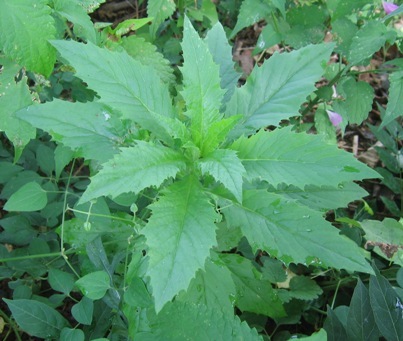
Erechthites hieracifolia
Erechtites hieraciifolius · Plant · Asteraceae
Erechthites suits patients prone to active and passive haemorrhages with excitement of the circulation. There is a tendency to sudden flushes of heat alternating with coldness, along with increased appetite and desire for exercise.
Key symptoms
- Haemorrhage from any part, especially lungs, always with circulatory excitement
- Epistaxis of bright blood
- Metrorrhagia and uterine haemorrhage
- Flashes of heat suddenly giving way to coldness
- Scanty urine and oedema of the extremities
- Increased appetite and feeling of strength with desire for exercise
- Skin symptoms resembling Rhus poisoning
- Orchitis and diarrhoea
Worse (aggravation)
- Motion aggravates haemorrhages
Better (amelioration)
- Rest ameliorates haemorrhagic flow

Fire-weed (ERECHTHITES)
A hæmorrhagic remedy. Epistaxis of bright blood. Hæmorrhage from any part, especially lungs; always attended by excitement of the circulation. Flashes of heat and coldness. Scanty urine, œdema of the extremities.
Skin
Symptoms like Rhus poisoning.
Relationship
Compare: Erig; Millef; Hamam; Rhus.
Dose
Tincture. Locally for Poison Oak.

Erechthites hieracifolia. Senecio hieracifolia. Fireweed. N. O. Compositæ. Tincture of whole fresh plant.
Clinical
Diarrhœa. Gonorrhœa. Hæmorrhages. Metrorrhagia. Orchitis.
Characteristics
Belonging to the Compositæ, and closely allied to Erigeron and the Groundsel family (Senecio), "Fireweed" (so called because it grows abundantly in clearings which have been burnt out) has been used empirically in hæmorrhages, especially metrorrhagia, and as a local application in skin affections, herpes, eczema, psoriasis, and indolent ulcers. A short proving has shown an action over the circulatory apparatus, producing flushes of heat which suddenly give way to coldness. Another marked feature is increased appetite; and also increased feeling of strength and desire for exercise. According to Hale, "Oil of Fireweed" is also extracted from Erigeron, and is said by chemists to be identical with turpentine. All three cause active and passive hæmorrhages, the former being the primary and the latter the secondary action. …
Classical texts are in the public domain. Educational reference only — not medical advice.
