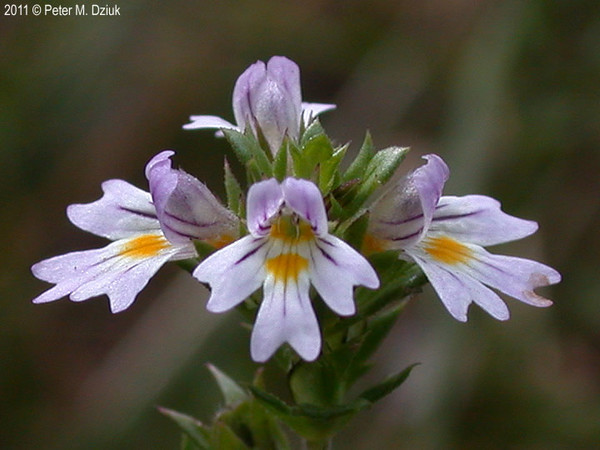
Euphrasia officinalis
Eyebright. · Plant · Orobanchaceae
People who respond well to Euphrasia are typically taciturn, indolent, melancholic, and prone to daydreaming.
Euphrasia has a classic affinity with the eyes. Common physical symptoms include irritation in the eyes, with cutting, burning, pressing pains and sticky mucus. There is typically heightened sensitivity to light, with burning, swollen eyelids and frequent blinking. The eyes tend to water profusely, a symptom that is exacerbated by open air, lying down, or coughing. The remedy is used mainly for allergies or infections affecting the eyes and nose, such as colds, hay fever, or conjunctivitis. It may also be prescribed if eye symptoms occur after an injury.
Key symptoms
- Profuse acrid lachrymation with bland nasal discharge (opposite of Allium cepa)
- Eyes water constantly; burning and swelling of lids
- Catarrhal conjunctivitis with acrid, excoriating eye discharge
- Sticky mucus on cornea requiring frequent blinking to clear
- Profuse fluent coryza with violent cough and abundant expectoration
- Catarrhal headache with profuse discharge from eyes and nose
- Better in open air; worse in the evening
- Hawking up of offensive mucus
Worse (aggravation)
Better (amelioration)

Eyebright (EYEBRIGHT)
Manifests itself in inflaming the conjunctival membrane especially, producing profuse lachrymation. Patient is better in open air. Catarrhal affections of mucous membranes especially of eyes and nose. Profuse acrid lachrymation and bland coryza; worse, evening. Hawking up of offensive mucus.
Head
Bursting headache with dazzling of eyes. Catarrhal headache, with profuse discharge from eyes and nose.
Nose
Profuse, fluent coryza, with violent cough and abundant expectoration.
Eyes
Catarrhal conjunctivitis; discharge of acrid matter. The eyes water all the time. Acrid lachrymation; bland coryza (Opposite: Cepa). Discharge thick and excoriating (Mercur thin and acrid). Burning and swelling of the lids. Frequent inclination to blink. Free discharge of acrid matter. Sticky mucus on cornea; must wink to remove it. Pressure in eyes. Little blisters on cornea. Opacities. Rheumatic iritis. Ptosis (Gels; Caust).
Face
Redness and heat of cheeks. Stiffness of upper lip.
Stomach
Vomiting from hawking mucus. Nausea and bitterness after smoking.
Rectum
Dysentery. Prolapse ani. Pressure down in anus when sitting. Constipation.
Female
Menses painful; flow lasts only an hour or day; late, scanty, short. Amenorrhœa, with ophthalmia.
Male
Spasmodic retraction of genitals, with pressure above pubic bone. Condyloma and sycotic excrescences. Prostatitis. Nocturnal irritability of bladder; dribbling urine.
Respiratory
Frequent yawning when walking in open air. Profuse, fluent coryza in morning, with much cough and expectoration. Influenza. Gags when clearing the throat in morning. Whooping-cough only in day-time, with profuse lachrymation.
Skin
First stage of measles; eye symptoms marked. Consequence of external injuries.
Sleep
Yawning when walking in open air. Sleepy during day.
Fever
Chilly and cold. Sweat mostly on chest, at night during sleep.
Modalities
Worse, in evening, indoors, warmth; south winds; from light. Better, from coffee, in dark.
Relationship
Antidotes: Camph; Puls. Compare: Hydrophyllum-Burr -flower--(catarrhal inflammation of eyes; hot lachrymation with itching, swollen lids, dull headache; also for effects of Poison-Oak); Cepa; Ars; Gels; Kali hyd; Sabadilla.
Dose
Third to sixth potency.

Head
Euphrasia is a short acting remedy of great usefulness in acute catarrhal affections with or without fever. Headaches that occur with coryza and eye symptoms, head aches in the evening as if bruised. Stitching pain in the head.
Headaches
; as if the head would burst with dazzling of the eyes from sunlight. These are catarrhal headaches with profuse watery discharge from the eyes and nose. The eye symptoms of Euphrasia are its most prominent feature.
Catarrh condition of the eyes with copious, acrid, watery discharge with or without coryza. Cutting pain in the eyes extending into the head, pressure in the eyes as if caused by sand. Sensation of dryness, burning, biting in the eyes. Sensation of dust in the eyes. Violent itching of the eyes obliging rubbing and winking, with copious lachrymation. Pupils much contracted and much tumefaction of the mucous membrane with redness and enlarged blood vessels and smarting.

Euphrasia officinalis. Eye-bright. N. O. Scrophulariaceæ. Tincture of whole plant.
Clinical
Blepharitis. Cataract. Cold. Colic. Condylomata. Conjunctivitis. Cough. Eyes, affections of. Glandular swellings. Granular lids. Influenza. Iritis. Lachrymation. Lips, stiffness of. Measles. Nasal catarrh. Nose, cancer of. Parotitis. Phlyctenulæ. Pimples. Ptosis. Prolapsus ani. Prostate gland, affections of. Scrofula. Staphyloma. Sycosis.
Characteristics
According to Grauvogl, the "signature" of a black spot in the corolla which looks like the pupil," marked Euphrasia as an eye medicine to the ancients, and homœopathic experiments have fully confirmed its old-time reputation. Eye-symptoms appear in great variety, and the irritation extends to the skin around the eye, and to the nose, producing nasal catarrh and affections of the external nose. Hering mentions "flat cancer on right side of nose" as having come within its curative range. The catarrhal effect is prolonged into the chest, producing hoarseness and …

Eyebright. (Scrophularaceae.)
Bad effects from falls, contusions or mechanical injuries of external parts (Arn.). Catarrhal affections of mucous membranes, especially of the eyes and nose. Profuse acrid lachrymation, with profuse, bland coryza (reverse of All. c.). The eyes water all the time and are agglutinated in the morning; margins of lids red, swollen, burning. Profuse fluent coryza in morning with violent cough and abundant expectoration, < from exposure to warm south wind. When attempting to clear the throat of an offensive mucus in the morning, gagging until he vomits the breakfast just eaten (Bry.). Profuse expectoration of mucus by voluntary hawking, < on rising in morning. Amenorrhoea, with catarrhal symptoms of eyes and nose; profuse acrid lachrymation. Menses: painful, regular, now lasting only one hour; or late, scanty, short, lasting only one day (Bar.). Pertussis: excessive lachrymation during cough; cough only in day time (Fer., Nat. m.).

Sight and Eyes
Lids swollen, red and covered with a thick yellow acrid discharge, together with profuse, acrid, burning lachrymation, which makes the lids and cheeks sore and excoriated.
Sight and Eyes
Feeling as though the cornea were covered with much mucus; it obscures his vision and obliges him to frequently close and press the lids together.
Nose
Profuse, bland, fluent coryza with scalding tears and aversion to light; worse in the evening and at night.
Respiratory Organs
Excessive lachrymation during cough; cough only in daytime (pertussis).

Phatak's chapter on Euphrasia officinalis is available in the app.
Read Phatak in the appClassical texts are in the public domain. Educational reference only — not medical advice.
