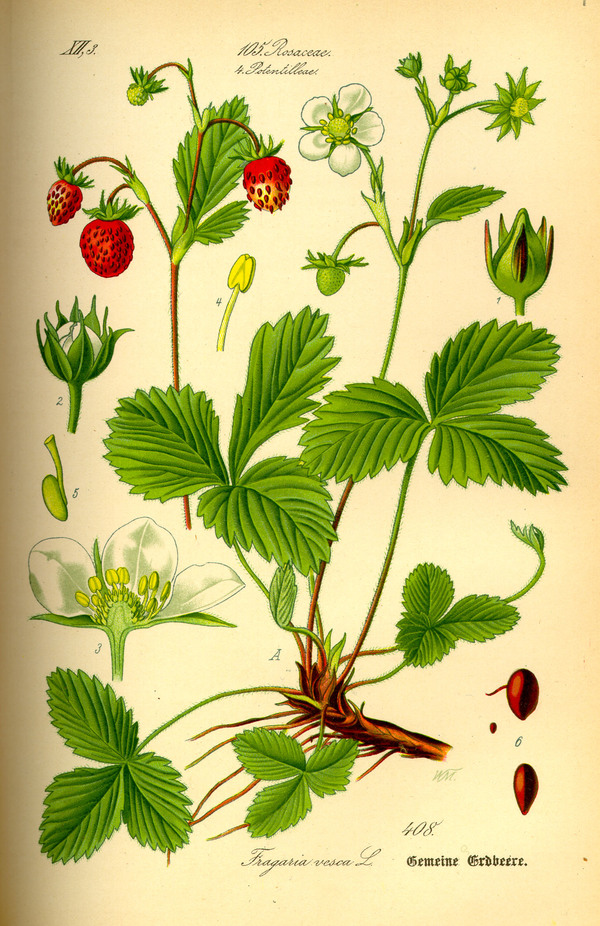
Fragaria vesca
Plant · Rosaceae
Fragaria Vesca suits individuals with marked sensitivity or anaphylaxis to strawberries, presenting with allergic skin reactions, urticaria, and anasarca. The remedy is indicated in persons with digestive and glandular disturbances, particularly where calculi formation or tartar accumulation is a problem. It is also useful in women during weaning when suppression of lactation is desired.
Key symptoms
- Urticaria and petechial eruptions from strawberry sensitivity
- Swollen tongue with characteristic strawberry appearance
- Swelling of the whole body with faintness
- Chilblains worse during hot weather
- Lack of mammary secretion; dries up milk
- Prevents formation of calculi and removes tartar from teeth
- Convulsions and apoplexy-like suffocation in severe reactions
Worse (aggravation)
- Worse during hot weather (chilblains)

Wood-strawberry (FRAGARIA)
Acts on digestion and mesenteric glands. Prevents formation of calculi, removes tartar from teeth and prevents attacks of gout. The fruit has refrigerant properties. Strawberries produce symptoms of poisoning in certain susceptible individuals, such as urticarial rashes (strawberry anaphylaxis). Here give Fragaria high potency.
Chilblains; worse during hot weather. Lack of mammary secretion. Psilosis (Spruce).
Mouth
Tongue swollen; strawberry tongue.
Skin
Urticaria; petechial and erysipelatous eruptions. Swelling of whole body.
Relationship
Compare: Apis. Calcarea.

Strawberry. N. O. Rosaceæ. Tincture of the ripe fruit. Infusion of the root.
Clinical
Anasarca. Biliousness. Chilblains. Convulsions. Erysipelas. Gonorrhœa. Psilosis (or Sprue). Tapeworm. Tongue, strawberry; swollen. Urticaria. Weaning.
Characteristics
It is well known that many persons are unable, to eat strawberries, and the poisonous effects resulting from them on those who are sensitive to their action have been utilised in homœopathy. Faintness; suffocation like apoplexy; convulsions and death have resulted; general anasarca, and especially swollen tongue. The well-known "strawberry tongue" is an indication for its use. Dr. Burnett gives it as "pippy tongue." An infusion of the root is used for drying up the breasts in women who wish to wean their children; it diminishes the size of the breasts and dries up the milk. Profuse viscid sweat has been observed. Lippe mentions: "Tapeworm. Pain in chilblains in hot weather." In old physic Fragaria vesca (in decoctions of leaves, root, or fruit ripe or unripe, …
Classical texts are in the public domain. Educational reference only — not medical advice.
