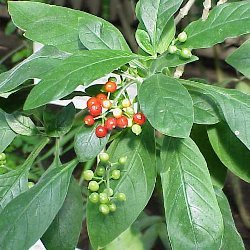
Ipecacuanha
Carapichea ipecacuanha (syn. Cephaelis ipecacuanha) · Ipecacuanha · Plant · Rubiaceae
Irritability is common in those who respond best to Ipecac., and children suited to the remedy may scream and howl. When unwell, these people can be capricious and hard to please, asking for things and then changing their minds. Illness can prompt them to become morose, depressed, impatient, and contemptuous of those around them.
Physical symptoms generally linked with Ipecac. are persistent nausea, with or without vomiting, and a tendency to hemorrhage. Despite any vomiting, the tongue is clean and unfurred. There is often oversensitivity to movement and a constant feeling of being hot on the inside and cold on the outside. These symptoms appear rapidly, are generally intermittent, and may also include coughing fits and breathing difficulties. Ipecac. is also used for headaches, migraines, and gynecological problems linked to the general tendency to bleed very easily.
Key symptoms
- persistent nausea and vomiting
- clean, unfurred tongue
- bright red bleeding
- excessive mucus production and a cough
- irritability
Worse (aggravation)
- Warm, moist weather; warm and relaxing atmosphere
- Indigestible food; raisins, cakes, and rich foods
- Motion; nausea from looking at moving objects
- Veal and certain specific foods trigger diarrhoea
- Periodically; symptoms recur at regular intervals
Better (amelioration)
- Open air; fresh cool air ameliorates
- Rest in horizontal position
- Closing the eyes relieves nausea and eye symptoms

Ipecac-root (IPECA)
The chief action is on the ramifications of the pneumogastric nerve, producing spasmodic irritation in chest and stomach. Morphia habit. The principal feature of Ipecacuanha is its persistent nausea and vomiting, which form the chief guiding symptoms. Indicated after indigestible food, raisins, cakes, etc. Especially indicated in fat children and adults, who are feeble and catch cold in relaxing atmosphere; warm, moist weather. Spasmodic affections. Hæmorrhages bright-red and profuse.
Mind
Irritable; holds everything in contempt. Full of desires, for what they know not.
Head
Bones of skull feel crushed or bruised. Pain extends to teeth and root of tongue.
Eyes
Inflamed, red. Pain through eyeballs. Profuse lachrymation. Cornea dim. Eyes tire from near vision. State of vision constantly changing. Spasm of accommodation from irritable weakness of the ciliary muscle. Nausea from looking on moving objects.
Face
Blue rings around eyes. Periodical orbital neuralgia, with lachrymation, photophobia, and smarting eyelids.
Nose
Coryza, with stoppage of nose and nausea. Epistaxis.
Stomach
Tongue usually clean. Mouth, moist; much saliva. Constant nausea and vomiting, with pale, twitching of face. Vomits food, bile, blood, mucus. Stomach feels relaxed, as if hanging down. Hiccough.
Abdomen
Amebic dysentery with tenesmus; while straining pain so great that it nauseates; little thirst. Cutting, clutching; worse, around the navel. Body rigid; stretched out stiff.
Stools
Pitch-like green as grass, like frothy molasses, with griping at navel. Dysenteric, slimy.
Female
Uterine hæmorrhage, profuse, bright, gushing, with nausea. Vomiting during pregnancy. Pain from navel to uterus. Menses too early and too profuse.
Respiratory
Dyspnœa; constant constriction in chest. Asthma. Yearly attacks of difficult shortness of breathing. Continued sneezing; coryza; wheezing cough. Cough incessant and violent, with every breath. Chest seems full of phlegm, but does not yield to coughing. Bubbling rales. Suffocative cough; child becomes stiff, and blue in the face. Whooping-cough, with nosebleed, and from mouth. Bleeding from lungs, with nausea; feeling of constriction; rattling cough. Croup. Hæmoptysis from slightest exertion (Millef). Hoarseness, especially at end of a cold. Complete aphonia.
Fever
Intermittent fever, irregular cases, after Quinine. Slightest chill with much heat, nausea, vomiting, and dyspnœa. Relapses from improper diet.
Sleep
With eyes half open. Shocks in all limbs on going to sleep (Ign).
Extremities
Body stretched stiff, followed by spasmodic jerking of arms towards each other.
Skin
Pale, lax. Blue around eyes. Miliary rash.
Modalities
Worse, periodically; from veal, moist warm wind, lying down.
Relationship
Compare: Emetine-principal alkaloid of Ipecac (A powerful amebicide, but is not a bactericide. Specific for amæbiasis; of remarkable value in treatment of amæbic dysentery; also as a remedy in pyorrhea, 1/2 gr daily for three days, then less. Emetin, 1/2 gr hypodermically, in Psoriasis. Emetin hydroch. 2x, diarrhœa with colicky, abdominal pains and nausea. Emetin for endamoebic dysentery. In physiological doses must be carefully watched. May produce hepatization of lungs, rapid heart action, tendency for the head to fall forward and lobar pneumonia. In hæmatemesis and other hæmorrhages, compare: Gelatin which has a marked effect on the coagulability of the blood. Hypodermically; or if by mouth, a 10 per cent jelly, about 4 oz, three times a day) Arsenic; Cham; Puls; Tart em; Squill. Convolvulus (colic and diarrhœa). Typha latifolia-Cat-tail flag (dysentery, diarrhœa) and summer complaint. Euphorbia hypericifolia--Garden Spurge--(Very similar to Ipecac. Irritation of the respiratory and gastro-intestinal tracts and female organs). Lippia mexicana--(Persistent dry, hard, bronchial cough--asthma and chronic bronchitis).
In Asthma, compare: Blatta orientalis.
Antidotes: Arsenic; China; Tabac.
Complementary: Cuprum; Arn.
Dose
Third to 200th potency.

Ipecac. has a wide sphere of action among acute sickness. Most of its acute complaints commence with nausea, vomiting.
The febrile conditions commence with pain in the back between the shoulders, extending down the back, as if it would break, with or without rigors, much fever, vomiting of bile and seldom any thirst. This is the general aspect of the beginning of an Ipecac. fever or gastric. trouble or chill in intermittents or bilious attacks.
The stomach is disordered. There is a sense of fullness in the stomach, cutting pains in the stomach and below the stomach, going from left to right. The cutting pain in colic goes from left to right. The patient is unable to stir or breathe until that pain passes off. It holds him transfixed in one position, coming like the stabbing of a knife in the region of the stomach, or above the navel, going from left to right, and is attended with prostration and nausea.

Cephaëlis ipecacuanha. N. O. Rubiaceæ. Tincture and trituration of the dried root.
Clinical
Anæmia. Asthma. Bronchitis. Catarrh. Cholera. Consumption. Convulsions. Cough. Deafness. Diarrhœa. Dysentery. Enteric fever. Eyes, affections of. Gall-stone colic. Gastric Ulcer. Hæmatemesis. Hæmorrhage. Hæmorrhoids. Hysteria. Intermittent fever. Menstruation, disorders of. Opium habit. Pregnancy, disorders of. Remittent fever. Salivation. Tetanus. Toothache. Vomiting. Whooping-cough. Worm-fever. Yellow-fever.
Characteristics
The well-known emetic effect of Ipecacuanha Wine gives a rough keynote for the use of Ipec. in homœopathy. Wherever ailments are associated with the presence of constant nausea Ipec. is very likely to be of use. The special form of nausea is a constant but unavailing desire to vomit; or immediately after vomiting there is, instead of relief, a desire to vomit again. With this there is a clean or not very dirty tongue. There is profuse salivation with the nausea. The nausea of …

Ipecac. (Rubiaceae.)
Adapted to cases where the gastric symptoms predominate (Ant. c., Puls.); tongue clean or slightly coated. In all diseases with constant and continual nausea. Nausea: with profuse saliva; vomiting of white, glairy mucus in large quantities, without relief; sleepy afterwards; worse from stooping; the primary effects of tobacco; of pregnancy. Stomach: feels relaxed, as if hanging down (Ign., Staph.); clutching, squeezing, griping, as from a hand, each finger sharply pressing into intestines; worse from motion. Flatulent, cutting colic about umbilicus. Stool: grassy-green; of white mucus (Colch.); bloody; fermented, foamy, slimy, like frothy molasses. Autumnal dysentry; cold nights, after hot days (Colch., Merc.). Asiatic cholera, first symptoms, where nausea and vomiting predominate (Colch.). Haemorrhage: active or passive, bright-red from all the orifices of the body (Erig., Mill.); uterine, profuse, clotted; heavy, oppressed breathing during; stitches from navel to uterus. …

Head
Headache as if the head was bruised; through all the bones of the head and down into the root of the tongue.
Stomach
Nausea intense, persistent, nothing > during convalescence.
Stomach
Sensation as if stomach hung down relaxed.
Stomach
Nausea constant, with many different complaints; nothing > the nausea.
Stomach
Vomiting, thirst, sweat, and bad breath.
Abdomen
With every movement a cutting pain in the abdomen, constantly running from left to right.
Anus and Stool
Stools yeast-like, foamy, or as if fermented; as green as grass, with nausea and vomiting.
Female Sexual Organs
During haemorrhage from the womb they commence to breathe heavily.
-
Headache, as if the brain were bruised, all through the bones of the head, and down into the root of the tongue, with nausea.
-
Distressing nausea, and inclination to vomit, with almost all complaints.
-
Stooping causes him to vomit.
-
Distressing feeling, as though the stomach were hanging down relaxed.
-
With every movement a cutting pain in abdomen, almost constantly running from left to right
-
Stools as if fermented, green as grass, with nausea and colic.
-
Hemorrhage from the uterus, blood bright red, profuse, clotted with heavy oppressed breathing.
-
Suffocation threatens from constriction in the throat and chest, worse from the least motion.

Phatak's chapter on Ipecacuanha is available in the app.
Read Phatak in the appClassical texts are in the public domain. Educational reference only — not medical advice.
