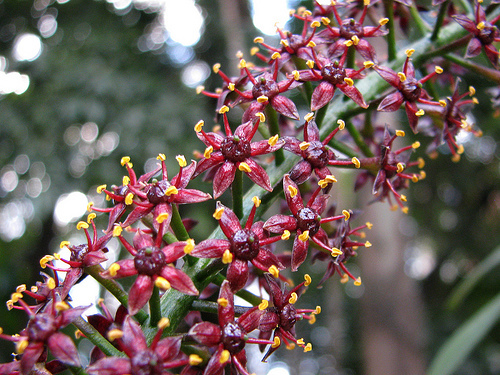
Jaborandi
Pilocarpus microphyllus · Plant · Rutaceae
Jaborandi suits patients with marked glandular over-activity, especially profuse simultaneous sweating and salivation from minimal stimulation. The remedy is particularly indicated for consumptives with night sweats and for exophthalmic goitre with palpitations, tremors, and perspiration. Eye strain with ciliary muscle irritability and contracted pupils is characteristic.
Key symptoms
- Profuse sweating and salivation simultaneously, often half a pint from a single dose
- Night sweats of consumptives; homeopathic to abnormal sweats
- Exophthalmic goitre with increased heart action, tremors, nervousness, heat and sweating
- Pupils contracted, not reacting to light; near-sightedness
- Eye strain with irritability of ciliary muscle; eyes fatigue from slightest use
- Everything at a distance appears hazy; vision indistinct every few moments
- Serous exudation into tympanic cavities with tinnitus
- Hot flushes with nausea, deeply flushed face, ears, and neck
Worse (aggravation)
- Start of menses
- Cold (increased sensitivity after treatment)
- Exhaustion
- Noon (headache)
Better (amelioration)
- Eating (distress in stomach)
- Late afternoon (headache from occiput)

Jaborandi (PILOCARPUS MICROPHYLLUS)
Pilocarpus is a powerful glandular stimulant and the most efficient diaphoretic. Its most important effects are diaphoresis, salivation and myosis. Hot flushes, nausea, salivation and profuse perspiration. The face, ears and neck become in a few minutes after a dose of Jaborandi deeply flushed, and drops of perspiration break out all over the body whilst at the same time the mouth waters and saliva pours out in an almost continuous stream. Other secretions, lachrymal, nasal bronchial and intestinal also but in less degree. The sweat and saliva produced by a single dose is often enormous in quantity, not infrequently half a pint.
Is homeopathic to abnormal sweats, and has achieved great success in night-sweats of consumptives. Acts upon the thyroid and its sudorific action may possibly be due to it. Exophthalmic goitre, with increased heart's action and pulsation of arteries; tremors and nervousness; heat and sweating; bronchial irritation. A valuable remedy in limiting the duration of mumps.
Eyes
Eye strain from whatever cause. Irritability of the ciliary muscle. Eyes easily tire from slightest use. Heat and burning in eyes on use. Headache; smarting and pain in globe on use. Everything at a distance appears hazy; vision becomes indistinct every few moments. Retinal images retained long after using eyes. Irritation from electric or other artificial light. Pupils contracted; do not react to light. Staring eyes. Near-sighted. Vertigo and nausea after using eyes. White spots before eyes. Smarting pain in eyes. Lids twitch. Atrophic choroiditis. Spasm of the accommodation while reading.
Ears
Serous exudation into the tympanitic cavities. Tinnitus (Pilocarpin 2x).
Mouth
Saliva viscid, like white of egg. Dryness. Free salivation, with profuse sweating.
Stomach
Nausea on looking at objects moving; vomiting; pressure and pain in stomach.
Abdomen
Diarrhœa, painless; during day with flushed face and profuse sweat.
Urinary
Scanty; pain over pubes with much urging.
Heart
Pulse irregular, dicrotic. Oppression of chest. Cyanosis; collapse. Nervous cardiac affections.
Respiratory
Bronchial mucous membrane inflamed. Much inclination to cough and difficult breathing. Œdema of lungs. Foamy sputa. Profuse, thin, serous expectoration. Slow, sighing respiration.
Skin
Excessive perspiration from all parts of the body. Persistent dryness of skin. Dry eczema. Semi-lateral sweats. Chilliness with sweat.
Relationship
Compare: Amyl nit; Atrop; Physos; Lycop; Ruta. Pilocarpin mur, (Meniere's disease, rapidly progressive phthisis, with free hæmorrhages, profuse sweating, 2x trit). Atropine is the antagonist to Pilocarpin, in dose of one one-hundredth grain for one-sixth of Pilocarpin.
Dose
Third potency.
Non-Homeopathic Uses
Chiefly as a powerful and rapid diaphoretic. It is of most service in renal disease, especially with uræmia, eliminating both water, and urea. Scarlatinal dropsy. Contra-indicated in heart failure, and in post-puerperal uræmia, and in senile cases.
Dose
One-eighth to one-fourth grain hypodermically.

Pilocarpus pinnatifolius. N. O. Rutaceæ. Tincture of fresh leaves. Tincture of dried leaves and stems. (The alkaloid, Pilocarpin, has been experimented with independently and is dealt with in a separate article.)
Clinical
Alopecia. Asthenopia. Bronchitis. Burns. Cataract. Ciliary spasm. Consumption. Diarrhœa. Dysmenorrhœa. Erysipelas. Eyes: tension in; hyperopia: affections of; operations on. Flushings, climacteric. Hair, affections of. Heart, affections of. Hypermetropia. Leucorrhœa. Miliaria. Mumps. Perspiration, excessive. Pregnancy, salivation of. Salivation. Scalds. Strabismus. Worms.
Characteristics
Jaborandi is a South American tree growing to the height of twenty feet. It is used by South American Indians as an antidote to the bite of serpents of the Trigonocephalus group. The drug has been extensively used in ophthalmic practice for its mydriatic properties. Incidentally its action on the skin and salivary glands was observed and led to extensive provings being made. Robin (C. D. P.) sums up …
Sight and Eyes
Everything at a distance appeared hazy, and although he could read moderate-sized type, at one foot or two feet, it was indistinct.
Sight and Eyes
Tension of the accommodative apparatus of the eye, with approximation of the nearest and farthest point of distinct vision.
Sight and Eyes
The state of vision is constantly changing, becoming suddenly more or less dim every few moments.

Phatak's chapter on Jaborandi is available in the app.
Read Phatak in the appClassical texts are in the public domain. Educational reference only — not medical advice.
