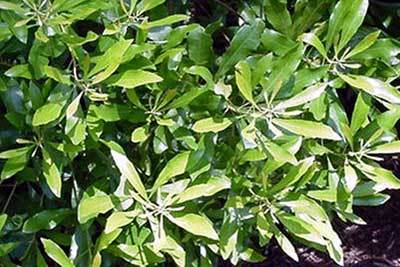
Myrica cerifera
Morella cerifera · Plant · Myricaceae
Myrica Cerifera suits patients with marked hepatic torpor and jaundice presenting with gloomy despondency, loss of appetite, and a persistent nauseating taste. The scalp feels tight, and there is heaviness on waking. A strong desire for acids accompanies the digestive symptoms. The remedy addresses the deeply jaundiced, debilitated liver patient.
Key symptoms
- Complete jaundice with bronze-yellow skin and loss of appetite
- Despondent, irritable, gloomy, indifferent mental state
- Dull heavy aching in temples and forehead on waking in morning
- Tongue furred with bad taste and nausea
- Tenacious thick nauseous secretion in mouth
- Bitter nauseous taste with offensive breath
- Weak sinking feeling in epigastrium increasing after eating
- Dull pain in region of liver with fullness in stomach and abdomen
- Scanty yellow frothy urine
Worse (aggravation)
- After eating (weak sinking feeling in epigastrium increases)
- On waking in the morning (heavy aching in temples)
Better (amelioration)
- Rapid walking (weak sinking feeling in epigastrium relieved)

Bayberry (MYRICA)
Marked action on the liver, with jaundice and mucous membranes. Persistent sleeplessness. Jaundice.
Mind
Despondent, irritable, indifferent. Gloomy.
Head
Scalp feels tight. Headache, with drowsiness; yellow sclerotica; aching in eyeballs. Pressure in vertex and forehead. Dull, heavy aching in temples and forehead on waking in the morning. Pain and stiffness in nape of neck.
Face
Yellow, Itching and stinging. Creeping sensation.
Mouth
Tongue furred, with bad taste in mouth, and nausea. Tenacious, thick, nauseous secretion. Tender, spongy and bleeding gums (Merc).
Throat
Constricted and rough feeling, with a constant desire to swallow. Stringy mucus; detached with difficulty.
Stomach
Taste bitter and nauseous, with offensive breath. Complete loss appetite, but with a feeling of fullness in the stomach after a hearty meal. Strong desire for acids. Weak, sinking feeling in the epigastrium, approaching nausea; increased after eating; relieved by rapid walking.
Abdomen
Dull pain in the region of the liver. Complete jaundice, with bronze-yellow skin; loss of appetite. Fullness in the stomach and abdomen. Scanty, yellow, frothy urine.
Stool
Constant discharge of flatus when walking. Urging to stool, with no other results than the expulsion of a great amount of flatus. Loose, light-colored stool; ash-colored and destitute of bile.
Urinary
Dark, frothy, scanty, high-colored, biliary.
Sleep
Disturbed, bad dreams and frequent waking; insomnia.
Extremities
Staggering gait. Pain under shoulder-blades and back of neck, in all muscles, in hollow of right foot.
Skin
Yellow and itching. Jaundice. Creeping sensation, as of insects.
Relationship
Compare: Ptel; Cornus cir; Chelid; Lept; Fagop.
Antidote: Digit (jaundice).
Dose
Tincture, to third potency.

Myrica cerifera. Wax Myrtle. Bayberry. Candleberry. N. O. Myricaceæ. Tincture of fresh bark of root.
Clinical
Catarrh. Conjunctivitis. Heart, affections of. Jaundice. Leucorrhœa. Liver, affections of. Pharynx, affections of. Tendo-Achillis, pain in. Throat, sore. Urticaria.
Characteristics
According to Hale, though Myrica was known to older botanic practitioners, it was Samuel Thomson, of Lobelia fame, who established its reputation. Thomson had a crude pathology of his own which served him to some extent. One of his ideas was that the digestive tract was liable to become fouled with a copious mucous lining. This he called "canker"; and he stated of Myrica that it "has the power of disengaging the thick, viscid secretions of the mucous membrane of the stomach." Myrica, says Hale, formed the chief ingredient in Thomson's famous "Composition powder." The provings confirm Thomson's observation, in that Myrica produced abundant secretion of tenacious mucus in the throat, difficult to detach. This may be …

Phatak's chapter on Myrica cerifera is available in the app.
Read Phatak in the appClassical texts are in the public domain. Educational reference only — not medical advice.
