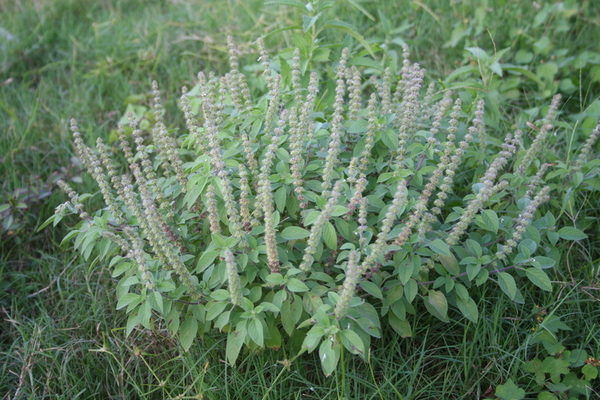
Ocimum canum
Ocimum americanum · Plant · Lamiaceae
Ocimum Canum suits patients with uric acid diathesis and tendency to renal calculi, presenting with characteristic brick-dust urinary sediment and musk-scented urine. Both male and female genital organs are affected. The remedy is a primary choice for right-sided renal colic with urinary gravel.
Key symptoms
- Red or brick-dust sediment in urine with an odour of musk
- Urine turbid, thick, purulent, or bloody; high uric acid with spike crystals
- Renal colic especially on the right side; cramps in kidneys
- Swelling of inguinal and mammary glands
- Vulva swollen with darting pains in labia; nipples painful to least contact
- Breasts full, tense, and itching; prolapse of vagina
- Heat and swelling of left testicle

Brazilian Alfavaca
Is to be remembered in diseases of the kidneys, bladder and urethra. Uric acid diathesis. Red sand in the urine is its chief characteristic, and frequently verified. Swelling of glands, inguinal and mammary. Renal colic, especially right side. Symptoms of renal calculus are pronounced.
Urine
High acidity, formation of spike crystals of uric acid. Turbid, thick, purulent, bloody; brick-dust red or yellow sediment. Odor of musk. Pain in ureters. Cramps in kidneys.
Male
Heat and swelling of left testicle.
Female
Valva swollen; darting pain in labia. Nipples painful to least contact. Breasts feel full and tense; itching. Prolapsus vaginæ.
Relationship
Compare: Berb; Hedeoma; Lycop; Pareir; Urtica.
Dose
Sixth to thirtieth potency.

Ocimum canum. O. incanescens (Mart.). O. fluminense (Wells) Alfavaca (Portuguese). N. O. Labiatæ. Tincture of fresh leaves.
Clinical
Albuminuria. Breasts, painful. Bubo. Calculus, renal, passage of. Diarrhœa. Gravel. Kidneys, diseases of. Renal colic. Urine, abnormal. Vagina, prolapse of.
Characteristics
Ocim. can. is one of the remedies we owe to Mure, who tells us that it is used in Brazil "as a specific for diseases of the kidneys, bladder, and urethra." He gives a short list of nineteen symptoms (apparently partly clinical and partly pathogenetic) which stamp him as a true observer. His indications have been confirmed many times. "Renal colic, with violent vomiting every fifteen minutes; one wrings one's hands and moans and cries all the time. Red urine with brick-dust sediment after the attack." The urine may be "saffron colour" or "thick, purulent, with an intolerable smell of musk." In two cases published by myself (J. B. H. S., January, 1896; H. W., xxxi. 178) the following symptoms were removed: …

Urinary Organs
Nephritic colic (right side), with violent vomiting every fifteen minutes; twists about, screams and groans, red (bloody) urine, with brick dust sediment after the attack.

Phatak's chapter on Ocimum canum is available in the app.
Read Phatak in the appClassical texts are in the public domain. Educational reference only — not medical advice.
