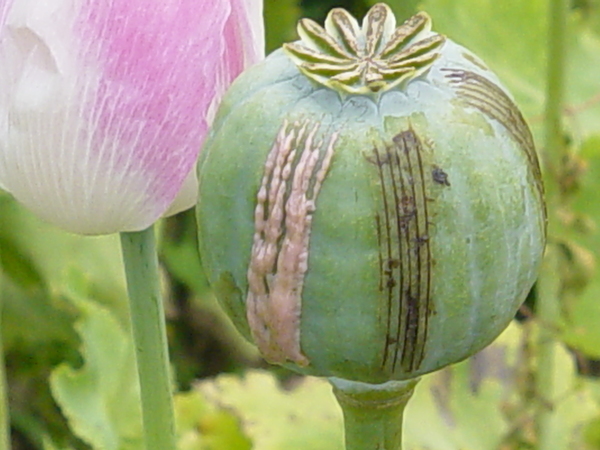
Opium
Papaver somniferum (latex) · Opium poppy, big smoke,Papaver somniferum · Plant · Papaveraceae
Opium is given to people who exhibit either or both of two opposite states. One is stupor, apathy, and dulled sensitivity to pain. The other is hyperactivity and intense sensitivity, often with insomnia.
If symptoms occur with one or both of these states, Opium is given for insomnia, sleeping disorders, respiratory problems, constipation, and shock. It can also be used to help treat recovery from stroke paralysis, brain injuries, delirium tremens, and alcohol withdrawal
Key symptoms
- stupor
- apathy
- dulled sensitivity to pain
- hyperactivity with difficulty in sleeping
Worse (aggravation)
- Worse from heat
- Worse during and after sleep
Better (amelioration)
- Better from cold things
- Better from constant walking

Dried Latex of the Poppy (PAPAVER SOMNIFERUM)
Hahnemann says that it is much more difficult to estimate the action of Opium than of almost any other drug. The effects of Opium as shown in the insensibility of the nervous system, the depression, drowsy stupor, painlessness, and torpor, the general sluggishness and lack of vital reaction, constitute the main indications for the drug when used homeopathically. All complaints are characterized by sopor. They are painless, and are accompanied by heavy, stupid sleep, stertorous breathing. Sweaty skin. Dark, mahogany-brown face. Serous apoplexy-venous, passive congestion. Want of sensitiveness to the action of medicines. Reappearance and aggravation from becoming heated. Opium lessens voluntary movements, contracts pupils, depresses higher intellectual powers, lessens self-control and power of concentration, judgment; stimulates the imagination, checks all secretions except that of the skin. Want of susceptibility to remedies even though indicated. Diseases that originate from fright.
Mind
Patient wants nothing. Complete loss of consciousness; apoplectic state. Frightful fancies, daring, gay, bright. Unable to understand or appreciate his sufferings. Thinks he is not at home. Delirious talking, with wide open eyes.
Head
Vertigo; lightness of head in old people. Dull, heavy, stupid. Delirium. Vertigo after fright. Pain in back of head; great weight there (Gels). Bursting feeling. Complete insensibility; no mental grasp for anything. Paralysis of brain.
Eyes
Half-closed, dilated; pupils insensible, contracted. Ptosis (Gels; Caust). Staring glassy.
Face
Red, bloated, swollen, dark suffused, hot. Looks intoxicated, besotted (Bapt; Lach). Spasmodic facial twitching, especially corners of mouth. Veins of face distended. Hanging down of lower jaw. Distorted.
Mouth
Dry. Tongue black, paralyzed bloody froth. Intense thirst. Blubbering op lips. Difficult articulation and swallowing.
Stomach
Vomiting, with colic and convulsions. Fecal vomiting. Incarcerated hernia. Hungry; no desire to eat.
Abdomen
Hard, bloated, tympanitic. Lead colic during colic, urging to stool and discharge of hard feces.
Stool
Obstinate constipation; no desire to go to stool. Round, hard, black balls. Feces protrude and recede (Thuj; Sil). Spasmodic retention of feces in small intestines. Stools involuntary, black, offensive, frothy. Violent pain in rectum, as if pressed asunder.
Urine
Slow to start; feeble stream. Retained or involuntary, after fright. Loss of power or sensibility of bladder.
Female
Suppressed menses from fright. Cessation of labor-pains with coma between paroxysms. Threatened abortion and suppression of lochia, from fright, with sopor. Horrible labor-like pains in uterus, with urging to stool.
Respiratory
Breathing stops on going to sleep; must be shaken to start it again (Grindelia). Hoarse. Deep snoring; rattling, stertorous breathing. Difficult, intermittent, deep, unequal respiration. Heat in chest; burning about heart. Cough, with dyspnœa and blue face; with bloody expectoration.
Sleep
Great drowsiness (Gels.; Nux mosch). Falls into a heavy stupid sleep. Profound coma. Loss of breath on falling asleep (Grind). Coma vigil. Picking at bedclothes. Very sleepy, but cannot go to sleep. Distant noise, cocks crowing, etc, keep him awake. Child dreams of cats, dogs, black forms. Bed feels so hot cannot lie on it. Pleasant, fantastic, amorous dreams. Shaking chill; then heat, with sleep and sweat. Thirst only during heat.
Fever
Pulse full and slow. Heat extending over body. Hot perspiration. Fever characterized by stupor, snoring respiration, twitching of limbs, intense thirst and sleepiness. General low temperature with inclination to stupor.
Back and Extremities
Opisthotonos. Swollen veins of neck. Painless paralysis (Oleand). Twitching of limbs. Numbness. Jerks as if flexors were overacting. Convulsions; worse from glare of light; coldness of limbs.
Skin
Hot, damp, sweating, Constant desire to uncover. Hot perspiration over whole body except lower limbs.
Modalities
Worse, heat, during and after sleep (Apis; Lach.). Better, cold things, constant walking.
Relationship
Compare: Apis; Bell; Gels; Nux mosch; Morphinum (extreme susceptibility to pain; twitching; tympanities; much itching); Codein (dry, teasing, incessant cough; twitching of muscles, especially those of eyelids); Eschscholtzia-Cal California Poppy--(a harmless soporific).
Antidote: Acute Opium poisoning. Atropin and Black Coffee. Chronic Opium poisoning. Ipecac; Nux; Passiflora. Berberis is useful to counteract opium habit.
Dose
Third to thirtieth and 200th potency.
Non-Homeopathic Preparations and Uses
Palliative only in great pain, sleeplessness, peritonitis, and to check excess secretion in diarrhœa, diabetes, etc.
Opium (crude).--Official dose, 1 grain.
Laudanum (tincture)-Dose, 5 to 20 drops. Extract of Opium 1/4 to 1 grain.
Paregoric-Tinctura Camphora Composita. Contains in each dram 1/4 grain of Opium equal to 1/30 grain of Morphine. Dose 1/2 to 1 fluid dram for adults. For an infant 3 to 5 drops.
Dover's Powder consists of Opium, Ipecac and Sulphate of Potash. It contains 10% each of Opium and Ipecac. Dose 5 to 15 grains.
Morphine-1/8 to 1/4 grain.
Magendie's solution-16 grains to 1 oz or 5 drops equal to 1/6 grain.
Codein-1/2 to 1 grain.
Apomorphia-1/20 to 1/10 grain hypodermically.

Generals
Among the striking features of Opium is a class of complaints marked by painlessness, inactivity, and torpor.
Many of the provers taking small doses had torpor, inability to realize or feel their surroundings, or to take in the nature of states and judge of things.
Deception in vision, taste, touch; deception of the state he exists in; in his own realization; a perversion of all the senses with much deception.
The general characteristic is painlessness, but now and then an alternate state is produced, in which a small dose of Opium will cause pain, sleeplessness, inquietude, nervous excitability; the very opposite state from that produced in the majority of cases.

Papaver somniferum. Poppy. N. O. Papaveraceæ. (Opium is the gummy exudation of the unripe capsule of the poppy.) Tincture.
Clinical
After-pains. Apoplexy. Bladder, paralysis of. Brain, affections of. Cancer. Catalepsy. Chilblains. Colic. Constipation. Diabetes mellitus. Dreams. Dysmenia. Epilepsy. Fear, effects of. Fœtus, movements of, excessive. Hernia, incarcerated. Hystero-epilepsy. Ileus. Intestines, obstruction of. Labour pains, abnormal. Lead colic. Marasmus. Measles. Melancholia. Meningitis. Paralysis. Puerperal convulsions. Sighing. Sleep, abnormal. Snoring. Starting. Sunstroke. Tympanitis. Uræmia. Urine, suppression of; retention of. Uterus, inertia of. Veins, fulness of. Whooping-cough.

Poppy. (Papaveraceae.)
Especially adapted to children and old people; diseases of first and second childhood (Bar. c., Mill.), persons with light hair, lax muscles, and want of bodily irritability. Want of susceptability to remedies; lack of vital reaction, the well chosen remedy makes no impression (Carbo v., Laur., Val.). Ailments: with insensibility and partial or complete paralysis; that originate from fright, bad effects of, the fear still remaining (Acon., Hyos.); from charcoal vapors; from inhaling gas; of drunkards. All complaints; with great sopor; painless, complains of nothing; wants nothing. Spasms: of children, from approach of strangers; from nursing after fright of mother (Hyos. - after anger of mother, Cham., Nux); from crying; eyes half open and upturned. Screaming before or during a spasm (Apis, Hell.). Deep stetorous respiration both on inhalation and exhalation. Delirium, constantly talking; eyes wide open, face red, puffed; or unconscious, eyes glassy, half-closed, face pale, deep coma; …

Mind
Complete loss of consciousness, with slow, stertorous breathing; insensibility to external impressions.
Mind
Drunkenness with stupor, as if from smoke; eyes hot, dry and burning.
Mind
After a fright, with fear; convulsions, or the head hot, and twitching around the mouth.
Mind
After a fright, the fear of the fright still remaining.
Mind
Delirious, talking, eyes wide open, face red and puffed up.
General Face
The lower lip and jaw hangs down.
General Face
Face bloated, dark red, and hot; features distorted; lower lip and jaw hanging down;
Abdomen
Colic from lead (in paints, pipes, or otherwise).
Anus and Stool
Nervous and irritable; passes nothing but hard black balls from the bowels.
-
Delirious talking, eyes wide open, face red and puffed up.
-
Drunkenness with stupor, as from smoke in the brain, eyes burning hot and dry.
-
Nervous and irritable, passes nothing but hard, black balls from the bowels.
-
After a fright, with fear, convulsions, or the head hot, and twitching around the mouth.
-
The lower lip and jaw hang down.
-
Child makes no water, with full bladder, and has no stool, from nursing after the nurse has had furious fit of passion.
-
Colic and other ailments from lead in paints, pipes and otherwise.
-
Twitching, trembling of the head, arms and hands, now and then jerks as if the flexors were overactive, body cold, inclination to stupid sopor, motion of the body and uncovering the head relieves.

Phatak's chapter on Opium is available in the app.
Read Phatak in the appClassical texts are in the public domain. Educational reference only — not medical advice.
