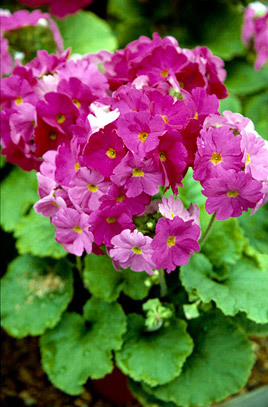
Primula obconica
Plant · Primulaceae
Primula Obconica suits hypersensitive patients who develop violent skin reactions from minimal contact with irritants. The remedy covers right-sided affections of the liver and spleen combined with intermittent eczematous eruptions of the face and extremities, with intense nocturnal itching.
Key symptoms
- Contact or proximity dermatitis with deep infiltration and tension of tissues
- Moist eczema and papular eruption on face; eyelids swollen
- Eczema on arms, wrists, forearms, and hands — papular and excoriated
- Blisters on fingers; purple blotches on back of hands; palmar surface stiff
- Great itching worse at night; skin red and swollen like erysipelas
- Intermittency of symptoms; worse on right side
- Pain in liver and spleen
- Paralyzed sensation and weakness
Worse (aggravation)
- At night — itching and burning of face worse
- Right side — symptoms more pronounced on right

Primrose
The poison of the Primrose occurs in its glandular hairs, which break easily and discharge an irritating fluid which is absorbed into the skin.
But skin symptoms of poisoning appear in sensitive patients even without coming in direst contact with the plant, mere nearness being sufficient, just like Poison ivy. Intermittency of symptoms; worse right side. Pain in liver and spleen. Deep infiltration and tension of tissues; blisters. Paralyzed sensation. Weakness. Pharyngeal soreness alternates with diminished facial irritation.
Face
Moist eczema. Papular eruption on chin. Burns at night. Urticaria-like eruption. Eyelids swollen.
Extremities
Eczema on arms, wrists, forearms, hands, papular and excoriated. Rheumatic pain around shoulder. Palms dry and hot. Cracking over joints and fingers. Eruption between fingers. Purple blotches on back of hands, palmar surface stiff. Blisters on fingers.
Skin
Great itching, worse at night, red and swollen like erysipelas. Tumefied. Small papules on a raised base. Skin symptoms accompanied by febrile symptoms.
Relationship
Compare: Rhus; Fagopyrum (Antidotal). Humea Elegans, similar skin symptoms.

P. obconca. N. O. Primulaceæ. Tincture of whole fresh plant.
Clinical
Chapped hands. Eczema. Eyes, inflammation of. Itching. Liver, pain in. Skin, affections of. Spleen, pains in.
Characteristics
Prim. ob. is an ornamented variety of Primrose. Gardeners, amateur and professional, have discovered after much suffering that it has with some persons a most powerful action on the skin, its action taking place chiefly by contact but partly by effluvia. The Rev. F. H. Brett (H. W., xxv. 496), who was one of the first to notice its poisonous properties, undertook to prove it. He had handled the plants freely up to that time without experiencing any ill effect. He cut up some young plants and added some vigorous fresh leaves of an old one and made a tincture. This he allowed to stand for a week, and then took three or four drops, three times a day for four days. Two days after ceasing to take it symptoms began to develop in the right little finger, and two days afterwards in the right thumb. These became very …
Classical texts are in the public domain. Educational reference only — not medical advice.
