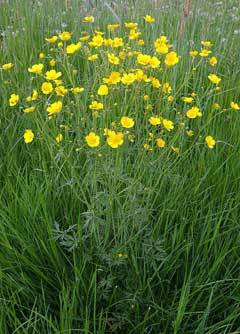
Ranunculus acris
Plant · Ranunculaceae
The remedy is suited to individuals with inflammatory conditions of muscles and joints presenting with intense rheumatic pains, and to skin conditions arising from external irritation by the plant. The general state may include fever with faintness and restlessness.
Key symptoms
- Rheumatic pain in muscles and joints, especially ankles and wrists
- Pains occur both on walking and at rest
- Lumbar pains worse on bending or turning the body
- Heat, faintness, and erethistic fever
- Skin hot, red, blistered, progressing to gangrene from external application
- Wandering pains in limbs, hands, knees, feet, and toes
- Violent pressing joint pains better from motion when sitting
Worse (aggravation)
- Bending or turning the body
- During inspiration for chest pains
Better (amelioration)
- Motion relieves pressing joint pains when sitting

Ranunculus acris. Buttercup. Goldcup. Crowfoot. N. O. Ranunculaceæ. Tincture of whole plant.
Clinical
Erysipelas. Fever. Gangrene. Lumbago. Neuralgia. Rheumatism. Ulcers.
Characteristics
Ranunculus acris is distinguished from R. bulbosus by its slender cylindrical flower-stalk, that of R. bulb. being furrowed. Both are common "buttercups," and have acrid and poisonous properties. R. acris was proved by Franz and Lembke, and the chief skin symptoms were observed in a woman of seventy who applied a handful of the herb to her limbs, with the result of setting up violent constitutional symptoms and fever and intense inflammation, going on to gangrene of the skin of the legs. In the provers a pain of a rheumatic character was experienced in the muscles and joints, especially ankles and wrists, which occurred when walking and also when at rest. Lumbar pains < on bending or turning the body. Heat, faintness, and fever.
Classical texts are in the public domain. Educational reference only — not medical advice.
