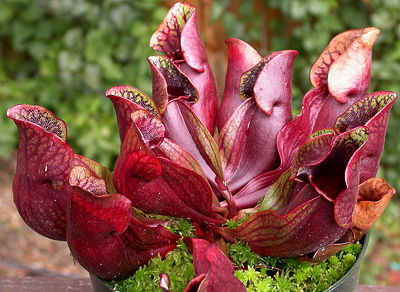
Sarracenia purpurea
Plant · Sarraceniaceae
Sarracenia purpurea is suited to conditions involving congestion to the head with irregular heart action and visual disorders, including chlorosis. The patient experiences intense hunger even after eating, combined with profound weakness of the limbs. Its most notable use is in variola, where it aborts the disease process and arrests pustulation.
Key symptoms
- Sick headache with throbbing especially in neck, shoulders, and head feeling full to bursting
- Congestion to head with irregular heart action
- Hungry all the time, even after a meal; sleepy during meals
- Copious, painful vomiting
- Pains shooting in zig-zag course from lumbar region to middle of scapula
- Photophobia; eyes feel swollen and sore with pain in orbits
- Black objects move with the eye
- Limbs weak with bruised pain in knees and hip-joints
- Skin: variola — aborts the disease and arrests pustulation
Worse (aggravation)
- About midnight and at 3 p.m.
- Morning
- Rising from lying
- Trying to walk
- Stormy weather
- Cold air (bone pains)
- Open air
Better (amelioration)
- Fresh air generally
- Out of bed

Pitcher-plant
A remedy for variola. Visual disorders. Congestion to head, with irregular heart action. Chlorosis. Contains a very active proteolytic enzyme. Sick headache; throbbing in various parts, especially in neck, shoulders and head, which feels full to bursting.
Eyes
Photophobia. Eyes feel swollen and sore. Pain in orbits. Black objects move with the eye.
Stomach
Hungry all the time, even after a meal. Sleepy during meals. Copious, painful vomiting.
Back
Pains shooting in zig-zag course from lumbar region to middle of scapula.
Extremities
Limbs weak; bruised pain in knees and hip-joints. Bones in arm pain. Weak between shoulders.
Skin
Variola, aborts the disease, arrests pustulation.
Relationship
Compare: Tartar em; Variol; Maland.
Dose
Third to sixth potency.

Sarracenia purpurea. Pitcher Plant. (Grows in boggy places from Canada southwards.) N. O. Sarraceniaceæ. Tincture of fresh plant. Tincture of root.
Clinical
Back, pains in. Bones, pains in. Borborygmus. Constipation. Coxalgia. Diarrhœa. Eruptions, scrofulous. Femur, pains in. Herpes. Influenza. Lumbago. Psoriasis. Small-pox Vision, disordered.
Characteristics
The use of the Pitcher Plant in small-pox is a discovery of the Indians of North America, the spotted appearance of the plant probably suggesting a resemblance to the disease. Hale has collected much confirmatory evidence of its power to antidote the small-pox poison. A proving by T. C. Duncan, Thomas, and others brought out symptoms of fever, backache, headache, and gastric disturbance. Hering quotes these instances of its action: (1) A woman far advanced in pregnancy was cured of small-pox with Sarr. 3, 6, and 9, delivery being happily accomplished during her convalescence, the infant bearing on its body numerous red blotches, indicating that it had …
Classical texts are in the public domain. Educational reference only — not medical advice.
