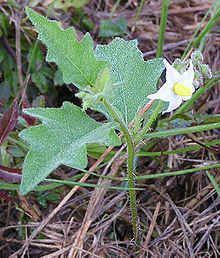
Solanum carolinense
Plant · Solanaceae
Horse-nettle is a domestic remedy in the Southern United States with a traditional reputation for treating convulsive disorders. It has demonstrated success in epilepsy and tetanic conditions, with evidence of action on neuromuscular relaxation.
Key symptoms
- Convulsions
- Epilepsy
- Tetanus
- Hysterical tetanic spasms
- Muscle relaxation in tetanus
- State of dangerous stupor

Solanum Carolinense. Horse-nettle. N. O. Solanaceæ. Tincture of fresh ripe berries.
Clinical
Convulsions. Epilepsy. Tetanus.
Characteristics
Solan. car. is a domestic remedy in the Southern States for "convulsions," and it has been tested by several old-school authorities (H. R., xi. 20) in cases of epilepsy with some success. Doses of from 30 to 60 drops were given three times a day, the only unpleasant effects being a "mild diarrhœa" in some cases. Grahn (H. R., xii. 462) relates a case of hysterical tetanus in a young negro woman. She had laughed whilst holding a pin in her mouth, and the pin had lodged in her throat. She had managed to get rid of it by coughing, but had hurt the throat, and the tetanic spasms followed. Passiflor. did good, but the supply gave out, and Sol. car. was given instead. By error of an attendant, maximum doses (two drachms every forty minutes) were given, and a state of dangerous stupor followed. However, all muscles were relaxed, and remained so the rest of that day. Next …
Classical texts are in the public domain. Educational reference only — not medical advice.
