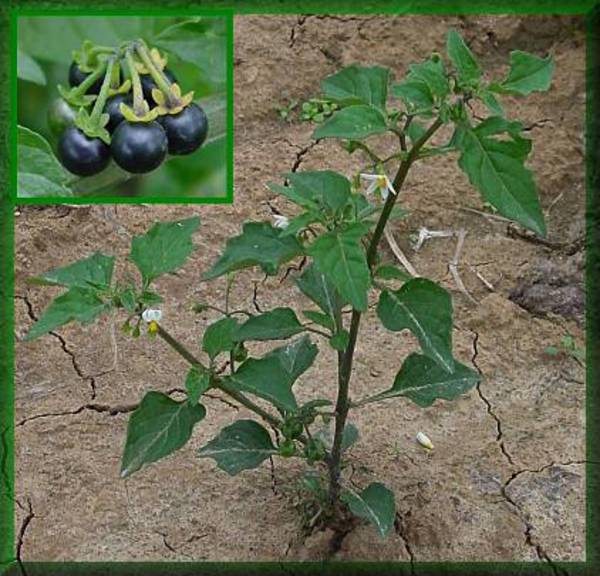
Solanum nigrum
Plant · Solanaceae
Black Nightshade, a common weed misidentified as native Belladonna. Marked action on head and eyes with meningitis and convulsive manifestations. Shows split headaches and tetanic rigidity from poisoning. Symptoms include frightful headaches and blackening of affected parts.
Key symptoms
- Furious delirium with stammering speech
- Vertigo with terrible headache
- Meningitis and brain irritation
- Congestive headache with spasms
- Profuse watery discharge from right nostril
- Pain over both eyes with alternate pupil dilation
- Floating spots and weak sight
- Thick yellow expectoration from cough
Worse (aggravation)
- By least movement of head
- Light and noise worsen headache
- Stooping aggravates pain
- Close room worse
- Touch worse overall
- Motion and movement worse
- Beginning to move after sitting
Better (amelioration)
- Open air better for headache
- Closing eyes helps headache

Black Nightshade
Used with success in ergotism, with tetanic spasms and stiffness of whole body, with mania. Marked action on head and eyes. Meningitis. Chronic intestinal toxæmia. Brain irritation during dentition. Restlessness of a violent and convulsive nature. Formication with contraction of extremities.
Head
Furious delirium. Vertigo; terrible headache and complete cessation of the mental faculties. Night terrors. Congestive headache.
Nose
Acute coryza; profuse, watery discharge from right nostril; left stopped up, with chilly sensation, alternating with heat.
Eyes
Pain over both eyes. Alternate dilatation and contraction of pupils; weak sight; floating spots.
Respiratory
Constructive feeling in chest, with difficult breathing; cough with tickling in throat. Expectoration thick, yellow. Pain in left chest, sore to touch.
Fever
Alternation of coldness and heat. Scarlet fever; eruption in spots, large and vivid.
Relationship
Compare: Bellad; Solanum Carolinense-Horse-nettle--(conclusions and epilepsy, twenty to forty-drop doses; is of great value in grand mal of idiopathic type, where the disease has begun beyond age of childhood; hystero-epilepsy, also in whooping-cough); Solan mammosum-Apple of Sodom--(pain in left hip-joint); Solan oleraceum (swelling of mammary gland, with profuse secretion of milk); Solan tuberosum (cramps in calves and contraction of fingers; spitting through closed teeth); Solan vesicarium (recommended in facial paralysis); Solaninum aceticum (threatening paralysis of the lungs in the course of bronchitis in the aged and children must cough a long time before able to raise expectoration); Solan pseudocaps (acute pains, in lower abdomen); Solan tuberos ægrotans-Diseased potato--(prolapse of the rectum, patulous anus; offensive breath and odor of body; tumors of rectum look like decayed potato; dreams of pools of blood); Solanum tuberosum-Potato berries--(cramps in the calves of the legs and fingers).
Dose
Second to thirtieth potency.

Solanum nigrum. Black nightshade. N. O. Solanaceæ. Tincture of fresh plant.
Clinical
Amaurosis. Chorea. Headache. Heartburn. Hydrocephalus. Mania. Meningitis. Night-terrors. Parotitis. Peritonitis. Puerperal convulsions. Scarlatina. Small-pox. Stammering. Tetanus. Trismus. Tympanites. Typhoid fever. Varicosis. Vertigo. Ulcers.
Characteristics
Sol. n. is a common weed found in waste places. It has white flowers and blackberries. "The leaves applied externally ease pain and abate inflammation. Too large a quantity occasions violent sickness and headache, giddiness, drowsiness, and other dangerous symptoms. The Arabians apply the leaves to burns and ulcers, skin diseases, and scrofulous and cancerous affections; they are diaphoretic, diuretic, and purgative" (Green's Herbal). Hale says some country practitioners used it with much success under the impression that it was "an indigenous Belladonna," having been misled by the name "nightshade." Hale verified its use in meningitis and headache; in scarlatina when …
Classical texts are in the public domain. Educational reference only — not medical advice.
