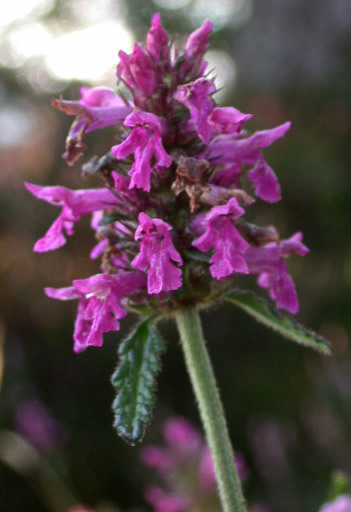
Stachys betonica
Betonica officinalis · Plant · Lamiaceae
A remedy primarily affecting the head, eyes, and respiratory system, characterized by dizziness and fullness with a peculiar feeling of oppressed breathing as if from diaphragmatic paralysis. The constitutional picture includes a disposition to take cold and weakness in legs.
Key symptoms
- Dizziness with fullness in head and eyes
- Stitches in right temple
- Inability to concentrate mind
- Oppressed breathing as from paralysis of diaphragm
- Pain in eyeballs as if too tense
- Shooting pain in wrist joints
- Pains in abdomen and hepatic region
Worse (aggravation)
- Closing eyes or moving head
- Looking at light, reading, thinking, bending head down
- On walking up hill
- Exposure to cold
Better (amelioration)
- Open air
- Walking about in room

Betony Wood (BETONICA)
Produces pains in various parts.
Head
Stitches in right temple. Inability to concentrate mind.
Abdomen
Pains in abdomen, hepatic region and of transverse colon, also in gall-bladder and right inguinal region and spermatic cords.
Extremities
Shooting pain in back of both wrist joints. Wrist drops. Pain in right popliteal space down leg, which feels paralyzed.

Stachys betonica. Wood Betony. N. O. Labiatæ. Tincture of whole fresh plant.
Clinical
Cold, Diaphragm, paralysis of. Headache. Vertigo.
Characteristics
Berridge published the proving of Stach. made by Croker and himself with some others. Dizziness, fulness in head and eyes with disposition to take cold were the most prominent symptoms. A feeling of oppressed breathing as from paralysis of diaphragm is a peculiar symptom. Stach. has been used in eye-waters, and as a remedy for headaches.
Relations
Compare Lycopus and the Labiatæ.
2. Head
Dizziness > open air; < closing eyes, or moving head.─Fulness over and in eyes as if they would burst.─Dull, heavy action in frontal region > walking about in room.
Classical texts are in the public domain. Educational reference only — not medical advice.
