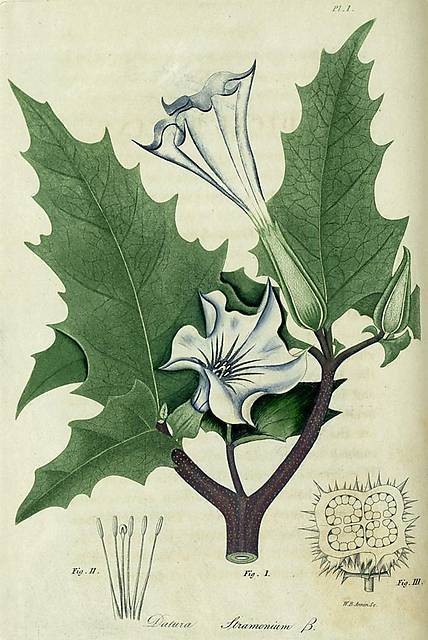
Stramonium
Datura stramonium · Thorn apple, devil’s apple, stinkweed, false castor oil,Datura stramonium · Plant · Solanaceae
People who respond best to Stramonium may experience rage and violence, particularly sudden outbursts accompanied by strong fears. The anger may be rooted in profound fear, following abuse or an accident. The fear may take the form of terror of the dark or of water. Those affected may also manifest hyperactive or overt sexuality. They are prone to stammering, and may have religious delusions, praying and proselytizing incessantly. Sleep may exacerbate symptoms.
Stramonium is prescribed for fevers and chest complaints accompanied by the typical rages and terrors. It is also used, if the characteristic traits are evident, for delirium, tics, convulsions, Parkinson’s disease, epilepsy, and other nervous-system disorders.
The remedy is sometimes prescribed to treat chorea and for some serious psychological problems, such as mania, manic depression, and schizophrenia, particularly if they are accompanied by hallucinations or violence
Key symptoms
- anger accompanied by fear
- fear of the dark
- fear of water
- stammering
- trembling and convulsions
Worse (aggravation)
- Worse in dark and when alone
- Worse at sight of water or anything glittering
- Worse before noon (headache worst until noon)
- Worse from suppressed secretions and excretions
Better (amelioration)
- Better in light and company
- Better from warmth

Thorn-apple
The entire force of this drug seems to be expended on the brain, through the skin and throat show some disturbance. Suppressed secretions and excretions. Sensation as if limbs were separated from body. Delirium tremens. Absence of pain and muscular mobility especially of muscles of expression and of locomotion. Gyratory and graceful motions. Parkinsonism.
Mind
Devout, earnest, beseeching and ceaseless talking. Loquacious, garrulous, laughing, singing, swearing, praying, rhyming. Sees ghosts, hears voices, talks with spirits. Rapid changes from joy to sadness. Violent and lewd. Delusions about his identity; thinks himself tall, double, a part missing. Religious mania. Cannot bear solitude or darkness; must have light and company. Sight of water or anything glittering brings on spasms. Delirium, with desire to escape (Bell; Bry; Rhus).
Head
Raises head frequently from the pillow. Pain in forehead and over eyebrows, beginning at 9 am; worse until noon. Boring pain, preceded by obscure vision. Rush of blood to head; staggers, with tendency to fall forward and to the left. Auditory hallucinations.
Eyes
Seem prominent, staring wide open; pupils dilated. Loss of vision; complains that it is dark, and calls for light. Small objects look large. Parts of the body seem enormously swollen. Strabismus. All objects look black.
Face
Hot, red; circumscribed redness of cheeks. Blood rushes to face; distorted. Expression of terror. Pale face.
Mouth
Dry; dribbling of viscid saliva. Aversion to water. Stammering. Risus sardonicus. Cannot swallow on account of spasm. Chewing motion.
Stomach
Food tastes like straw. Violent thirst. Vomiting of mucus and green bile.
Urine
Suppression, bladder empty.
Male
Sexual erethism, with indecent speech and action. Hands constantly kept on genitals.
Female
Metrorrhagia, with loquacity, singing, praying. Puerperal mania, with characteristic mental symptoms and profuse sweatings. Convulsions after labor.
Sleep
Awaken terrified; screams with fright. Deep snoring sleep. Sleepy, but cannot sleep (Bell).
Extremities
Graceful, rhythmic motions. Convulsions of upper extremities and of isolated groups of muscles. Chorea; spasms partial, constantly changing. Violent pain in left hip. Trembling, twitching of tendons, staggering gait.
Skin
Shining red flash. Effects of suppressed eruption in scarlatina, with delirium, etc.
Fever
Profuse sweat, which does not relieve. Violent fever.
Modalities
Worse, in dark room, when alone, looking at bright or shining objects, after sleep, on swallowing. Better, from bright light, company, warmth.
Relationship
Compare especially: Hyoscy and Bellad. It has less fever than Bellad, but more than Hyos. It causes more functional excitement of the brain, but never approaches the true inflammatory condition of Bellad.
Antidotes: Bellad; Tabac; Nux.
Dose
Thirtieth potency and lower.

Mind
When considering Stram. the idea of violence comes into mind.
One cannot look upon a patient who needs Stram., or who has been poisoned with it, without wondering at the tremendous turmoil, the great upheaval taking place in mind and body.
Full of excitement, rage, everything is tumultuous, violent; the face looks wild, anxious, fearful; the eyes are fixed on a certain object; face flushed, hot raging fever with hot head and cold extremities, violent delirium. In his anxiety he often turns away from the light, wants it dark, is aggravated especially if the light is bright.
High fever with delirium; the heat is so intense that it may be mistaken for Bell., but it is usually a continued fever, only at times remittent, while the intense fever of Bell. is remittent always.

Datura stramonium. Thorn-apple. Jamestown-weed. Stink-weed. (Grows in vicinity of cultivation on rank soil where refuse is deposited in all parts of the world.) N. O. Solanaceæ. Tincture of fresh plant in flower and fruit.
Clinical
Anasarca (after scarlatina). Aphasia. Apoplexy. Burns. Catalepsy. Chordee. Chorea. Delirium tremens. Diaphragmitis. Ecstasy. Enuresis. Epilepsy. Erotomania. Eyes, affections of. Headache; from sun. Hiccough. Hydrophobia. Hysteria. Lochia, offensive. Locomotor ataxy. Mania. Meningitis. Nymphomania. Œsophagus, spasm of. Scarlatina. Stammering. Starting. Strabismus. Sunstroke. Tetanus. Thirst. Tremors. Trismus. Typhus.

Thron Apple (Solanaceae.)
Adapted to: ailments of young plethoric persons (Acon., Bell.); especially children in chorea; mania and fever delirium. Delirium: loquacious, talks all the time, sings, makes verses, raves; simulates Bell. and Hyos., yet differs in degree. The delirium is more furious, the mania more acute, while the congestion, though greater that Hyos., is much less that Bell., never approaching a true inflammation. Disposed to talk continually (Cic., Lach.); incessant and incohorent talking and laughing; praying, beseeching, entreating; with suppressed menses. Desires light and company; cannot bear to be alone (Bis.); worse in the dark and solitude; cannot walk in a dark room. Awakens with a shrinking look, as if afraid of the first object seen. Hallucinations which terrify the patient. Desire to escape, in delirium (Bell., Bry., Op., Rhus). Imagines all sorts of things; that she is double, lying crosswise, etc. (Petr.). Head feels as is scattered about (Bap.). *Eyes wide open, prominent, …

Mind
Excessive loquacity during the menses, face bloated with blood, with tears and prayers and earnest supplications.
Mind
Young men or women who pray, sing or talk so devoutly or constantly as to excite the sympathy of all in the home.
Mind
Disposed to talk continually.
Mind
Mania for light and company; cannot bear to be alone; wants hand held.
Mind
Awakens with a shrinking look as if frightened at the first object seen.
Head
Spasmodic jerking of the head up from the pillow.
Head
Vertigo staggering as if drunk.
General Face
The face is bloated, red with blood.
Sight and Eyes
Eyes wide open, prominent, pupils exceedingly dilated, insensible, with injected conjunctiva or total blindness (Typhus).
-
Attacks of rage with beating and striking.
-
Desire for company and light.
-
Twitches in the face, frowns in the forehead.
-
Difficult deglutition from spasmodic constriction of the throat.
-
The child awaking is frightened at everything it sees, it wants to get away from them.
-
During the chill the head is hot, does not want to be uncovered.
-
Red, hot face with cold feet.
-
Excessive aversion to liquids, water, a mirror, or anything bright. excites convulsions or spasmodic constriction of throat.

Phatak's chapter on Stramonium is available in the app.
Read Phatak in the appClassical texts are in the public domain. Educational reference only — not medical advice.
