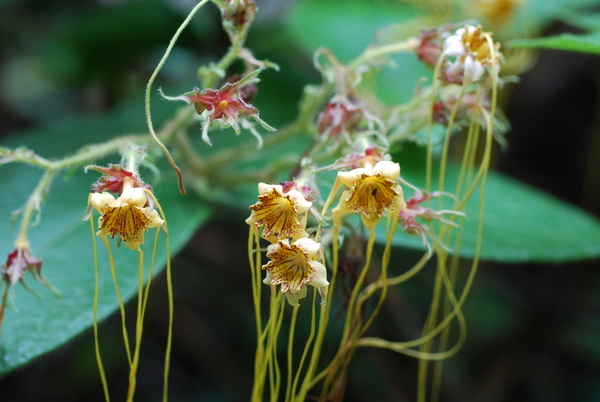
Strophanthus hispidus
Plant · Apocynaceae
Particularly suited to the elderly, corpulent, or debilitated patient with rigid arteries, fatty degeneration of the heart, or failing cardiac compensation. Also indicated in young anemic girls with marked palpitation and breathlessness, and in persons whose heart has been weakened by prolonged use of alcohol, tobacco, or stimulants.
Key symptoms
- Weak, rapid, irregular heart with muscular debility
- Dyspnea especially on ascending or exertion
- Cardiac dropsy and dropsical swelling of extremities
- Nausea with strong aversion to alcohol
- Anemia with palpitation and breathlessness
- Irritable heart from tobacco, alcohol, or tea
- Chronic urticaria, especially after gastric disturbance
- Senile vertigo with temporal pain and double vision
- Mitral regurgitation with supervening edema
Worse (aggravation)
- Exertion and ascending
- Alcohol
- Tobacco
- Tea
- Lying down (cough worse)
Better (amelioration)
- Rest
- Small doses (tones the heart at low potency)

Kombe-seed
Strophanthus is a muscle poison; it increases the contractile power of all striped muscles. Acts on the heart; increasing the systole and diminishes the rapidity. May be used with advantage to tone the heart, and run off dropsical accumulations. In small doses for weak heart; it feels enlarged. In mitral regurgitation, where œdema and dropsy have supervened (Digit). Strophanthus occasions no gastric distress, has no cumulative effects, is a greater diuretic, and is safer for the aged, as it does not affect the vaso-motors. In pneumonia and in severe prostration from hæmorrhage after operations and acute diseases. After the long use of stimulants; irritable heart of tobacco-smokers. Arterio-sclerosis; rigid arteries of aged. Restores tone to a brittle tissue, especially of the heart muscle and valves. Especially useful in failing compensation dependent upon fatty heart. Hives. Anæmia with palpitation and breathlessness. Exophthalmia goitre. Corpulent persons.
Head
Temporal pains with double vision, impaired sight; brilliant eyes, flushed face. Senile vertigo.
Stomach
Nausea with special disgust for alcohol and so aids in treatment of dipsomania. Seven drops of tincture.
Urinary
Increased secretion; scanty and albuminous.
Female
Menorrhagia; uterine hæmorrhage; uterus heavily congested. Aching pain through hips and thighs during climacteric.
Respiratory
Dyspnœa, especially on ascending. Lungs congested. Œdema of lungs. Bronchial and cardiac asthma.
Heart
Pulse quickened. Heart's action weak, rapid irregular, due to muscular debility; and insufficiency. Cardiac pain.
Skin
Urticaria, especially more chronic forms.
Extremities
Swollen, dropsical. Anasarca.
Relationship
Compare: Digit (but is slower than strophant in its action); Phos ac (weak heart, irregular pulse, fluttering sensation in cardiac region, palpitation during sleep, fainting).
Dose
Tincture and 6x potency. In more acute cases, five to ten drops of the tincture three times a day.

Strophanthus hispidus. Inee. Onaye. Onage. Poison of Pahonias. N. O. Apocynaceæ. Tincture of the seeds.
Clinical
Alcoholism. Anæmia. Cough. Diplopia. Dropsy; cardiac. Hæmoptysis. Heart, affections of. Levitation.
Characteristics
Strophanthus is an ornamental, evergreen, climbing shrub, native of Tropical Africa and Asia. It is used as an arrow-poison by natives of Africa. T. R. Fraser experimented with it on animals, and his conclusions are marked (F) in the Schema. Piedvache proved the tincture (C. D. P.), but only with reference to the pulse. His symptoms are marked (P). Gisevius (H. R., xii. 502) proved Strop. Ø, beginning with 5 drops, increasing to 80 drops during the five days of his proving. His symptoms are marked (G). Matthes (ibid. 508) proved Strop. Ø (10 drops), and Strop. 2 (10 drops). His symptoms are marked (M). Some well-marked symptoms were produced on two chemists from preparing the tincture (C. D. P.). Other effects curative and pathogenetic have been observed on patients …

Phatak's chapter on Strophanthus hispidus is available in the app.
Read Phatak in the appClassical texts are in the public domain. Educational reference only — not medical advice.
