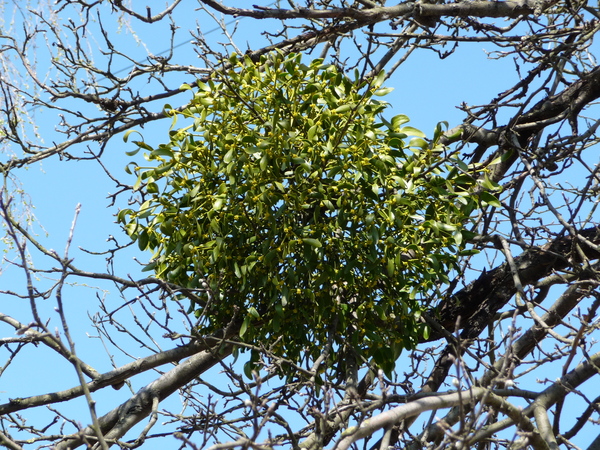
Viscum album
Mistletoe. · Plant · Santalaceae
Fear and detachment from others is typical in those for whom Viscum alb. is most appropriate. They seem to dream constantly, both when awake and asleep, and may talk incoherently. They may be alternately cold and hot.
The classic symptom picture for Viscum alb. is of seizures, tremors, or epilepsy, tearing joint and neuralgic pains, and asthma. It is prescribed for generalized tremors, uncontrollable jerking after a fright, seizures, including “absences,” petit mal, chorea, and epilepsy that begins as a glow radiating from the head to the feet. Attacks may be accompanied by breathing difficulties or asthma, and followed by persistent dizziness and by twitching of the body that causes insomnia.
Neuralgic pains usually treated with Viscum alb. include headaches with a numb, tightening sensation and throbbing in the top of the head, as though the skull is being lifted off the body. Headaches are sometimes accompanied by eye pains, difficulty in opening the eyelids, and crackling noises or deafness in the ears.
Key symptoms
- Rheumatic and gouty complaints with tearing pains
- Lowered blood pressure; slow pulse from vagus irritation
- Sciatica and neuralgia, especially of rheumatic origin
- Asthma connected with gout or rheumatism
- Feeling of suffocation when lying on left side
- Epileptic-like symptoms and petit mal attacks
- Metrorrhagia with pain; blood partly clots and bright red
- Rheumatic deafness; buzzing and stopped-up feeling in ears
Worse (aggravation)
Better (amelioration)

Mistletoe
Lowered blood pressure. Dilated blood vessels but does not act on the centers in the medulla. Pulse is slow due to central irritation of the vagus.
The symptoms point especially to rheumatic and gouty complaints; neuralgia, especially sciatica. Epilepsy, chorea, and metrorrhagia. Rheumatic deafness. Asthma. Spinal pains, due to uterine causes. Rheumatism with tearing pains. Hypertensive albuminuria. Valvular disease, with disturbances in sexual sphere. Symptoms like epileptic aura and petit mal.
Head
Feeling as if whole vault of skull were lifted up. Blue ring around eyes. Double vision. Buzzing and stopped-up feeling in ear. Deafness from cold. Facial muscles in constant agitation. Persistent vertigo.
Respiratory
Dyspnœa; feeling of suffocation when lying on left side. Spasmodic cough. Asthma, if connected with gout or rheumatism. Stertorous breathing.
Female
Hæmorrhage, with pain; blood partly clots and bright red. Climacteric complaints (Lach; Sulph). Pain from sacrum into pelvis, with tearing, shooting pains from above downwards. Retained placenta (Secale). Chronic endometritis. Metrorrhagia. Ovaralgia, especially left.
Heart
Hypertrophy with valvular insufficiency; pulse small and weak; unable to rest in a reclining position. Palpitation during coitus. Low tension. Failing compensation, dyspnœa worse lying on left side. Weight and oppression of heart; as if a hand were squeezing it; tickling sensation about heart.
Extremities
Pains alternate in the knee and ankle with shoulder and elbow. Sciatica. Tearing, shooting pains in both thighs and upper extremities. A glow rises from the feet to the head; seems to be on fire. Periodic pains from sacrum into pelvis, worse in bed, with pains into thighs and upper extremities. General tremor, as if all muscles were in state of fibrillary contraction. Dropsy of extremities. Sensation of a spider crawling over back of hand and foot. Itching all over. Compressing pain in feet.
Modalities
Worse, winter, cold, stormy weather; in bed. Movement; lying on left side.
Relationship
Compare: Secale: Convallar; Bry; Puls; Rhodod. Guipsine -active principle--(exalts the hypotensive properties of Viscum). Hedera Helix-Ivy--(Intercranial pressure).
Dose
Tincture and lower potencies.

Viscum album. Mistletoe. N. O. Loranthaceæ. Tincture of ripe berries. Tincture of bruised leaves. Tincture of whole plant.
Clinical
Aura epileptica. Chorea. Deafness. Dysphagia. Endometritis. Epilepsy. Labour, slow. Levitation. Lumbago. Menorrhagia. Metrorrhagia. Orchitis. Otalgia. Otorrhœa. Ovaritis. Retained placenta. Sciatica. Spleen, pain in. Struma. Throat, sore. Whooping-cough.
Characteristics
In a pamphlet on "Viscum Album" Dr. George Black, of Torquay, has put together most of the facts relating to this plant, including four new provings, by himself and three female provers. The symptoms of these provings I have marked in the Schema─(B) Dr. Black, 43, from 3x and Ø; (B1) Miss F., 20, from 2x and Ø; (B2) Mrs. X., 37 from 3; (B3) Miss S., 27, from 3x, 2x, 1x, and Ø. Proell made a proving of the tincture, and developed symptoms resembling epileptic aura and petit mal, which had the additional epileptic feature of recurrence─they recurred frequently for two years. Belcher gave to a girl, 17, suffering from …

Phatak's chapter on Viscum album is available in the app.
Read Phatak in the appClassical texts are in the public domain. Educational reference only — not medical advice.
