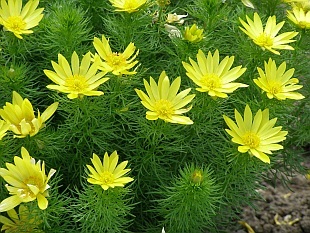
Adonis vernalis
False hellebore, yellow pheasant’s eye. · Plant · Ranunculaceae
People for whom Adonis is suitable tend to be apprehensive and prone to horrible dreams and restless sleep. They generally feel “waterlogged” and uncomfortable.
The classic symptom picture for Adonis is of heart degeneration, perhaps following a bout of severe influenza or rheumatic fever. There may be pain and palpitations in the area around the heart. The heart rhythms may be abnormally rapid or slow and faltering, possibly because of diseased valves or fatty degeneration. Edema (an irregular accumulation of fluid in the body tissues or cavities), which develops as a result of poor circulation and is accompanied by scanty urine, may be treated by Adonis.
The remedy is also used to treat asthma with breathlessness, discomfort, or heart disease. Further symptoms may include headaches that move from the back of the head, around the temples, to the eyes.
Key symptoms
- Heart medicine for fatty degeneration of heart muscle
- Rapid and feeble heart action with droppy conditions
- Regulates pulse and increases force of contractions
- Preæcordial pain, palpitation and dyspnœa
- Mitral and aortic regurgitation
- Cardiac asthma with venous engorgement
- Scanty albuminous urine
- Low vitality with weak and slow pulse
Worse (aggravation)
Better (amelioration)

Pheasant's Eye
A heart medicine, after rheumatism or influenza, or Bright's disease, where the muscles of the heart are in stage of fatty degeneration, regulating the pulse and increasing the power of contractions of heart, with increased urinary secretions. Most valuable in cardiac dropsy. Low vitality, with weak heart and slow, weak pulse. Hydrothorax, ascites. Anasarca.
Head
Feels light; aches across front, from occiput around temples to eyes. Vertigo on rising, turning head quickly or lying down. Tinnitus. Scalp feels tight. Eyes dilated.
Mouth
Slimy. Tongue dirty yellow, sore, feels scalded.
Heart
Mitral and aortic regurgitation. Chronic aortitis, Fatty heart pericarditis. Rheumatic Endocarditis (Kalmia). Preæcordial pain, palpitation, and dyspnœa. Marked venous engorgement. Cardiac asthma (Quebracho). Fatty heart. Myocarditis, irregular cardiac action, constriction and vertigo. Pulse rapid, irregular.
Stomach
Heavy weight. Gnawing hunger. Faint feeling in epigastrium. Better out of doors.
Urine
Oily pellicle on urine. Scanty, albuminous.
Respiratory
Frequent desire to take a long breath. Feeling of weight on chest.
Sleep
Restlessness, with horrible dreams.
Extremities
Aching in nape. Spine stiff and aching. Œdema.
Relationship
Adonidin is a cardiac tonic and diuretic. Quarter grain daily, or two to five grains of first decimal trit increases arterial pressure and prolongs the diastole, favoring emptying engorged veins. Is an excellent substitute for Digitalis and is not cumulative in action.
Compare: Digit; Cratoeg; Conval; Strophanthus.
Dose
Five to ten drops of the tincture.

Adonis vernalis. N. O. Ranunculaceæ. Infusion or tincture of fresh plant; an extract, Adonidin.
Clinical
Albuminuria. Dropsy. Heart, affections of.
Characteristics
Like Convallaria, Adonis is a popular heart remedy in Russia. It has not been proved, but the indications for its use have been defined by experience as follows: Rapid and feeble action of the heart; dropsy; scanty urine with albumen and casts. Valvular disease and cardiac asthma. There is no record of its use in the potencies. Cash gave great relief to "a water-logged patient of seventy-four" with mitral regurgitation, with one-grain doses of Adonidin at eight-hour intervals, after failure of Arsenicum and Digitalis. Urinary secretion rose from half a pint to 2 1/2 pints in twenty-four hours. Breathing was relieved; sleep returned.

Phatak's chapter on Adonis vernalis is available in the app.
Read Phatak in the appClassical texts are in the public domain. Educational reference only — not medical advice.
