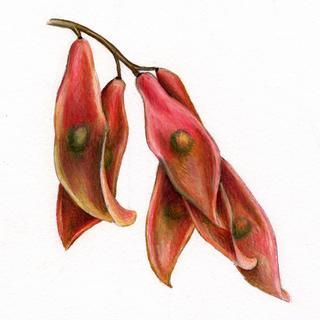
Ailanthus glandulosa
Ailanthus altissima · Tree of heaven, shade tree, Chinese sumac, copal tree,Ailanthus altissima · Plant · Simaroubaceae
Ailanthus is best suited to those who feel extremely weak when ill, and frequently behave in a stupid, dull, and confused way. They may feel anxious, odd, or even crazy. Key symptoms indicating that this remedy is suitable are fevers with great weakness and congestion of the blood, which typically gives the skin a purple, mottled, swollen appearance. Ailanthus is often given for acute bouts of mononucleosis with swollen tonsils and neck glands. Pain extends from the neck glands to the ears on swallowing. The tonsils on the left side are mainly affected, and may develop oozing mucus or ulcers.
Key symptoms
- Livid or purplish skin appearance with patchy irregular eruptions
- Face dark as mahogany, hot, with throat swollen and purple
- Low fevers with stupor, torpor, and general prostration
- Diphtheria and follicular tonsillitis with hemoptysis
- Symptoms resemble malignant scarlatina with adynamia
- Frontal headache with drowsiness and confusion
- Hemorrhagic and ulcerative mucous membranes
Worse (aggravation)
Better (amelioration)

Chinese Sumach
This remedy shows by its peculiar skin symptoms its pronounced power of disorganizing the blood, causing conditions we meet with in low fevers, low types of eruptive diseases, diphtheria, follicular tonsillitis, Streptococcus infection, Hæmorrhagic diathesis, etc. The skin appears livid or purplish; face dark as mahogany, hot; sordes; throat swollen, purple, livid; semi-conscious, delirious; weak pulse, general torpor and prostration. Symptoms remarkably alike to malignant scarlatina. Diarrhœa, dysentery and great weakness are very marked. Adynamia characterizes all its conditions. Lividity, stupor and malignancy. Mucous membranes hæmorrhagic and ulcerative (Lach. Ars).
Head
General stupor, with sighing. Confused mind, mental depression. Headache, frontal, with drowsiness. Passive congestion headaches. Suffused, dilated eyes; photophobia. Face dusky. Thin, copious, ichorous, bloody nasal discharge.
Throat
Inflamed, œdematous, dusky red. Much swelling, internal and external. Dry, rough, scraping, choking feeling. Neck tender and swollen. Hoarse, croupy voice. Tongue dry and brown. Teeth covered with sordes. Pain in swallowing extends to the ears.
Respiratory
Hurried breathing; irregular. Dry, hacking cough. Lungs sore and tired.
Sleep
Drowsy, restless. Heavy, disturbed, unrefreshing.
Skin
Miliary, livid rash, returns annually. Large blisters filled with dark serum. Irregular, patchy, livid eruption, disappearing on pressure. Cold. Raynaud's disease.
Relationship
Antidotes: Rhus; Nux.
Compare: Ammon carb; Bapt; Arn; Mur ac; Lach; Rhus.
Dose
First to sixth potency.

Generalities
This medicine is especially suitable in the low zymotic forms of sickness, such as we find in diphtheria and scarlet fever, in blood poisoning and in symptomatic typhoids, especially those cases that are characterized by capillary congestion in spots, red mottled spots.
Scarlet
Perhaps the most striking manifestation of such a low type of sickness is malignant scarlet fever. The regular rash does not come out, but in its place red spots, roseola-like, make their appearance; the usual uniform spread of the eruption has failed, or has been suppressed, and there is bleeding from the gums and nose, and dreadful tumefaction in the throat.

The Tree of Heaven. (Eastern Asia; cultivated as a shade-tree in North America.) N. O. Simarubaceæ. Tincture from flowers beginning to open.
Clinical
Acne. Cerebro-spinal meningitis. Chancre. Coryza. Diphtheria. Headache. Mumps. Puerperal fever. Rheumatic fever. Scarlatina. Syphilis. Typhoid fever. Typhus fever.
Characteristics
Corresponds to conditions characterised by certain livid or purpled appearances of the skin. Rash coming out in patches. Eruptions which are slow in appearing. Low adynamic forms of disease with extreme prostration, torpor, vomiting. Prostration at the outset of a disease is a leading indication for it. The patient is stupid, dull, delirious, weak. It has proved of signal service in cases of malignant and suppressed scarlatina. The head is burning hot, with piercing pains. The parotid glands are sensitive and enlarged. The attacks are characterised by fulness of head with heat; pains burning, darting in temples and occiput; vertigo and nausea. The rash of Ailanth. often returns …

Mouth and Throat
Throat livid, almost purple, swollen, tonsils prominent and studded with many deep, angry looking ulcers, oozing a scanty fetid discharge; external neck swollen and sensitive (scarlatina).
Skin
Eruptions of miliary rash in patches of dark, almost livid colors, mostly on forehead and face; returns very slowly after disappearing on pressure.
- Malignant scarlatina and other low adynamic forms of disease, characterized by sudden and extreme prostration, stupor, vomiting and purplish appearance of the skin.

Phatak's chapter on Ailanthus glandulosa is available in the app.
Read Phatak in the appClassical texts are in the public domain. Educational reference only — not medical advice.
