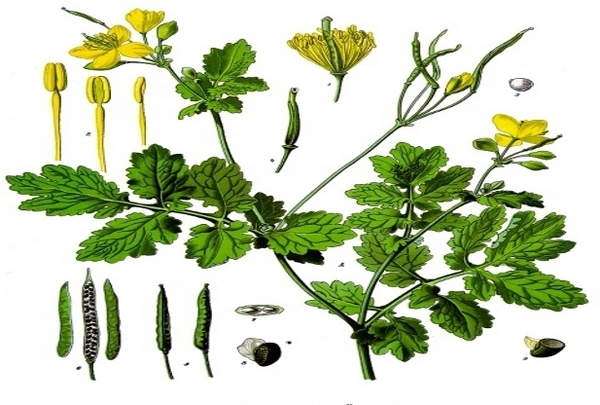
Chelidonium majus
Greater celandine, wartweed, swallow wort · Plant · Papaveraceae
An aggressive, domineering personality is typically linked with Chelidonium. Those who respond well to the remedy tend also to be practical rather than intellectual people who do not like to “waste time” analyzing their emotions. Typical physical symptoms include cravings for hot drinks and cheese. There is a feeling of heaviness, with symptoms tending to be right-sided.
Chelidonium is used mainly for liver conditions, or spleen, kidney, gallbladder, intestine, and lung complaints. It may also be given prior to surgery linked to hepatitis or gallstones.
Key symptoms
- right-sided complaints
- practical, dominant nature
- pain in the right shoulder blade
- liver and gallbladder problems
- person
- feels better for hot drinks and eating
Worse (aggravation)
- Change of weather
- Right side
- Early morning around 4 am
- Motion; touch
- Cold
Better (amelioration)
- Hot food and hot drinks
- Pressure on painful parts
- After dinner; lying on abdomen

Celandine
A prominent liver remedy, covering many of the direct reflex symptoms of diseased conditions of that organ. The jaundiced skin, and especially the constant pain under inferior angle of right scapula, are certain indications. Paralytic drawing and lameness in single parts. The great general lethargy and indisposition to make any effort is also marked. Ailments brought on or renewed by change of weather. Serous effusions. Hydrocele. Bilious complication during gestation.
Head
Icy coldness of occiput from the nape of neck; feels heavy as lead. Heavy, lethargic; drowsiness very marked, with general numbness; vertigo, associated with hepatic disturbance. Inclination to fall forward. Right-sided headache down behind ears and shoulder-blade. Neuralgia over right eye, right cheek-bone and right ear, with excessive lachrymation, preceded by pain in liver.
Nose
Flapping of alæ nasi (Lyc).
Eyes
Dirty yellow color of whites. Sore sensation on looking up. Tears fairly gush out. Orbital neuralgia of right eye, with profuse lachrymation; pupils contracted, relieved by pressure.
Face
Yellow; worse nose and cheeks. Wilted skin.
Stomach
Tongue yellow, with imprint of teeth; large and flabby (Merc; Hyd). Taste bitter, pasty. Bad odor from mouth. Prefers hot food and drink. Nausea, vomiting; better, very hot water. Pain through stomach to back and right shoulder-blade. Gastralgia. Eating relieves temporarily, especially when accompanied with hepatic symptoms.
Abdomen
Jaundice due to hepatic and gall-bladder obstruction. Gall-colic. Distention. Fermentation and sluggish bowels. Constriction across, as by a string. Liver enlarged. Gallstones (Berberis).
Urine
Profuse, foaming, yellow urine, like beer (Chenop) dark, turbid.
Stool
Constipation; stools hard, round balls, like sheep's dung, bright yellow, pasty; clay-colored, stools float in water; alternation of diarrhœa and constipation. Burning and itching of anus (Ratanh; Sulph).
Female
Menses too late and too profuse.
Respiratory
Very quick and short inspirations; pain on deep inspiration. Dyspnœa. Short, exhausting cough; sensation of dust not relieved by cough. Whooping-cough; spasmodic cough; loose, rattling; expectoration difficult. Pain in right side of chest and shoulder, with embarrassed respiration. Small lumps of mucus fly from mouth when coughing. Hoarse in afternoon. Constriction of chest.
Back
Pain in nape. Stiff neck, head drawn to left. Fixed pain under inner and lower angle of right scapula. Pain at lower angle of left scapula.
Extremities
Pain in arms, shoulders, hands, tips of fingers. Icy coldness of tips of fingers; wrists sore, tearing in metacarpal bones. Whole flesh sore to touch. Rheumatic pain in hips and thighs; intolerable pains in heels, as if pinched by too narrow a shoe; worse, right. Feels paralyzed. Paresis of the lower limbs with rigidity of muscles.
Skin
Dry heat of skin; itches, yellow. Painful red pimples and pustules. Old, spreading, offensive ulcers. Wilted skin. Sallow, cold, clammy.
Modalities
Worse, right side, motion, touch, change of weather, very early in morning. Better, after dinner, from pressure.
Relationship
Chelidonin.--(Spasm of smooth muscle everywhere, intestinal colic, uterine colic, bronchial spasm, tachycardia, etc). Boldo-Boldoa fragrans--(Bladder atony; cholecystitis and biliary calculus. Bitter taste, no appetite; constipation, hypochondriasis languor, congestion of liver; burning weight in liver and stomach. Painful hepatic diseases. Disturbed liver following malaria). Elemuy Gauteria--(Stones in kidneys and bladder; grain doses of powdered bark in water or 5 drops of tincture. Pellagra).
Sulph often completes its work.
Complementary: Lycop; Bryon.
Antidote: Chamom.
Compare: Nux; Sulph; Bry; Lyc; Opium; Podophyl; Sanguin; Ars.
Dose
Tincture and lower attenuations.

Chelidonium is a remedy more suitable for acute diseases, though it cures certain chronic conditions. It is not a very deep acting remedy. It is about like Bryoniain its general plane, length and depth of action.
It has been used principally in gastric and intestinal catarrhs, in acute and semi-chronic liver troubles, and in right-sided pneumonia.
Skin
The skin is likely to be sallow, and gradually increases to a marked jaundice in connection with these complaints. Semi-chronic gastritis, with jaundice.
"Gastro-duodenal catarrh.
Congestion and soreness in the liver, with jaundice.
Right-sided pneumonia, complicated with liver troubles, or jaundice."

Chelidonium majus. Greater Celandine. N. O. Papaveraceæ. Tincture of entire fresh plant, at time of flowering.
Clinical
Antrum of Highmore, inflammation of. Cancer. Chest, affections of. Chorea. Constipation. Cough. Diarrhœa. Dyspepsia. Gall-stones. Gonorrhœa. Hæmoptysis. Hæmorrhoids. Headache. Influenza. Jaundice. Lachrymal fistula. Laryngismus. Liver, affections of. Nephritis. Neuralgia. Nose-bleed. Pleurodynia. Pneumonia. Rheumatism. Scald-head. Stiff-neck. Taste, altered. Tumours. Warts. Whooping-cough. Yawning.
Characteristics
Chelidonium is a poppy and therefore allied to Opium and Sanguinaria, with both of which it has many features in common. But its closest analogue is Lycopodium, with which it holds a complementary relation. I have often cured with Chel. when Lyc. was apparently indicated and failed to act well. The juice of Chel. causes vesication when applied to the skin. An extract injected locally in cancer cases has gained a reputation in the old school. The juice is …

Celandine (Papaveraceae)
Persons of light complexion, blondes; thin, spare, irritable; subject to hepatic, gastric and abdominal complaints (Pod.); every age, sex and temperament. Constant pain under the lower and inner angle of right scapula (Kali c., Mer. - under the left, Chenop. g., Sang.). Ailments: brought on or renewed by change of weather (Mer.); all lessen after dinner. Tongue coated thickly yellow, with red edges, showing imprint of teeth (Pod. - large, flabby, with imprint of teeth, Mer.). Desire for very hot drinks, unless almost boiling stomach will not retain them (Ars., Casc.). Periodic orbital neuralgia (right side), with excessive lachrymation; tears fairly gush out (Rhus). Constipation: stool, hard, round balls like sheep's dung (Op., Plumb.); alternate constipation and diarrhoea. Diarrhoea: at night; slimy, ligh-gray; bright-yellowish; brown or white, watery, pasty; involuntary. Face, forehead, nose, cheeks, remarkably yellow. Yellow-gray color of the skin; wilted skin; of the palms …

General Face
Yellow color of the face, especially of forehead, nose, cheeks, and whites of the eyes.
Stomach
All complaints lessen after dinner.
Stomach
Nothing but very hot drinks > the nausea and vomiting.
Abdomen
Pain in the hepatic region and across the umbilicus, as if the abdomen were constricted by a string.
Anus and Stool
Stools thin, fecal, bright yellow, yellow as gold.
Urinary Organs
Urine dark yellow, turbid on passing, dark brownish-red, staining linen or diaper dark yellow.
Neck and Back
Constant pain under lower, inner angle of right scapula.
Generalities
Jaundice when the sclerotic, face, urine, and stool are all very yellow.
-
Constant pain under inferior angle of right scapula. may extend to the chest or stomach.
-
Yellow colour of the face, especially of the forehead, nose, cheeks and white of eyes.

Phatak's chapter on Chelidonium majus is available in the app.
Read Phatak in the appClassical texts are in the public domain. Educational reference only — not medical advice.
