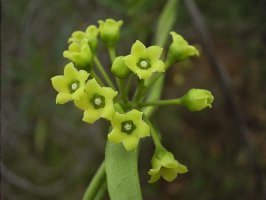
Cundurango
Marsdenia cundurango · Plant · Apocynaceae
Cundurango is suited to cachetic patients with epithelial cancers, particularly of the stomach, breast, tongue, and lips, where painful fissures and cracks at muco-cutaneous junctions are a guiding symptom. Burning and constrictive pains are characteristic. It has also been used in syphilitic and obstinate foul-smelling ulcers when other remedies have failed.
Key symptoms
- Painful cracks in corners of mouth, a keynote for cancer or syphilitic conditions
- Cancer of stomach: constant burning pain, vomiting, food sticks behind sternum
- Cancer of breast with retracted nipple and lancinating radiating pains
- Rhagades at muco-cutaneous orifices: anus, mouth, lips
- Jagged ulcers of tongue, possibly cancerous or syphilitic
- Warty excrescences at muco-cutaneous junctions
- Severe dull headache; cutting pains in left temple and through left eye
- Locomotor ataxia from the active principle Condurangin

Condor Plant (CONDURANGO)
Stimulates the digestive functions and thus improves the general health. Allays the pain in gastralgia accompanying cancer of stomach. Modifies secretions of digestive glands. Varicose ulcers. Lupus.
Painful cracks in corner of mouth is a guiding symptom of this drug. Chronic gastric catarrh, syphilis, and cancer. Tumors; stricture of œsophagus. The active principle (Condurangin) produces locomotor ataxia.
Stomach
Painful affections of the stomach; ulceration. Vomiting of food and indurations, constant burning pain. Stricture of œsophagus, with burning pains behind sternum, where food seems to stick. Vomiting of food, and indurations in left hypochondrium with constant burning pain.
Skin
Fissures form about the muco-cutaneous outlets. Epithelioma of lips or anus. Ulcerative stage of carcinoma cutis when fissures form.
Relationship
Compare: Asterias; Conium; Hydrast; Arsenic.
Dose
Tincture, or bark, 5-grain doses before meals in water. Also the thirtieth potency, in tumors.

Gonolobus cundurango. Condor plant. (High altitudes in Ecuador, S. America.) N. O. Asclepiadaceæ. Tincture and trituration of the dried bark of the stem.
Clinical
Anus, rhagades of. Breast, tumours of. Cancer. Cracks. Epithelioma. Fistula. Headache. Locomotor ataxy. Rodent ulcer. Small-pox. Stomach, affections of. Syphilis. Ulcers.
Characteristics
Cundurango belongs to the "Milk-weed" family, and is thus related to Asclepias Syriaca, and Tuberosa, and also to Calotropis. The action of the latter in syphilitic conditions may be compared with the power of Cundurango over cancer. The Condor plant was introduced into medicine as a cancer remedy by Dr. Bliss, of Washington. Clotar Muller cured with it several cases of "old, obstinate, foul-smelling, ichorous ulcers"; one case of "carcinoma of the lips, an unclean and sinuous ulcer." Burnett, who proved it, and whose symptoms were of a severe nature, observed that it produced "a painful crack in the right corner of the mouth." These cracks he has seen …

Phatak's chapter on Cundurango is available in the app.
Read Phatak in the appClassical texts are in the public domain. Educational reference only — not medical advice.
