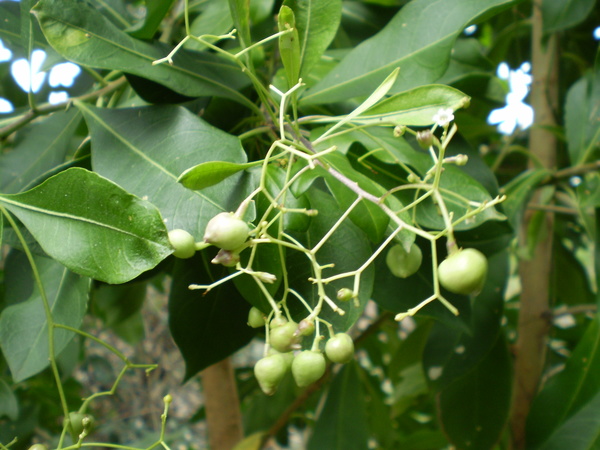
Duboisia myoporoides
Plant · Solanaceae
Duboisia Myoporoides suits individuals with marked nervous system involvement characterized by incoherence, absent-mindedness, and impaired memory combined with profound ocular effects. Tendency to fall backwards when eyes are shut and sensation of stepping on empty space are characteristic. It is palliative in exophthalmic goitre and useful in pharyngitis sicca with black stringy mucus.
Key symptoms
- Dilates the pupil more promptly and strongly than Atropine
- Red spots floating in the field of vision
- Sensation as if stepping on empty space
- Vertigo with pale face, not gastric in origin
- Conjunctivitis acute and chronic with mydriasis
- Paralysis of accommodation with dim vision
- Larynx dry, voice hoarse, phonation difficult
- Loss of power in limbs, staggers, trembling and numbness
- Absent-minded, incoherent, silly, and nonsensical with impaired memory

Corkwood Elm (DUBOISIA)
Acts chiefly on the nervous system, eyes, upper respiratory tract. Recommended in pharyngitis sicca, with black, stringy mucus. It dilates the pupil, dries the mouth, checks perspiration, causes headache and drowsiness. On the eye it acts more promptly than Atropia, much stronger as a mydriatic. Red spots floats in the field of vision. Sensation as if stepping on empty space. Vertigo with pale face; not gastric in origin. Scarlet fever; locomotor ataxia. Palliative in exophthalmic goitre.
Mind
Absent-minded, incoherent, silly and nonsensical, memory impaired.
Head
Impossible to stand with eyes shut, tendency to fall backwards.
Eyes
Conjunctivitis, acute and chronic. Mydriasis. Paralysis of accommodation. Hyperæmia of retina with weakness of accommodation, fundus red, blood-vessels full and tortuous; pupils dilated, with dim vision. Pain over eye, between it and brow.
Respiratory
Larynx dry, voice hoarse, phonation difficult. Dry cough with oppressed breathing.
Extremities
Loss of power in limbs, staggers; feels as if he stepped on empty space. Trembling, numbness and weakness.
Relationship
It antagonizes Muscarine. Duboisin sulphate 1-100 gr sedative in mania. 2-4 milligrams a day. Hystero-epilepsy. Motor restlessness of insane (Has been used as a substitute for Atropia in doses of 1-20 of a grain hypodermically). Antidotes: Morphia; Pilocarp. Compare: Bellad; Stram; Hyos.
Dose
Third to twelfth potency.

Duboisia myoporoides. Corkwood Tree. (Queensland.) N. O. Solanaceæ. Tincture and solution of alkaloid prepared from extract of the leaves.
Clinical
Delirium. Drowsiness. Eyes: dilated pupils. Locomotor ataxy. Mouth, dryness of. Paralysis. Presbyopia. Throat, dryness of. Vertigo. Vision, disorders of.
Characteristics
Duboisia belongs to the same order as Belladonna, and its alkaloid, Sulphate of duboisia, has been used as a substitute for Atropine. Its application to the eye has caused marked constitutional symptoms of fever, delirium, stupor, and dry mouth. A symptom which may prove a keynote is "a red spot floating in the field of vision." Guided by this, C. H. Helfrich cured a case of hyperæmia of optic nerve with Duboisin 3 (N. A. J. H., xiii. 267). Dryness of mucous membranes is very characteristic. Cool feeling in the eyes. Sensation as if stepping on empty space. Feeling of largeness in eyes, in tongue. Inability to stand with the eyes shut gives it a place in locomotor ataxy. It has also been proved.
Sight and Eyes
Complete paralysis of accommodation; could not read at any distance, or look at food while eating on account of pain.
Sight and Eyes
Hyperaemia of retina, and weakness of accommodation.
Classical texts are in the public domain. Educational reference only — not medical advice.
