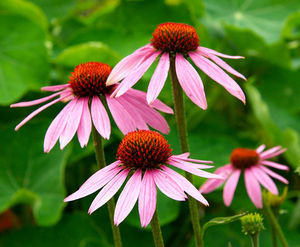
Echinacea angustifolia
Echinacea, coneflower. · Plant · Asteraceae
Echinacea is typically prescribed for its antiseptic properties, to treat abscesses, boils, carbuncles, swollen glands, animal and insect bites and stings, septicemia, and diphtheria. The remedy is also given to treat cancer, especially as an analgesic in the late stages of the illness. Typical physical symptoms include chilliness, tiredness, and weakness, with aching muscles, considerable weight loss, debility, and foul-smelling discharges.
Key symptoms
- Blood poisoning and septic conditions; corrector of blood dyscrasia
- Boils, erysipelas, gangrene, and foul ulcers with malignant tendency
- Foul discharges with emaciation and great debility
- Lymphatic inflammation; snake bites and venomous stings
- Tonsils purple or black with gray exudation extending to air passages
- Gums recede and bleed; corners of mouth crack; tongue dry and swollen
- Profound prostration with periodic flushing of face and dizziness
- Puerperal infections; cerebro-spinal meningitis
- Tired feeling; last stages of cancer to ease pain
Worse (aggravation)
Better (amelioration)

Purple Cone-flower (ECHINACEA - RUDBECKIA)
We are indebted to the Eclectic school for this remarkable medicine as a "corrector of blood dyscrasia". Acute auto-infection. Symptoms of blood poisoning, septic conditions generally. Diarrhœa in typhoid. Gonorrhœa. Boils. Erysipelas and foul ulcers. Gangrene. Goitre with exophthalmic symptoms; full doses, also injecting 5-10 drops into thyroid gland. Tendency to malignancy in acute and subacute disorders. Last stages of cancer to ease pain. Venom infection. Cerebro-spinal meningitis. Puerperal infections. Tired feeling. Piles. Pustules. Acts on vermiform appendix thus has been used for appendicitis, but remember it promotes suppuration and a neglected appendicitis with pus formation would probably rupture sooner under its use. Lymphatic inflammation; crushing injuries. Snake bites and bites and stings generally. Foul discharges with emaciation and great debility.
Head
Confused, depressed. Aches with a peculiar periodical flushing of the face, even to the neck; dizziness and profound prostration.
Nose
Foul-smelling discharge, membranous formations protruding. Post-nasal catarrh with ulceration and fetor. Nose feels stuffed up. Right nostril raw, bleeding.
Mouth
Canker; gums recede and bleed easily; corners of mouth and lips crack; tongue dry and swollen; sores; dirty brownish. Tongue, lips, and fauces tingle, with sense of fear about heart (Acon). White coating of tongue, with red edges. Promotes the flow of saliva.
Throat
Tonsils purple or black, gray exudation extending to posterior nares and air-passages. Ulcerated sore throat.
Stomach
Sour belching and heartburn. Nausea; better lying down.
Chest
Pain as of a lump in chest and under sternum. Pain in pectoral muscles (Aristolochia).
Urine
Albuminous, scanty, frequent, and involuntary.
Female
Puerperal septicæmia; discharges suppressed; abdomen sensitive and tympanitic; offensive, excoriating leucorrhœa.
Extremities
Aching in limbs and general lassitude.
Skin
Recurring boils. Carbuncles. Irritations from insect bites and poisonous plants. Lymphatics enlarged. Old tibial ulcers. Gangrene.
Fever
Chilliness, with nausea. Cold flashes all over back. Malarial fever.
Relationship
Compare: Cenchris contortrix; Bothrops; Ars; Laches; Baptis; Rhus; Cistus; Hepar; Calendula.
Dose
Tincture, one to ten drops, every two hours, and larger doses.
Locally, as a cleansing and antiseptic wash.

(Echinacea angustifolia is the Western species of E.; not to be confounded with E. purpurea, or Black Sampson, the Eastern species.) N. O. Compositæ, allied to Rudbeckia. Tincture of whole fresh plant.
Clinical
Appendicitis. Bites of rabid animals. Blood-poisoning. Carbuncles. Diphtheria. Enteric Fever. Gangrene. Poisoned wounds. Pyæmia. Rhus-poisoning. Scarlatina. Septicæmia. Snake-bites. Struma. Syphilis. Typhoid. Ulcers. Vaccination, effects of.
Characteristics
Echinacea angustifolia has long been prized by eclectics in low typhoid conditions, diphtheria, malignant scarlatina, carbuncles and boils, and as a remedy in snake-bites. A remarkable case of vaccinal poisoning is recorded (H. R., x. 527) in a man, 45, cured mainly by Echin. in 20-drop doses. The symptoms were: vitality ebbed; he became so weak he could not sit up; hair fell out; an eruption of psoriasis appeared on extremities extending to body. The disease advanced rapidly; the nails fell off. Left iritis supervened, and then keratitis …

Phatak's chapter on Echinacea angustifolia is available in the app.
Read Phatak in the appClassical texts are in the public domain. Educational reference only — not medical advice.
