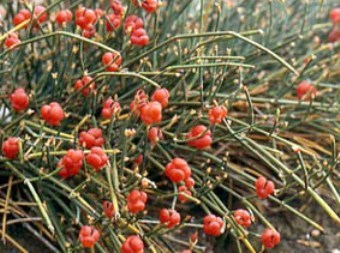
Ephedra vulgaris
Ephedra distachya · Plant · Ephedraceae
Ephedra Vulgaris suits individuals with exophthalmic goitre symptoms, profound apathy, and stiff neck with backward body pulling when turning the head. It acts on the sympathetic nervous system ganglia causing congestion of the spinal cord. The remedy has been considered for Graves disease-like conditions.
Key symptoms
- Extreme apathy
- Stiff neck with backward pulling of whole body on turning the head
- Starting of the eyes from their orbits as if pushed out
- Violent headache with nausea and general weakness
- Left-sided hemicrania with numbness of entire left arm
- Dull pain in region of spleen
- Retention of urine from early morning fatigue

E. vulgaris. N. O. Gnetaceæ. Tincture of branches and flowers.
Clinical
Exophthalmic goître. Headache.
Characteristics
Ephedra has been proved in Russia by Dr. B. H. Mouravow (Universal Homœopathic Annual, p. 56). It produced symptoms when twenty drops of a strong alcoholic extract were taken five times a day; fifteen drops four times a day having been taken without apparent effect. Extreme apathy was produced, stiff-neck, and backward pulling of whole body on turning the head. There was also starting of the eyes from the orbits as if pushed out. This suggested exophthalmic goître to Mouravow, who considered that the drug acted on the ganglions of the sympathetic nerve, and caused congestion of the spinal cord.
Classical texts are in the public domain. Educational reference only — not medical advice.
