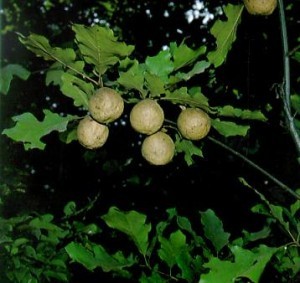
Gallicum acidum
Gallic acid · Plant · Fagaceae
Gallicum Acidum is suited to debilitated individuals with hemorrhagic tendencies, particularly pulmonary hemorrhage and passive bleeding from relaxed capillaries. The remedy is valuable in phthisis where it checks morbid secretions and night sweats while improving appetite and tone. Patients tend to have extreme prostration, wild nocturnal delirium, and urinary and respiratory complaints.
Key symptoms
- Passive hemorrhages when pulse is feeble and capillaries relaxed with cold skin
- Pulmonary hemorrhage with excessive expectoration
- Wild delirium at night with restlessness and rude behavior
- Pain in back of head and neck with thick stringy nasal discharge
- Kidney pain with distress along ureters into bladder
- Urine loaded with thick cream-colored mucus
- Chronic mucous discharges from rectum

Gallic Acid
Should be remembered as a remedy in phthisis. It checks the morbid secretions, gives tone to the stomach, and increases the appetite. Passive hæmorrhages when pulse is feeble and capillaries relaxed, cold skin. Hæmaturia. Hæmophilia. Itching of skin. Pyrosis.
Mind
Wild delirium at night; very restless, jumps out of bed; sweats; is afraid to be alone; is rude and abuses every one.
Head
Pain in back of head and neck. Thick, stringy discharge from nose; photophobia with burning of lids.
Respiratory
Pain in lungs; pulmonary hæmorrhage; excessive expectoration. Much mucus in throat in the morning. Dry at night.
Urinary
Kidneys painful, distress along ureters into bladder. Dull heavy pain in bladder, directly over pubis. Urine loaded with thick, cream-colored mucus.
Rectum
Copious stool; anus feels constricted. Faint feeling after stool. Chronic mucous discharges.
Relationship
Compare: Ars; Iod; Phos.
Dose
First trituration and pure acid 2 to 5 grain doses.

Gallic Acid. C7 H6 O5. Trituration.
Clinical
Asthma. Constipation. Debility. Delirium. Hæmorrhages. Phthisis. Urticaria.
Characteristics
Gallic acid is the well-known astringent, derivative of Tannic acid, obtained from galls or oak-apples. It is used in old-school practice as a local application to arrest hæmorrhages. A case is recorded (H. W., xxviii. 502) in which the application of an ointment containing Gallic acid, or the insertion of a tannin suppository for piles, caused an attack resembling hay-asthma, with an eruption of urticaria. The experience was repeated several times before the cause was found out. This is sufficient to show that Gall. ac. is truly homœopathic to pulmonary cases, in which it has been largely used by the old school as well as the new. In pulmonary hæmorrhage, and in the excessive expectoration and the night-sweats of phthisis it has been found of especial service. Marcy, of New York, has recorded the case of a young lady who had a cavity in the left lung, with copious …
Classical texts are in the public domain. Educational reference only — not medical advice.
