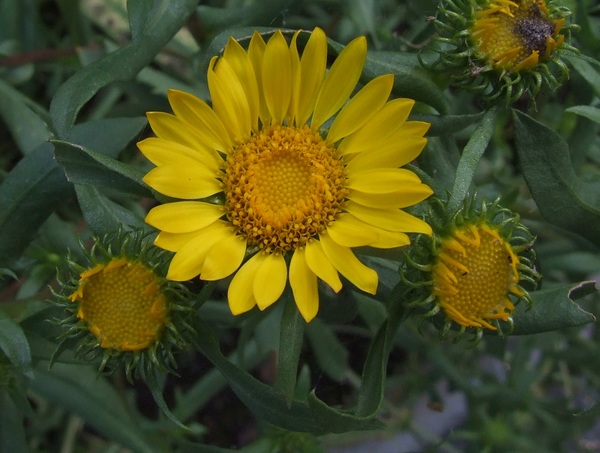
Grindelia robusta
Plant · Asteraceae
Suited to patients with chronic bronchitis and asthmatic conditions characterized by profuse, tough mucus that is very difficult to detach but brings relief when expectorated. The distinctive feature is smothering or cessation of breathing on falling asleep, requiring the patient to sit upright. Cheyne-Stokes respiration and weak cardiac function accompany the respiratory symptoms.
Key symptoms
- Stops breathing when falling asleep; wakes with a start gasping for breath
- Must sit up to breathe; cannot breathe when lying down
- Asthma with profuse tenacious expectoration which relieves
- Bronchorrhoea with tough, whitish, foamy mucus very difficult to detach
- Wheezing and oppression with disseminated sibilant rales
- Cheyne-Stokes respiration; weak heart and respiration
- Nausea and retching of gastric ulcer; sugar in urine
- Smothering after falling asleep in asthmatic and bronchitic patients
Worse (aggravation)
- Worse lying down (breathing difficulty)
- Worse on falling asleep (smothering, stops breathing)
Better (amelioration)
- Better sitting up to breathe
- Better after expectorating the tenacious mucus

Rosin-wood (GRINDELIA)
Both Grindelia robusta and Grindelia squarrosa have been used for the symptoms here recorded. There is practically no difference in their action, although the G. Squarrosa is credited with more splenic symptoms, dull pains and fullness in left hypochondrium; chronic malaria; gastric pains associated with splenic congestion. Induces paralysis, beginning in extremities Its action is shown on the heart first quickening, then retarding it.
Acts on the cardio-pulmonary distribution of the pneumo-gastric in dry catarrh (Tart Emetic in muco-purulent). Produces a paresis of the pneumo-gastric, interfering with respiration. Smothering after falling asleep. Asthmatic conditions, chronic bronchitis. Bronchorrhœa with tough mucus, difficult to detach. Raises the blood pressure. Nausea and retching of gastric ulcer. Sugar in urine. An effective antidote to Rhus-poisoning, locally and internally; also for burns, blisters, vaginal catarrh and herpes zoster. Hyperchlorhydria when attended with asthmatic and other neurotic symptoms. Hyperæmia of gastric mucous membrane with difficult respiration.
Head
Feels full, as from quinine. Pain in eyeballs, running back to brain; worse, moving eyes. Pupils dilated. Purulent ophthalmia and iritis.
Respiratory
An efficacious remedy for wheezing and oppression in bronchitic patients. The sibilant rales are disseminated with foamy mucus, very difficult to detach. Acts on the pulmonary circulation. Asthma, with profuse tenacious expectoration, which relieves. Stops breathing when falling asleep; wakes with a star, and gasps for breath. Must sit up to breathe. Cannot breathe when lying down. Pertussis, with profuse mucous secretion (Coccus). Bronchorrhœa, with tough, whitish, mucous expectoration. Sibilant rales. Weak heart and respiration. Cannot breathe lying down. Cheyne-Stokes respiration.
Spleen
Cutting pain in region of spleen, extending to hips. Spleen enlarged (Ceanoth; Carduus).
Skin
Rash, like roseola, with severe burning and itching. Vesicular and papular eruptions. Herpes zoster. Itching and burning. Poison oak (locally as a wash). Ulcers, with swollen, purplish skin.
Relationship
Compare: Tart-emet. Eriodictyon; Lach; Sanguinar.
Dose
Tincture in 1 to 15 drop doses, also lower potencies.

Grindelia robusta and Grindelia squarrosa. N. O. Compositæ. The Grindeliæ are a genus of asteroid composites growing on the Pacific coast and inland on the mountains. The terminal heads of yellow flowers and the leaves are usually covered with a viscid balsamic secretion, from which they have been called "gum plants." A tincture is made of the leaves and unexpanded flowers. Bundy's proving of G. squarrosa was made with a tincture of the dried plant.
Clinical
Asthma. Bites. Bronchitis. Cheyne-Stokes breathing. Conjunctivitis. Emphysema. Erythema. Eyes, pains in. Glaucoma. Heart, affections of. Iritis. Itching. Liver, pain in. Pruritus vulvæ. Pruritus vaginæ. Rhus-poisoning. Spleen, pain in. Ulcers.

Respiratory Organs
Bronchitis with heart trouble, loses his breath on falling asleep.
Heart and Pulse
Weak heart; on falling asleep breath stops, and he awakens suffocated; is afraid to go to sleep on this account.

Phatak's chapter on Grindelia robusta is available in the app.
Read Phatak in the appClassical texts are in the public domain. Educational reference only — not medical advice.
