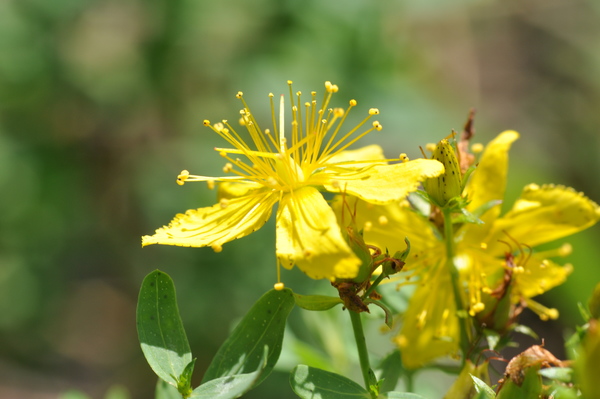
Hypericum perforatum
St. John’s-wort. · Plant · Hypericaceae
Hypericum is prescribed for people who are depressed, frightened, or shocked following an injury or accident. They may be nervous, overexcited, constantly drowsy, talk while asleep, and forgetful when speaking. These people may also experience a constant sensation of elevation or falling.
Key physical symptoms associated with this remedy are injuries or wounds that feel more painful than they appear, with extremely sharp pains, perhaps in nerve-rich areas such as the fingertips or the base of the spine. The remedy may be used to relieve pain following operations, accidents, puncture wounds, and animal bites, and is also given to help prevent tetanus. Nervous pains in phantom limbs after amputation, and toothaches or discomfort after dental treatment, may also be helped by the remedy.
Key symptoms
- Great remedy for nerve injuries, especially fingers, toes, and nails
- Excessive painfulness following injuries is a guiding symptom
- Crushed fingertips with shooting pains upward
- Punctured wounds; prevents tetanus and lockjaw
- Neuritis with tingling, burning, and numbness
- Coccydynia; pain after falls on the coccyx
- Haemorrhoids with pain, bleeding, and tenderness
- Spasms after every injury; spasmodic asthmatic attacks
- Throbbing in vertex worse in close room
- Pressure over sacrum; spinal concussion
Worse (aggravation)
Better (amelioration)

St. John's-wort (HYPERICUM)
The great remedy for injuries to nerves, especially of fingers, toes and nails. Crushed fingers, especially tips. Excessive painfulness is a guiding symptom to its use. Prevents lockjaw. Punctured wounds. Relieves pain after operations. Quite supersedes the use of Morphia after operations (Helmuth). Spasms after every injury. Has an important action on the rectum; hæmorrhoids. Coccydynia. Spasmodic asthmatic attacks with changes of weather or before storms, better by copious expectoration. Injured nerves from bites of animals. Tetanus. Neuritis, tingling, burning and numbness. Constant drowsiness.
Mind
Feels as if lifted high in air, or anxiety lest he fall from heights. Mistakes in writing. Effects of shock. Melancholy.
Head
Heavy; feels as if touched by an icy cold hand. Throbbing in vertex; worse in close room. Brain seems compressed. Right side of face aches. Brain-fag and neurasthenia. Facial neuralgia and toothache of a pulling, tearing character, with sadness. Head feels longer-elongated to a point. In fractured skull, bone splinters. Brain feels alive. Pains in eyes and ears. Falling out of hair.
Stomach
Craving for wine. Thirst; Nausea. Tongue coated white at base, tip clean. Feeling of lump in stomach (Abies nig; Bry).
Rectum
Urging, dry, dull, pressing pain. Hæmorrhoids, with pain, bleeding, and tenderness.
Back
Pain in nape of neck. Pressure over sacrum. Spinal concussion. Coccyx injury from fall, with pain radiating up spine and down limbs. Jerking and twitching of muscles.
Extremities
Darting pain in shoulders. Pressure along ulnar side of arm. Cramp in calves. Pain in toes and fingers, especially in tips. Crawling in hand and feet. Lancinating pain in upper and lower limbs. Neuritis, with tingling, burning pain, numbness and flossy skin. Joints feel bruised. Hysterical joints. Tetanus (Physost; Kali brom). Traumatic neuralgia and neuritis.
Respiratory
Asthma worse foggy weather and relieved by profuse perspiration.
Skin
Hyperidrosis, sweating of scalp, worse in morning after sleep; falling of hair from injury; eczema of hands and face, intense itching, eruption seems to be under the skin. Herpes zoster. Old ulcers or sores in mouth when very sensitive. Lacerated wounds with much prostration from loss of blood.
Modalities
Worse, in cold; dampness; in a fog; in close room; least exposure; touch. Better, bending head backward.
Relationship
Compare: Ledum (punched wounds and bites of animals); Arnica; Staphis; Calend; Ruta; Coff.
Antidotes: Ars; Cham.
Dose
Tincture, to third potency.
One who makes a study of the proving of Hypericum will be reminded of a class of injuries involving sentient nerves and it is not surprising that this remedy has come into use for the results of such injuries.
Injuries
The surgery of Homeopathy largely involves the use of Arnica, Rhus tox., Ledum, Staphysagria, Calcarea and Hypericum. These remedies are used in a routine way when a physician runs into semi-surgical conditions, or the results of injuries.
For the bruised, "black-and-blue," sore appearance and sensation Arnicacomes into use it corresponds especially to the acute stage until the soreness and bruised condition have disappeared from the parts injured or from the whole body; but for the strains of muscles and tendons Arnicaproves insufficient and a thorough study of Rhuswill show that that remedy is suitable for the resultant weakness of tendons and muscles, and the bruised, rheumatic feelings that come on in every storm and often wear off on continued motion.

Hypericum perforatum, H. perfoliatum. St. John's Wort. N. O. Hypericaceæ. Tincture of whole fresh plant.
Clinical
After-pains. Asthma. Bites. Brachial neuralgia. Breast, affections of. Brain, concussion of. Bruises. Bunions. Compound fractures. Corns. Coxalgia. Diarrhœa. Gunshot wounds. Hæmorrhoids. Headache. Hydrophobia. Hypersensitiveness. Impotence. Labour, effects of. Meningitis. Mind, affections of. Neuralgia. Operations, effects of. Panaritium. Paralysis. Rheumatism. Scars. Sciatica. Spastic paralysis. Spinal concussion. Spinal irritation. Stiff-neck. Tetanus. Ulceration. Whooping-cough. Wounds.
Characteristics
The leaves of various species of Hypericum are sprinkled with pellucid dots and black glands which contain an essential oil. These, which are most conspicuous in H. perforatum, have evidently given the signature which has led to the chief use of the plant in medicine, namely, as a remedy for wounds or perforations of the integuments. The leaves, moreover, are lance-shaped. The leaves of …
St. Johns Wort (Hypericaceae)
Mechanical injuries of spinal cord; bad effects of spinal concussion; pains, after a fall on coccyx. Punctured, incised or lacerated wounds; sore, painful (Led. - contused wounds, Arn., Ham.), especially if of long duration. Injuries: from treading on nails, needles, pins, splinters (Led.); from rat-bites; prevents lock-jaw. Preserves integrity of torn and lacerated members when almost entirely separated from body (Calend.). Injury to parts rich in sentient nerves - fingers, toes, matrices of nails, palms or soles - where the intolerable pains shows nerves are severely involved; of tissues of animal life, as hands and feet. Nervous depression following wounds or surgical operations; removes bad effects of shock, of fright, of mesmerism. Always modifies and sometimes arrests ulceration and sloughing (Calend.). Crushed, mashed finger-tips. Tetanus after traumatic injuries (compare, Phys.). Vertigo: sensation as if head became suddenly elongated; at night, with urging to urinate. …

Phatak's chapter on Hypericum perforatum is available in the app.
Read Phatak in the appClassical texts are in the public domain. Educational reference only — not medical advice.
