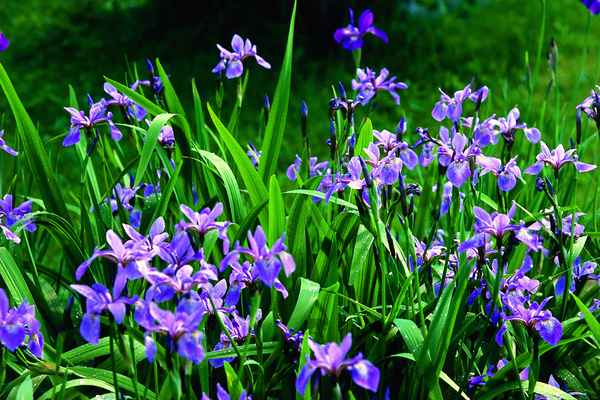
Iris versicolor
Blue flag, snake lily. · Plant · Iridaceae
The mood of people who respond best to Iris is generally low. They often feel restless and discouraged.
Key symptoms related to the remedy are headaches and migraines accompanied by digestive disorders such as nausea, severe diarrhea, or cholera. Warning signals that precede a migraine include great exhaustion and blurring or loss of vision. Migraines are typically right-sided but may alternate from side to side. They usually center in the temple or around the eyes, and involve throbbing pain, severe nausea, vomiting, and profuse salivation. The head pain is typically aggravated by vomiting and is typically weekly.
Key symptoms
- Sick headache beginning with blur before eyes after mental strain
- Burning of the entire alimentary canal
- Vomiting sour, bloody, or biliary matter
- Profuse ropy flow of saliva with nausea
- Periodic diarrhoea at night with green discharges
- Scalp feels constricted; right temples especially affected
- Roaring, buzzing, ringing in ears with deafness
- Pancreas and salivary glands especially affected
- Shifting sciatica as if left hip-joint wrenched
- Liver sore; cutting pain with flatulent colic
Worse (aggravation)
Better (amelioration)

Blue Flag
Thyroid, pancreas, salivary, intestinal glands, and gastro-intestinal mucous membrane, are especially affected. Increases the flow of bile. Sick headaches and cholera morbus are a special therapeutic field for its action.
Head
Frontal headache, with nausea. Scalp feels constricted. Right temples especially affected. Sick headache, worse rest; begins with a blur before eyes, after relaxing from a mental strain. Pustular eruption on scalp.
Ears
Roaring, buzzing, ringing in ears, with deafness. Aural vertigo, with intense noises in ears.
Face
Neuralgia after breakfast, beginning in infra-orbital nerve, and involving whole face.
Throat
Mouth and tongue feel scalded. Heat and smarting in throat. Burning. Profuse flow of saliva; ropy. Goitre.
Stomach
Burning of whole alimentary canal. Vomiting, sour bloody, biliary. Nausea. Profuse flow of saliva (Merc; Ipec; Kali iod). Deficient appetite.
Abdomen
Liver sore. Cutting pain. Flatulent colic. Diarrhœa; stools watery, with burning at anus and through intestinal canal. Periodical night diarrhœa, with pain and green discharges. Constipation (give 30th)
Extremities
Shifting pains. Sciatica, as if left hip-joint were wrenched. Pain extends to popliteal space. Gonorrhœal rheumatism (use Irisin).
Skin
Herpes zoster, associated with gastric derangements. Pustular eruptions. Psoriasis; irregular patches with shining scales. Eczema, with nightly itching.
Modalities
Worse, in evening and at night, from rest. Better, from continued motion.
Relationship
Antidote: Nux.
Compare: Iris florentina-Orris-root--(delirium, convulsions, and paralysis); Iris factissima (headache and hernia); Iris germanica-Blue Garden Iris--(dropsy and freckles); Iris tenax-I. minor--(dry mouth; deathly sensation at point of stomach, pain in ileo-cæcal region; appendicitis. Pain from adhesions after). Pancreatinum-a combination of several enzymes--(Indicated in intestinal indigestion; pain an hour or more after eating. Lienteric diarrhœa. Dose.--3-5 grains, better not given during the active period of stomachic digestion). Pepsinum--(Imperfect digestion with pain in gastric region. Marasmus of children who are fed on artificial foods. Diarrhœa due to indigestion. Dose.--3-4 grains) (Diseases of pancreas, gout, diabetes); Ipec; Podoph; Sanguin; Ars; Ant cr.
Dose
Tincture to thirtieth potency. Favorable reports from the very highest potencies.

Iris hexagona. Blue flag. N. O. Iridaceæ. Tincture of fresh root collected in early spring or autumn. Trituration of the resinoid, Iridin or Irisin.
Clinical
Anus, fissure of. Bilious attack. Constipation. Crusta lactea. Diabetes (pancreatic). Diarrhœa. Dysentery. Dysmenorrhœa. Dyspepsia. Eczema. Fistula. Gastrodynia, intermittent. Headache. Impetigo. Liver, affections of. Migraine. Neuralgia. Nocturnal emissions. Pancreas, affections of. Parotid glands, affections of. Pregnancy, morning sickness of. Psoriasis. Rectum, burning in. Rheumatism. Salivation. Sciatica. Vomiting. Whitlow. Zoster.
Characteristics
The Blue Flag is in great repute as a remedy among the Indians of North America. It was introduced into homœopathic practice by Kitchen, of Philadelphia, by whom it was proved, as well as by that heroic prover, Burt, and others, of all of whose experiences Hale gives an excellent account. I will relate one of Burt's experiments. "May 18th.─Took forty grains of the green root; fifteen minutes after, …
-
Sick headache, resulting from gastrohepatic derangement; dull, heavy, or throbbing headache, with vomiting of food and bile.
-
Mouth and tongue feel as though they had been scalded.

Phatak's chapter on Iris versicolor is available in the app.
Read Phatak in the appClassical texts are in the public domain. Educational reference only — not medical advice.
