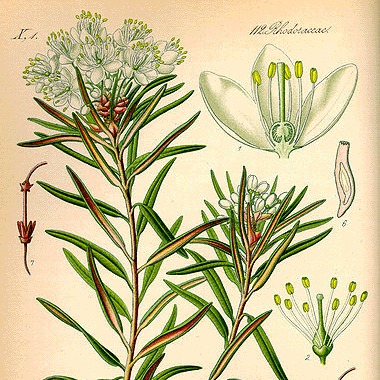
Ledum palustre
Rhododendron tomentosum (syn. Ledum palustre) · Marsh tea, wild rosemary. · Plant · Ericaceae
Those who respond best to Ledum have a tendency to be angry, dissatisfied, anxious, antisocial, or even demented when ill.
Ledum is best known as a first-aid remedy for cuts, grazes, puncture wounds, insect stings, and black eyes and other eye injuries. It is used to prevent infection in open wounds, especially in severe wounds with bruising, puffy, purplish skin, and stinging pains. It may help treat a slow-healing black eye. Ledum is also used for bleeding into the eye chamber after an iridectomy (removal of part of the iris). Other symptoms treated with Ledum include rheumatic pains that arise in the feet and move upward, and stiff, painful joints that feel hot inside despite being cold to the touch. The pain may be relieved by cold compresses.
Key symptoms
- Rheumatism begins in feet and travels upward
- Punctured wounds from sharp instruments or animal bites
- Wounded parts feel cold; general lack of animal heat
- Heat of bed intolerable despite feeling cold
- Extravasation of blood in eyes from contused wounds
- Red pimples on forehead and cheeks; stinging when touched
- Anal fissures; haemoptysis alternating with rheumatism
- Antidote to insect stings and poison-oak eruption
Worse (aggravation)
Better (amelioration)

Marsh-Tea (LEDUM)
Affects especially the rheumatic diathesis, going through all the changes, from functional pain to altered secretions and deposits of solid, earthy matter in the tissues. The Ledum rheumatism begins in feet, and travels upward. It affects also the skin, producing an eruption like Poison-oak, and is antidotal thereto, as well as to stings of insects. There is a general lack of animal heat, and yet heat of bed is intolerable. For punctured wounds, produced by sharp-pointed instruments or bites particularly if the wounded parts are cold, this is the remedy. Tetanus with twitching of muscles near wound.
Head
Vertigo when walking, with tendency to fall to one side. Distress when head is covered. Nosebleed (Mellilot; Bry).
Eyes
Aching in eyes. Extravasation of blood in lids, conjunctiva, aqueous or vitreous. Contused wounds. Cataract with gout.
Face
Red pimples on forehead and cheeks; stinging when touched. Crusty eruption around nose and mouth.
Mouth
Dry, retching with eructation. Musty taste with catarrhal affection.
Respiratory
Burning in nose. Cough, with bloody expectoration. Dyspnœa; chest feels constricted. Suffocative arrest of breathing. Pain along trachea. Bronchitis with emphysema of aged. Oppressive constriction of chest. Tickling in larynx; spasmodic cough. Hæmoptysis, alternating with rheumatism. Chest hurts when touched. Whooping-cough; spasmodic, double inspiration with sobbing.
Rectum
Anal fissures. Hæmorrhoidal pain.
Extremities
Gouty pains shoot all through the foot and limb, and in joints, but especially small joints. Swollen, hot, pale. Throbbing in right shoulder. Pressure in shoulder, worse motion. Cracking in joints; worse, warmth of bed. Gouty nodosities. Ball of great to swollen (Bothrops). Rheumatism begins in lower limbs and ascends (Kalmia opposite). Ankles swollen. Soles painful, can hardly step on them (Ant c; Lyc). Easy spraining of ankle.
Fever
Coldness, want of animal heat. Sensation as of cold water over parts; general coldness with heat of face.
Skin
Acne on forehead, sticking pain therein. Eczema (facial). Itching of feet and ankles; worse, scratching and warmth of bed. Ecchymosis. Long discoloration after injuries. Carbuncles (Anthracin. Tarant cuben). Antidote to Rhus poisoning (Grindel; Cyprip; Anac).
Modalities
Better, from cold, putting feet in cold water. Worse, at night, and from heat of bed.
Relationship
Compare: Ledum antidotes spider poisons. Ruta; Ham; Bellis; Arnica.
Dose
Third to thirtieth potency.

Surgeon
This remedy comes up well after the study of Lachesis, for we find in the pathogenesis many features similar to those in Lachesis.
It has the mottled aspect and the same puffed and bloated appearance of the face. It is antidotal to Lachesis, to the poison of insects, to the poison of Apis and to animal poisons.
Ledum is a remedy for the surgeon, and is closely associated in traumatism with Arnicaand Hypericum. The symptoms very much resemble such as follow certain kinds of injury, for instance an injury from stepping on tacks, from puncturing with needles, wounds that bleed scantily but are followed by pain, puffiness and coldness of the part.

Ledum palustre. Wild Rosemary. Marsh Cistus. Marsh Tea. Labrador Tea. N. O. Ericaceæ. Tincture of dried small twigs and leaves collected after flowering begins. Tincture of whole fresh plant.
Clinical
Ascites. Asthma. Bites. Black-eye. Boils. Bruises. Deafness. Ear, inflammation of. Eczema. Erythema nodosum. Face, pimples on. Feet, pains in; tender. Gout. Hæmoptysis. Hands, pains in. Intoxication. Joints, affections of, cracking in. Ménière's disease. Pediculosis. Priapism. Prickly heat. Punctured wounds. Rheumatism. Skin, eruptions on. Stings. Tetanus. Tinnitus. Tuberculosis. Varicella. Whitlow. Wounds.
Characteristics
In the preface to his proving of Ledum Hahnemann says it "is suitable for the most part only for chronic maladies in which there is a predominance of coldness and deficiency of animal heat." Teste, who is one of the chief clinical authorities on Ledum, mentions that it is native to damp regions of the North of Europe, and that no animal except the goat eats it, on account of the …

Marsh Tea. (Ericaceae.)
Adapted to the rheumatic, gouty diathesis; constitutions abused by alcohol (Colch.). Haemorrhage into anterior chamber after iridectomy. Contusions of eye and lids, especially if much extravasation of blood; ecchymosis of lids and conjunctiva. Rheumatism or gout; begins in lower limbs and ascends (descends, Kal.); especially if brought to a low asthenic condition by abuse of Colchicum; joints become the seat of nodosities and "gout stones." which are painful; acute and chronic arthiritis. Affects left shoulder and right hip-joint (Agar., Ant. t., Stram.). Emaciation of affected parts (Graph.). Pains are sticking, tearing, throbbing; rheumatic pains are < by motion; < at night, by warmth of bed and bed-covering (Mer.); > only when holding feet in ice-water (Sec.). Complaints of people who are cold all the time; always feel cold and chilly; lack of animal or vital heat (Sep., Sil.); the wounded parts especially are cold to touch. Parts cold to touch, but not cold subjectively to patient. …

Sight and Eyes
Ecchymosis of the lids or conjunctiva, especially after contusion.
Hearing and Ears
Hardness of hearing after cutting the hair, or chilling head.
Extremities
Rheumatism begins below and travels upward.
Extremities
Rheumatism begins in limbs and ascends.
Extremities
Rheumatism begins in lower extremities and ascends.
Skin
Stings of insects, especially mosquitoes; punctured wounds.
Skin
To prevent or remove black and blue spots after blows.
Skin
Long remaining discoloration after injuries; "black or blue" spots turn green.
Generalities
Cold all the time, lack of animal or vital heat (Helod.).
Causes and Modalities
Rheumatic pains are < in warmth of bed and bed covering, only when holding feet in cold water.
-
In rheumatic affections the heat of the bed is intolerable, wants to uncover.
-
Eruptions which burn and sting, like the bites or stings of Insects. Especially useful in insect bites, particularly mosquitoes.

Phatak's chapter on Ledum palustre is available in the app.
Read Phatak in the appClassical texts are in the public domain. Educational reference only — not medical advice.
