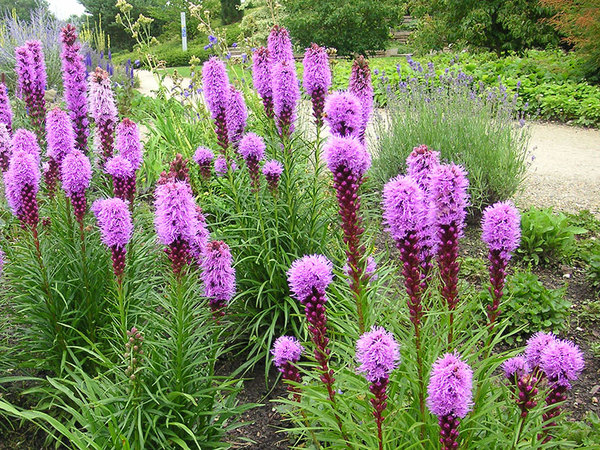
Liatris spicata
Plant · Asteraceae
Liatris Spicata is a vascular stimulant suited to patients with dropsy from liver, spleen, heart, or kidney disease. It acts as a prompt diuretic and has been used successfully when suppressed urination accompanies generalised oedema. It is also useful locally on ulcers and unhealthy wounds.
Key symptoms
- Dropsy from liver and spleen diseases; also renal dropsy
- Suppressed urination most favourably influenced as a prompt diuretic
- General anasarca due to heart and kidney disease
- Diarrhoea with violent urging and pain in lower back
- Colic and flatulency
- Increased functional activity of skin and mucous membranes

Colic Root (LIATRIS SPICATA - SERRATULA)
A vascular stimulant. Increases functional activity of the skin, mucous membranes.
Of use in dropsy due to liver and spleen diseases, also renal dropsy. Here the suppressed urination is most favorably influenced. General anasarca due to heart and kidney disease. Diarrhœa with violent urging and pain in lower part of back. Colic. Locally, applied to ulcers and unhealthy wounds.
A prompt diuretic.
Dose
1 to 4 drams of tincture of infusion.

Liatris spicata. Dense button-snakeroot. Gay feather. Devil's bit. Colic root. N. O. Compositæ (tribe Cichoraceæ). Tincture of powdered fresh root.
Clinical
Diarrhœa. Dropsy. Renal dropsy. Ulcers.
Characteristics
Liatris is an old botanic remedy for indigestion and colic. As T. C. Duncan explains (H. R., xiii. 110), it is called "Devil's bit,"─a piece is missing from each tuber, just as if it had been bitten out. It has the reputation of being aromatic, stimulant, diaphoretic, diuretic, anodyne, and carminative; particularly useful in colic, headache, and flatulency. It was introduced to homœopathic medicine (H. R., xiii. 35) because of its action in two cases of dropsy under eclectic treatment: (1) Dropsy from material enlargement of liver and spleen. (2) Dropsy with almost total suppression of urine. After other remedies had failed Liatris was given, and on the second day the patient passed a gallon and a half of urine. A. E. White wrote in Minneap. Hom. Mag. (date not noted) of another use of …
Classical texts are in the public domain. Educational reference only — not medical advice.
