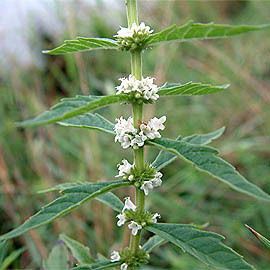
Lycopus virginicus
Bugleweed, Virginian horehound. · Plant · Lamiaceae
People who respond best to Lycopus tend to be irritable when ill unless spoken to very softly. Their minds often wander from one thing to another, and they may experience increased mental and physical activity in the evening.
Lycopus is associated chiefly with the heart, and is used to treat a weak heart and erratic pulse or heart disease. Additional symptoms may include a tendency to hemorrhage, and overactivity of the thyroid gland, particularly during menopause. Respiratory complaints may develop in conjunction with the heart problems. These include violent coughing in the evening or at night during sleep, with sweet-tasting mucus that recurs in cold weather, especially following exposure to cold winds. In addition, there may be an increase in appetite.
Key symptoms
- Tumultuous, forcible action of the heart with precordial pain
- Haemoptysis due to valvular heart disease
- Exophthalmic goitre; protrusion of eyes with tumultuous heart action
- Pulse weak, irregular, intermittent, tremulous, rapid
- Frontal headache worse at frontal eminences, often followed by labored heart
- Profuse or scanty urine when heart is most irritable
- Bleeding from rectum; haemorrhoids
- Wheezing; cough with frequent small haemoptysis
Worse (aggravation)
Better (amelioration)

Bugle-weed
Lower the blood pressure, reduces the rate of the heart and increases the length of systole to a great degree. Passive hæmorrhages (Adrenaline 6x).
A heart remedy, and of use in exophthalmic goitre and hæmorrhoidal bleeding. Indicated in diseases with tumultuous action of the heart and more or less pain. Hæmoptysis due to valvular heart disease. Beneficial in toxic goitre used in the pre-operative stage dose, 5 drops of tincture (Beebe).
Head
Frontal headache; worse, frontal eminences; often succeeded by labored heart. Nosebleed.
Eyes
Protrusion, pressing, outward, with tumultuous action of heart. Supraorbital pain, with aching in testicles.
Mouth
Toothache in lower molars.
Heart
Rapid heart action of smokers. Præcordial pain; constriction, tenderness, pulse, weak, irregular, intermittent, tremulous, rapid. Cyanosis. Heart's action tumultuous and forcible. Palpitation from nervous irritation, with oppression around heart. Rheumatoid, flying pains, associated with heart disease. Cardiac asthma (Sumbul).
Respiratory
Wheezing. Cough, with hæmoptysis, bleeding small but frequent.
Urine
Profuse flow of limpid, watery urine, especially when the heart is most irritable; also scanty urine. Bladder feels distended when empty. Diabetes. Pain in testicles.
Rectum
Bleeding from rectum. Hæmorrhoids.
Sleep
Wakefulness and morbid vigilance with inordinately active, but weak circulation.
Relationship
Compare: Ephedra-Teamsters Tea--(in exophthalmic goitre; eyes feel pushed out with tumultuous action of heart); Fucus; Spartein; Cratægus. Adrenaline 6x.
Dose
First to thirtieth potency.

Lycopus Virginicus. Bugle-weed. Virginia horehound. (Shady and wet places in U.S.) N. O. Labiatæ. Tincture of fresh plant in flower.
Clinical
Aneurism. Bites of reptiles. Bright's disease. Cough. Diabetes. Exophthalmos. Hæmoptysis. Headache. Heart, diseases of. Pericarditis. Phthisis. Snake-bites. Tarentula bites. Typho-malarial fever.
Characteristics
According to Hale Lycopus is mentioned by Rafinesque as "partaking of the properties of Digitalis, Sanguinaria, Cimicifuga, and Spigelia," and as being "one of the mildest and best narcotics in existence." He commends it specially as a substitute for Dig., as having the advantage over it of being non-poisonous; as useful in hæmoptysis and "wherever it is required to quell inordinate motions of the blood." This gives a very good picture of the Lcps. place and action, which homœopathy has made good use of and developed. The association of Lcps. with Dig., Act. r., and Spi. particularly shows a very clear insight into the action of the remedy, which an …

Phatak's chapter on Lycopus virginicus is available in the app.
Read Phatak in the appClassical texts are in the public domain. Educational reference only — not medical advice.
