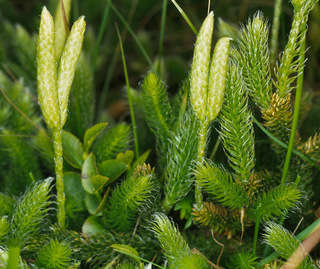
Lycopodium clavatum
Club moss, wolf’s claw, stag’s-horn moss, running pine, lamb’s tail, fox tail, witch meal, vegetable sulfur. · Plant · Lycopodiaceae
Lycopodium is prescribed when anticipatory anxiety features strongly in the psychological symptoms. Lack of confidence is often hidden by a veneer of arrogance or sarcasm. There is a dislike of close company, but also of being left alone.
Physical symptoms usually focus on digestive problems, with excessive bloating and gas. Complaints are often right-sided, or move from the right to the left of the body. Another typical physical trait, poor physical stamina, is often worse in the afternoons. Desire for sweet foods is common. Lycopodium is also used for kidney and prostate problems, headaches, and chest infections.
Key symptoms
anticipatory anxiety
- lack of self-esteem
- flatulence and constipation
- desire for sweet foods
- person feels worse between 4 p.m. and 8 p.m
Worse (aggravation)
- 4 to 8 PM
- Right side
- Cold drinks and cold food
- Warm room and warm applications
- Noise and odors
- Before urination (backache, renal region)
Better (amelioration)
- Warm food and drinks
- Motion
- Open air
- After midnight
- Warm applications

Club Moss (LYCOPODIUM)
This drug is inert until the spores are crushed. Its wonderful medicinal properties are only disclosed by trituration and succussion.
In nearly all cases where Lycopodium is the remedy, some evidence of urinary or digestive disturbance will be found. Corresponds to Grauvogle's carbo-nitrogenoid constitution, the non-eliminative lithæmic. Lycopodium is adapted more especially to ailments gradually developing, functional power weakening, with failures of the digestive powers, where the function of the liver is seriously disturbed. Atony. Malnutrition. Mild temperaments of lymphatic constitution, with catarrhal tendencies; older persons, where the skin shows yellowish spots, earthy complexion, uric acid diathesis, etc; also precocious, weakly children. Symptoms characteristically run from right to left, acts especially on right side of body, and are worse from about 4 to 8 pm. In kidney affections, red sand in urine, backache, in renal region; worse before urination. Intolerant of cold drinks; craves everything warm. Best adapted to persons intellectually keen, but of weak, muscular power. Deep-seated, progressive, chronic diseases. Carcinoma. Emaciation. Debility in morning. Marked regulating influence upon the glandular (sebaceous) secretions. Pre-senility. Ascites, in liver disease. Lycop patient is thin, withered, full of gas and dry. Lacks vital heat; has poor circulation, cold extremities. Pains come and go suddenly. Sensitive to noise and odors.
Mind
Melancholy; afraid to be alone. Little things annoy, Extremely sensitive. Averse to undertaking new things. Head strong and haughty when sick. Loss of self-confidence. Hurried when eating. Constant fear of breaking down under stress. Apprehensive. Weak memory, confused thoughts; spells or writes wrong words and syllables. Failing brain-power (Anac; Phos; Baryt). Cannot bear to see anything new. Cannot read what he writes. Sadness in morning on awaking.
Head
Shakes head without apparent cause. Twists face and mouth. Pressing headache on vertex; worse from 4 to 8 pm, and from lying down or stooping, if not eating regularly (Cact). Throbbing headache after every paroxysm of coughing. Headaches over eyes in severe colds; better, uncovering (Sulph). Vertigo in morning on rising. Pain in temples, as if they were screwed toward each other. Tearing pain in occiput; better, fresh air. Great falling out of hair. Eczema; moist oozing behind ears. Deep furrows on forehead. Premature baldness and gray hair.
Eyes
Styes on lids near internal canthus. Day-blindness (Bothrops). Night-blindness more characteristic. Sees only one-half of an object. Ulceration and redness of lids. Eyes half open during sleep.
Ears
Thick, yellow, offensive discharge. Eczema about and behind ears. Otorrhœa and deafness with or without tinnitus; after scarlatina. Humming and roaring with hardness of hearing; every noise causes peculiar echo in ear.
Nose
Sense of smell very acute. Feeling of dryness posteriorly. Scanty excoriating, discharge anteriorly. Ulcerated nostrils. Crusts and elastic plugs (Kal b; Teuc). Fluent coryza. Nose stopped up. Snuffles; child starts from sleep rubbing nose. Fan-like motion of aloe nasi (Kali brom; Phos).
Face
Grayish-yellow color of face, with blue circles around eyes. Withered, shriveled, and emaciated; copper-colored eruption. Dropping of lower jaw, in typhoid fever (Lach; Opium). Itching; scaly herpes in face and corner of mouth.
Mouth
Teeth excessively painful to touch. Toothache, with swelling of cheeks; relieved by warm application. Dryness of mouth and tongue, without thirst. Tongue dry, black, cracked, swollen; oscillates to and fro. Mouth waters. Blisters on tongue. Bad odor from mouth.
Throat
Dryness of throat, without thirst. Food and drink regurgitates through nose. Inflammation of throat, with stitches on swallowing; better, warm drinks. Swelling and suppuration of tonsils. Ulceration of tonsils, beginning on right side. Diphtheria; deposits spread from right to left; worse, cold drinks. Ulceration of vocal bands. Tubercular laryngitis, especially when ulceration commences.
Stomach
Dyspepsia due to farinaceous and fermentable food, cabbage, beans, etc. Excessive hunger. Aversion to bread, etc. Desire for sweet things. Food tastes sour. Sour eructations. Great weakness of digestion. Bulimia, with much bloating. After eating, pressure in stomach, with bitter taste in mouth. Eating ever so little creates fullness. Cannot eat oysters. Rolling of flatulence (Chin; Carb). Wakes at night feeling hungry. Hiccough. Incomplete burning eructations rise only to pharynx there burn for hours. Likes to take food and drink hot. Sinking sensation; worse night.
Abdomen
Immediately after a light meal, abdomen is bloated, full. Constant sense of fermentation in abdomen, like yeast working; upper left side. Hernia, right side. Liver sensitive. Brown spots on abdomen. Dropsy, due to hepatic disease. Hepatitis, atrophic from of nutmeg liver. Pain shooting across lower abdomen from right to left.
Stool
Diarrhœa. Inactive intestinal canal. Ineffectual urging. Stool hard, difficult, small, incomplete. Hæmorrhoids; very painful to touch, aching (Mur ac).
Urine
Pain in back before urinating; ceases after flow; slow in coming, must strain. Retention. Polyuria during the night. Heavy red sediment. Child cries before urinating (Bor).
Male
No erectile power; impotence. Premature emission (Calad; Sel; Agn). Enlarge prostate. Condylomata.
Female
Menses too late; last too long, too profuse. Vagina dry. Coition painful. Right ovarian pain. Varicose veins of pudenda. Leucorrhœa, acrid, with burning in vagina. Discharge of blood from genitals during stool.
Respiratory
Tickling cough. Dyspnœa. Tensive, constrictive, burning pain in chest. Cough worse going down hill. Cough deep, hollow. Expectorations gray, thick, bloody, purulent, salty (Ars; Phos; Puls). Night cough, tickling as from Sulphur fumes. Catarrh of the chest in infants, seems full of mucus rattling. Neglected pneumonia, with great dyspnœa, flaying of alæ nasæ and presence of mucous rales.
Heart
Aneurism (Baryta carb). Aortic disease. Palpitation at night. Cannot lie on left side.
Back
Burning between scapulæ as of hot coals. Pain in small of back.
Extremities
Numbness, also drawing and tearing in limbs, especially while at rest or at night. Heaviness of arms. Tearing in shoulder and elbow joints. One foot hot, the other cold. Chronic gout, with chalky deposits in joints. Profuse sweat of the feet. Pain in heel on treading as from a pebble. Painful callosities on soles; toes and fingers contracted. Sciatica, worse right side. Cannot lie on painful side. Hands and feet numb. Right foot hot, left cold. Cramps in calves and toes at night in bed. Limbs go to sleep. Twitching and jerking.
Fever
Chill between 3 and 4 pm, followed by sweat. Icy coldness. Feels as if lying on ice. One chill is followed by another (Calc; Sil; Hep).
Sleep
Drowsy during day. Starting in sleep. Dreams of accidents.
Skin
Ulcerates. Abscesses beneath skin; worse warm applications. Hives; worse, warmth. Violent itching; fissured eruptions. Acne. Chronic eczema associated with urinary, gastric and hepatic disorders; bleeds easily. Skin becomes thick and indurated. Varicose veins, nævi, erectile tumors. Brown spots, freckles worse on left side of face and nose. Dry, shrunken, especially palms; hair becomes prematurely gray. Dropsies. Offensive secretions; viscid and offensive perspiration, especially of feet and axilla. Psoriasis.
Modalities
Worse, right side, from right to left, from above downward, 4 to 8 pm; from heat or warm room, hot air, bed. Warm applications, except throat and stomach which are better from warm drinks. Better, by motion, after midnight, from warm food and drink, on getting cold, from being uncovered.
Relationship
Complementary: Lycop acts with special benefit after Calcar and Sulphur. Iod; Graphites, Lach; Chelidon.
Antidotes: Camph; Puls; Caust.
Compare: Carbo-Nitrogenoid Constitution: Sulphur; Rhus; Urtica; Mercur; Hepar. Alumina (Lycop is the only vegetable that takes up aluminum. T. F. Allen) Ant c; Nat m; Ery; Nux; Bothrops (day-blindness; can scarcely see after sunrise; pain in right great toe). Plumbago littoralis-A Brazilian plant--(Costive with red urine, pain in kidneys and joints and body generally; milky saliva, ulcerated mouth). Hydrast follows Lycop in indigestion.
Dose
Both the lower and the highest potencies are credited with excellent result. For purposes of aiding elimination the second and third attenuation of the Tincture, a few drops, 3 times a day, have proved efficacious, otherwise the 6th to 200th potency, and higher, in not too frequent doses.
Lycopodium is an antipsoric, anti-syphilitic and anti-sycotic, and its sphere is broad and deep. Though classed among the inert substances, and thought to be useful only for rolling up allopathic pills, Hahnemann brought it into use and developed its power by attenuation.
It is a monument to Hahnemann. It enters deep into the life, and ultimate changes in the soft tissues, blood-vessels, bones, liver, heart, joints. The tissue changes are striking; there is tendency to, necrosis, abscesses, spreading ulcers and great emaciation.
Generalities
There is a predominance of symptoms on the right sideof the body, and they are likely to travel from right to left or from above downward, e. g., from head to chest.

Lycopodium clavatum. Muscus terrestris repens. Pes ursinus. Clubmoss. Wolf's-claw. (Hilly pastures and heaths in Central and Northern Europe, Russian Asia, and North America. Common in Great Britain, especially the North.) N. O. Lycopodiaceæ. Trituration of spores. Tincture of spores. Tincture of fresh plant. Etherial tincture of spores (ether dissolves the spore cases).
Clinical
Abdomen, distended. Abortion. Albuminuria. Aneurism. Angina pectoris. Aphasia. Asthma. Axilla, offensive perspiration of. Biliousness. Borborygmi. Bright's disease. Cancer. Cataract. Constipation. Consumption. Corns. Cough. Cramps. Cystitis. Debility. Diphtheria. Distension. Dropsies. Dysentery. Dysmenorrhœa. Dyspepsia. Ear, eczema behind. Eczema. Ephelis. Epistaxis. Epithelioma. Excoriation. Eye, inflammation of; polypus of canthus. Face, eruption on. Feet, perspiring. Fibroma. Flatulence. Gall-stone colic. Glands, swelling of. Goître. Gout. Gravel. Hæmaturia. Hæmorrhoids. Hair, falling out. Hands, chapped. …
Wolf's Foot; Club Moss (Lycopodiaceae)
For persons intellectually keen, but physically weak; upper part of body emaciated, lower part semi-dropsical; predisposed to lung and hepatic affections (Cal., Phos., Sulph.); especially the extremes of life, children and old people. Deep-seated, progressive, chronic diseases. Pains: aching-pressure, drawing; chiefly right sided, < four to eight P.M. Affects right side, or pain goes from right to left; throat, chest, abdomen, liver, ovaries. Children, weak, emaciated; with well-developed head but puny, sickly bodies. Baby cries all day, sleeps all night (rev. of, Jal., Psor.). Ailments from fright, anger, mortification, or vexation with reserved displeasure (Staph.). Avaricious, greedy, miserly, malacious, pusillanimous. Irritable; peevish and cross on walking; ugly, kick and scream; easily angered; cannot endure opposition or contradiction; seeks disputes; is beside himself. Weeps all day, cannot calm herself; very sensitive, even cries when thanked. Dread of men; of …
Head
Throbbing headache after every paroxysm of coughing.
Head
Vertigo in the morning when rising and after, so that she reels back and forth.
Head
Shattering as if from a shock in both temples and chest (when coughing).
Sight and Eyes
Sees only left half of an object distinctly.
Sight and Eyes
Evening light blinds him very much; can see nothing on the table.
Hearing and Ears
Purulent, ichorous otorrhoea, with impaired hearing, after scarlatina.
Nose
Nose stopped up, especially at night, cannot breathe through it; excessive dryness (chronic).
Nose
Fan-like motion of the alae-nasi.
Mouth and Throat
Tongue oscillating from side to side like a pendulum.
-
Excessive fullness and distension of the abdomen, with flatulence, relieved by eructations.
-
Hunger, but a small quantity of food seems to fill him full.
-
Continuous rumbling and rolling in the abdomen.
-
Severe backache, relieved by passing urine, urine deposits a red, sandy sediment.
-
Fan-like motion of the alae nasi in respiratory diseases, especially of children and young persons.
-
Aggravation of the symptoms from 4 to 8 p.m.
-
Humid suppurating eruptions, especially on occiput and face, crusts thick, easily bleeding, oozing a fetid moisture, worse after scratching and from warmth.
-
Much flatus accumulates here and there in the abdomen. in the hypochondria, in the back, in region of ribs and chest, causing tension, bubbling and gurgling, relieved by empty eructations.

Phatak's chapter on Lycopodium clavatum is available in the app.
Read Phatak in the appClassical texts are in the public domain. Educational reference only — not medical advice.
