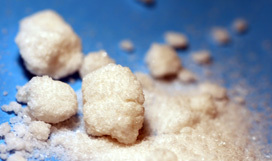
Mercurius cyanatus
Mercury(II) cyanide · Hydrargyrum cyanatum,Mercurous cyanide. · Mineral
Merc. cyan. is given most often to people who are talkative, highly emotional, and overexcited. They may have frequent spells of unconsciousness or fainting, depending on the severity of their illness. The remedy is typically used for acute infectious diseases with rapidly sinking strength and a tendency to hemorrhage. It is strongly associated with throat and mouth conditions such as tonsillitis and diphtheria. The throat is typically red with a white coating, and there may be pain on swallowing, with inflammation of the uvula. The tongue, lips, and cheeks tend to ulcerate, and there is metallic-tasting saliva and offensive-smelling breath. These symptoms are usually accompanied by weakness, great sensitivity to the cold, nausea, and cold, damp, sweaty skin.
Key symptoms
- Malignant diphtheria with great and rapid prostration
- Necrotic destruction of soft parts of palate and fauces
- Ulcerations of mouth with gray membrane; intense redness of fauces
- Haemorrhages from different orifices of dark fluid blood; cyanosis
- Twitching and jerking of muscles; rapid respiration and heart action
- Swallowing very difficult; talking painful with hoarseness
- Black stools with intolerable rectal pain; fetid liquid discharge
Worse (aggravation)
Better (amelioration)

Cyanide of Mercury
Acute infections, pneumonia, nephritis. Its action is similar to that of the toxines of infections diseases. Great and rapid prostration, tendency toward hæmorrhages, from the different orifices, of dark fluid blood, cyanosis, rapid respiration and heart action, albuminuria and twitching and jerking of muscles. Typhoid pneumonia.
Livid states from great struggling, where suffocation is imminent and paralysis of lung threatening; great sweat.
Affects most prominently the buccal cavity. This, together with marked prostration, gives it a place in the treatment of diphtheria, where it has achieved unquestioned great results. Malignant types, with prostration. Coldness and nausea. Syphilitic ulcers when perforation threatens.
Head
Great excitement, fits of passion; fury; talkativeness. Atrocious headache. Eyes sunken; face pale.
Mouth
Covered with ulcerations. Tongue pale. Free salivation. Fetor of breath. Pain and swelling of salivary glands. Astringent taste. Ulcerations of mouth have a gray membrane.
Throat
Feels raw and sore. Mucous membranes broken down, ulcerated. Looks raw in spots, especially in public speakers. Hoarseness, and talking is painful. Necrotic destruction of soft parts of palate and fauces. Intense redness of fauces. Swallowing very difficult. Dark blood from nose. Diphtheria of the larynx and nose (Kali bich).
Stomach
Nausea, vomiting, bilious, bloody; hiccough; abdomen painful, tender to pressure.
Rectum
Intolerable pain. Redness around anus. Frequent hæmorrhage; stools with tenesmus. Discharge of fetid liquid with gangrenous odor. Black stools.
Urinary
Amber color, painful, albuminous, scanty. Nephritis with great debility and chilliness. Suppression of urine.
Skin
Moisture, with icy coldness.
Dose
Sixth to thirtieth potency. Aggravation is apt to occur from potencies below the sixth.

Given a Merc. base and diphtheria, when the membrane is greenish and inclined to spread through the nose and involve a large surface, the Cyanide of Mercury is needed.
It has exudation more marked than any other form of Mercury.
Malignant forms of diphtheria, rapidly forming, and with phagedenic ulceration.

Bicyanide of Mercury. Mercuric Cyanide. Hg (CN)2. Solution. Trituration.
Clinical
Diphtheria. Dysentery. Enteric fever. Hæmorrhages. Kerato-iritis syphilitica. Phlebitis. Throat, sore. Varicosis.
Characteristics
The history of this remedy is a romantic one. When Dr. Alexander Villers was an infant he had diphtheria. Known remedies had failed to arrest the disease, and his father, Dr. Dominic von Villers, was in despair. Taking counsel with his friend, Dr. Beck (of Monthey in Switzerland), the latter was struck with the likeness of the case to the effects of Merc. cy. in some poisoning cases, reports of which he had just been reading. He suggested the remedy A small quantity of the salt was procured and an attenuation rapidly made and administered. Improvement soon set in, and recovery happily followed. The patient, saved by Merc. cy., lived to do most brilliant work with the same remedy when practising in St. Petersburg, and Merc. cy. has taken a sure place at the head of remedies for this affection. …

Cyanide of Mercury. (Hg(CN2).)
Malignant diphtheria with intense redness of fauces and great difficulty of swallowing; pseudo-membranous formation extends all over fauces and down throat; putrid, gangrenous diphtheria, with phagedenic ulceration; membranous croup. Great weakness; extreme prostration; cannot stand up from weakness. When it corresponds to the genus epidemicus, like every other remedy, is effective as a prophylactic.

Phatak's chapter on Mercurius cyanatus is available in the app.
Read Phatak in the appClassical texts are in the public domain. Educational reference only — not medical advice.
