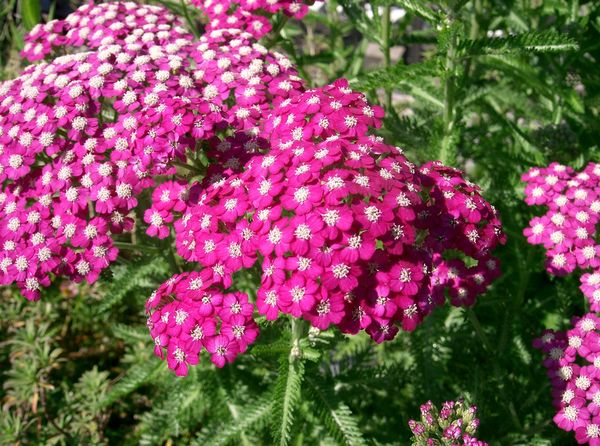
Millefolium
Achillea millefolium · Yarrow, milfoil, woundwort, staunchweed, nosebleed. · Plant · Asteraceae
Millefolium best suits those who tend to be most irritable in the evening. Longing for rest but going to bed late, they wake feeling unrefreshed, confused, dizzy, and stupefied, as if drunk. When irritable, they may become overly excitable and violent. Children who fit this profile tend to moan and sigh.
Millefolium is used chiefly for bleeding from injuries, and for internal bleeding and menstrual irregularities, such as delayed or absent menstruation that may lead to convulsions, or heavy menstrual periods that impair fertility. Millefolium may also be given in pregnancy for severe colicky pain, diarrhea, and painful varicose veins, or for recovery from miscarriage. It is used for profuse, painless uterine bleeding following childbirth or an abortion, and for sore nipples and suppressed breast milk after childbirth.
The other key symptom for Millefolium is congestion, associated with piercing pains in the ears, teeth, and temples. There may be congestion in the ears, eyes, nose, and chest.
Key symptoms
- Hemorrhages of bright red, fluid blood from any organ
- Nosebleed with piercing pain from eyes to root of nose
- Hemoptysis in incipient phthisis
- Menses early, profuse, protracted with bright red hemorrhage from uterus
- Bleeding hemorrhoids and bloody urine
- Bad effects from falls from a height or overlifting
Worse (aggravation)
Better (amelioration)

Yarrow
An invaluable remedy for various types of hæmorrhages; blood bright red. Incarcerated hernia; smallpox, with great pain in pit of stomach. After operations for stone. Bad effects from fall from a height; overlifting. Continued high temperature. Hæmoptysis.
Head
Vertigo when moving slowly. Sensation as if he had forgotten something. The head seems full of blood. Convulsions and epilepsy from suppressed menses. Piercing thrusts of pain.
Nose
Nosebleed (Erecht). Piercing pain from eyes to root of nose.
Stool
Hæmorrhage from bowels. Bleeding hæmorrhoids. Urine bloody (Senec aur).
Female
Menses early, profuse, protracted. Hæmorrhage from uterus; bright red, fluid. Painful varices during pregnancy.
Respiratory
Hæmoptysis in incipient phthisis. Cough, with bloody expectoration, in suppressed menses or hæmorrhoids. Violent palpitation.
Relationship
Compare: Ficus venosa (Pakur). Hæmorrhage from bowels and lungs. Acalypha and Helix tosta-Snail--(in hæmoptysis, diseases of chest, consumption); also, Secale; Ipec; Erecht; Geran; Hamam.
Dose
Tincture, to third potency.

Veins
This is a most useful remedy in varicose veins; especially are the capillaries spongy and enlarged.
Veins break easily when congested. Wounds bleed easily and much. It favors apoplexy. Ecchymoses of the skin and eyes. It favors local congestions. Hemorrhage from any part, from wounds, from ulcers.
*Atony of the blood vessels.*Haemorrhage from the lungs, stomach, rectum, nose, after extraction of teeth. The blood is generally bright red. Varicose veins on the limbs during pregnancy when painful. Haemorrhage in malignant ulceration.
After an operation and the wound has been properly closed the skin forming the edges of the wound continues to ooze a bright red blood. When a general haemorrhagic condition prevails. These features are often associated with heart troubles that will be expected.

Achillea millefolium. Yarrow. N. O. Compositæ. Tincture of whole fresh plant.
Clinical
Asthma. Cancer. Chlorosis. Consumption. Dentition. Diarrhœa. Dysmenorrhœa. Enuresis. Epilepsy. Fistula lachrymalis. Hæmatemesis. Hæmaturia. Hæmoptysis. Hæmorrhages. Hypochondriasis. Hysteria. Leucorrhœa of children. Lochia, too profuse; suppressed. Milk, absence of. Nipples, sore. Nose, bleeding of. Puerperal convulsions. Puerperal fever. Rodent ulcer. Sterility. Sycosis Hahnemanni. Tetanus. Varices.
Characteristics
Yarrow was named Achillea by Linnæus because the plant is mentioned in the Iliad as having been used by Achilles, on the instruction of Chiron, to heal the wounds of his soldiers. The knowledge of the vulnerary powers of Mill. is thus of great antiquity. It received its popular name, "Nose-bleed," because nose-bleed comes on if the leaves are inserted into the nostrils. There is another species of Achillea, besides A. millefolium, indigenous to Great Britain, A. ptarmica, called "sneeze-wort" from its …

Yarrow. (Compositae.)
Ailments: from over-lifting, over-exertion, or a fall. Vertigo; when moving slowly, but not when taking violent exercise. Haemorrhages: painless, without fever; bright red, fluid blood (Acon., Ipec., Sab.); from lungs, bronchi, larynx, mouth, nose, stomach, bladder, rectum, uterus; of mechanical origin (Arn.); of wounds (Ham.). Wounds which bleed profusely, especially after a fall (Arn., Ham.). Haemoptysis: after injury; in incipient phthisis; in haemorrhoidal patients; from a ruptured blood vessel. Painless drainage, from nose, lungs, uterus; after labor or abortion; after great exertion; after miscarriage. Preventive in post- partum haemorrhage. Menses: early, profuse, protracted; suppressed, with colic pain in abdomen. Leucorrhoea of children from atony (Cal.). Cough: with raising of bright blood; in suppressed menses or haemorrhoids; with oppression and palpitation; after a fall from a height (Arn.); after violent extertion; with blood, daily at 4 p. m. (Lyc.).

Phatak's chapter on Millefolium is available in the app.
Read Phatak in the appClassical texts are in the public domain. Educational reference only — not medical advice.
