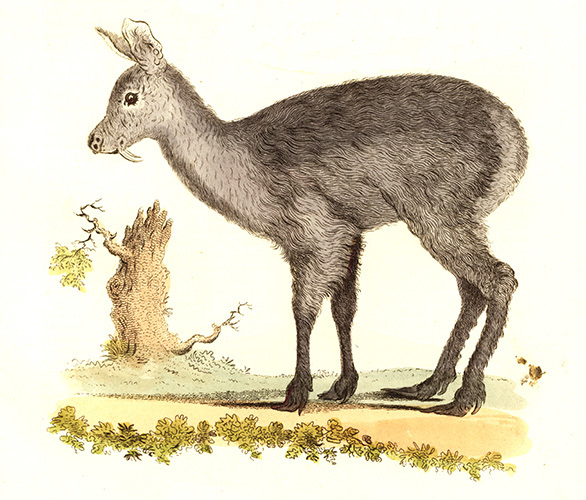
Moschus
Moschus moschiferus · Musk deer,Moschus moschiferus · Animal
Moschus is best suited to people who are bustling, overexcited, and prone to uncontrollable laughter. They tend to be quarrelsome and may express violent anger. Often physically awkward and with confused speech, they may be preoccupied and absent-minded. Their feelings of anxiety and fear of death may lead to hysteria, and they may experience intense sexual excitement even if they are elderly.
Key symptoms associated with Moschus include heightened physical and mental tension, which may cause spasms, twitches, and seizures in the muscles. General coldness is another characteristic symptom, or a chill in a specific area of the body; for instance, one cheek may be red but cold, the other pale but hot. The remedy is prescribed chiefly for fainting that is triggered by the slightest excitement, such as scolding or anger, or by eating, menstruation, or heart disease. In addition, Moschus is given for chest spasms, and spasms in the abdominal muscles or diaphragm, such as hiccups.
Key symptoms
- Hysteria, fainting fits, and convulsions aggravated by cold
- Uncontrollable laughter; scolding; anxiety with palpitation
- Spasmodic nervous hiccough
- Great flatulence with enormously distended abdomen
- Violent sexual desire with involuntary emissions in males
- Menses too early and too profuse with disposition to faint
- Vertigo on least motion, sensation as if falling from great height
Worse (aggravation)
Better (amelioration)

Musk
A remedy for hysteria and nervous paroxysms, fainting fits and convulsions, catalepsy, etc. The characteristic condition being aggravation by cold; there is great sensitiveness to air. Much nervous trembling and frequent fainting. Great flatulence. Diseases do not follow a normal course. Coldness. Tension in muscles, skin and mind.
Mind
Uncontrollable laughter. Scolding. Anxiety with palpitation; starting as if frightened. Sexual hypochondriasis.
Head
Compressive pain over root of nose. Pressure on top of head. Vertigo on least motion; sensation as if falling from a great height. Scalp sensitive. Sounds in ears as from the report of a cannon.
Stomach
Desire for black coffee, stimulants. Aversion to food. Everything tastes flat. With stomach symptoms, anxiety in chest. Distended. Faints when eating. Abdomen greatly distended. Spasmodic, nervous hiccough (Hydrocy ac; Sulph ac; Ignat; Cajap).
Male
Violent desire; involuntary emissions. Impotence, associated with diabetes (Coca). Premature senility. Nausea and vomiting after coition.
Female
Menses too early, too profuse, with disposition to faint (Nux m; Veratr). Sexual desire, with intolerable titillation in parts. Drawing and pushing in the direction of the genitals; sensation as if menses appear.
Urine
Profuse urination. Diabetes.
Respiratory
Tightness of chest, is obliged to take a deeper breath. Sudden constriction of larynx and trachea. Difficult respiration; chest oppressed; hysterical spasm of chest; asthma. Spasm of glottis. Impending paralysis of lungs. Asthma, with intense anxiety, fear, and smothering sensation. Cough ceases, mucus cannot be expectorated. Globus hystericus.
Heart
Hysterical palpitation. Trembling around heart. Weak pulse and fainting.
Modalities
Better, in open air, rubbing. Worse, cold. The open air is felt very, very cold.
Relationship
Compare: Nux mosch; Asaf; Valer; Sumbul; Ign; Castor.
Compatible: Ambra.
Antidotes: Camph; Coff.
Dose
First to third potency.
Mind
: Moschus cures many hysterical girls who have come to adult age without ever learning what obedience means.
They are self-willed, obstinate and selfish. When they have been encouraged to resort to crafty cunning, to have every whim gratified from infancy to eighteen years of age they become fit subjects for Mosch., Asa f., Ignatia and Valer.
They not only have volumes of real and imaginary symptoms, but they become adepts at producing at will a kaleidoscopic complex of symptoms, increasing in quantity and intensity until all their own desires are attained, and the onlooker, be he or she nurse, physician or bewildered mother, is overwhelmed, dismayed and in retreat.

Moschus moschiferus. Musk Deer. N. O. Mammalia. Trituration of inspissated secretion contained in preputial follicles.
Clinical
Angina pectoris. Catalepsy. Croup. Diabetes. Dyspnœa. Epilepsy. Fainting. Heart, failure of. Herpes, mercurial and venereal. Hiccough. Hypochondriasis. Hysteria. Hystero-epilepsy. Impotence. Laryngismus. Lungs, paralysis of. Pregnancy, complaints of. Rage, fits of. Stings. Typhoid. Vertigo. Whooping-cough.
Characteristics
The well-known power of Musk─the perfume─to produce fainting in some by the mere smelling of it, gives the chief keynote for its use in homœopathy: Faints easily; faints dead away from the least excitement; scolds and rages till she falls unconscious globus hystericus ending in unconsciousness; faints while eating during menses; faints from heart disease. All complaints which have easy fainting as a leading accompaniment may want Mosch. Coldness is another keynote. "In nervous or spasmodic complaints where the patient feels very cold: in epileptic fits …

Phatak's chapter on Moschus is available in the app.
Read Phatak in the appClassical texts are in the public domain. Educational reference only — not medical advice.
