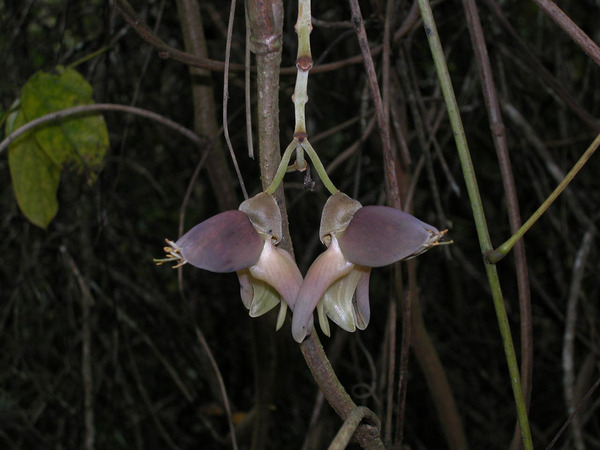
Mucuna urens
Plant · Fabaceae
Mucuna Urens is a South American remedy with primary action on the haemorrhoidal system. The keynote is burning, which may or may not be accompanied by bleeding. It is related to Dolichos (Cowhage) but uses a different plant part and preparation. Its use is chiefly empirical, based on Venezuelan traditional and clinical experience.
Key symptoms
- Burning haemorrhoids with or without bleeding (keynote is burning)
- Complaints arising from the haemorrhoidal diathesis
- Affections of liver associated with haemorrhoidal conditions

Mucuna urens. Horse-Eye. (Hot regions of Venezuela.) N. O. Leguminosæ. The pulverised bean is macerated in five times its weight of alcohol.
Clinical
Hæmorrhoidal discharges. Hæmorrhoids.
Characteristics
In New, Old, and Forgotten Remedies (p. 220) is a letter by Delgado Palacios, of Venezuela, pointing out that the name Dolichos, given to Cowhage or Cow-itch in homœopathic literature (see Vol. I.), is not in accordance with latest botanical terminology. Cowhage is really a Mucuna, Mucuna and Dolichos being separate genera of the Leguminosæ. They are so described in the Treasury of Botany. (Allen gives Linnæus as the authority for the name Dolichos puriens.) Palacios has used M. urens, with which, he says, modern botanists consider Cowhage identical; but he does not name his plant M. Pruriens, an alternative name of Cowhage, and as he says, further, that M. urens is a "special plant which grows in the calid regions of Venezuela," and that the beans are "very difficult to obtain," I think it …
Classical texts are in the public domain. Educational reference only — not medical advice.
