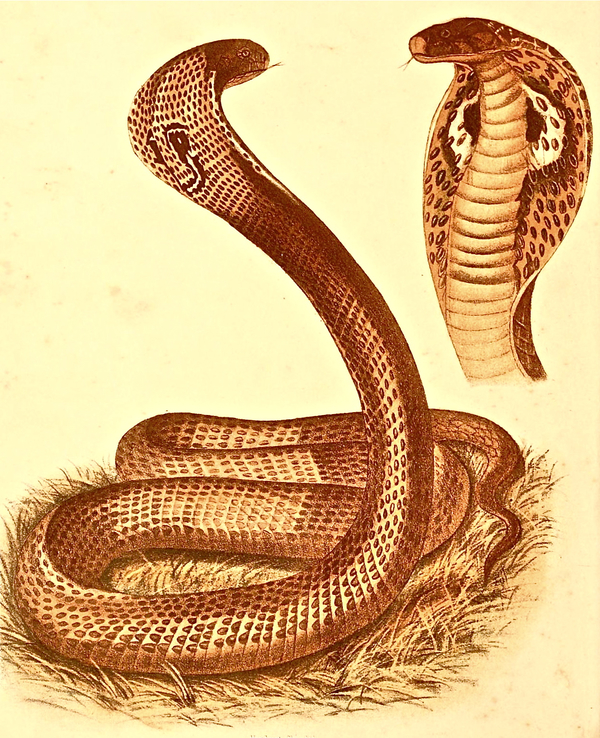
Naja tripudians
Naja naja · tripudians,Indian cobra. · Animal
People who respond best to Naja feel unfortunate and deeply wronged, but tend to exaggerate or take their problems out of context. They often feel confused, with a sensation of duality, forgetful, sad, tremulous, weak, and chilly.
Naja is prescribed chiefly for heart symptoms, particularly those affecting the valves. Symptoms typically include heart murmurs, a slow or racing pulse, violent palpitations with choking and an inability to speak, a valvular lesion (abnormality of the structure or function of the valve), and angina with pain extending down the left arm and up to the throat and neck. Naja may be used for a heart that has become enlarged due to being forced to work harder in order to push blood through damaged valves. The internal organs feel as if they are drawn together or screwed up. Sleep may be restless or inhibited by a sense of suffocation at night.
Key symptoms
- Valvular heart troubles with marked surging of blood upward
- Inability to lie on left side; marked dyspnea
- Pain in left temple and orbital region extending to occiput with nausea
- Broods constantly over imaginary troubles; suicidal tendency
- Bulbar paralysis with loss of speech and swallowing control
- Very susceptible to cold; organs seem to be drawn together
Worse (aggravation)
Better (amelioration)

Virus of the Cobra
Naja produces a typical bulbar paralysis (L. J. Boyd). Causes no hæmorrhage but only œdema, hence the victims of this reptile frequently bear very little sign of external injury a small scratch or puncture being the only indication where the fangs have worked their havoc. The tissue lying beneath the wound is colored dark purple, and a large quantity of viscid blood-like fluid collects in the vicinity of the wound. An intense burning pain at the spot bitten is the first symptom. In man there follows an interval before fresh symptoms occur. The average is about an hour. Once developed, the symptoms follow a rapid course. A feeling of intoxication is produced, followed by a loss of power over the limbs. The patient is bereft of speech, swallowing, and the control over the movement of the lips. The saliva is ejected in large quantities, the respiration gradually becomes slower and slower, and at length ceases. Conscious all time. Is not a hæmorrhagic or septic, medicine like Lachesis and Crotalus. Its action settles around the heart; valvular troubles. Marked surging of blood upwards, marked dyspnœa, inability to lie on left side. Hypertrophy, and valvular lesions. Organs seem to be drawn together. Very susceptible to cold. With heart symptoms, pain in forehead and temples. Diseases, primarily depending upon degeneration of motor cells. Control of sphincters lost.
Mind
Broods constantly over imaginary troubles. Suicidal insanity (Aur). Depressed. Aversion to talking. Blurred speech. Melancholy. Dreads to be left alone. Fear of rain.
Head
Pain in left temple and in left orbital region, extending to occiput, with nausea and vomiting. Hay-fever, with dry larynx. Suffocative spells after sleeping (Lach). Eyes staring. Ptosis of both lids.
Ears
Illusions of hearing; otalgia; chronic otorrhœa, black discharges; smells like herring brine.
Respiratory
Grasping at throat, with sense of choking. Irritating, dry cough, dependent on cardiac lesions (Spong; Lauroc) Sticky mucus and saliva. Asthmatic constriction in evening. Asthma beginning with coryza.
Heart
Dragging and anxiety in præcordia. Feeling of weight on heart. Angina pains extending to nape of neck, left shoulder and arm with anxiety and fear of death. With the heart symptoms pain in forehead and temples. Pulse irregular in force. Threatened paralysis of heart, body cold, pulse slow, weak, irregular, tremulous. Acute and chronic endocarditis. Palpitation. Stitching pain in region of heart. Damaged heart after infections diseases. Marked symptoms of low tension (Elaps, Vipera).
Female
Neuralgia of left ovary; often serviceable in obscure pain in left groin, especially in post-operative cases; seems to be drawn to heart.
Sleep
Profound, like a log, with stertorous breathing, a typical reptilian state.
Modalities
Worse, from use of stimulants; better, from walking or riding in open air.
Relationship
Compare: Serpent poisons generally. Bungarus Fasciatus (Banded Krait). This venom produces a condition like an acute polioencephalitis and myelitis, both symptomatically and histologically. Lach; Crotal; Spig; Spong.
Dose
Sixth to thirtieth potency.
The use of Naja has extended far beyond its proving.
So many of the Ophidian family present symptoms in common with it, that much has been presumed truly so.
Many characteristics run through these remedies, each remedy having its own peculiar sphere. Taken together the family presents a wide range of curative action.
Mure, of Brazil, thought that the snake family presented curative powers for the healing of the nations.
In the mineral kingdom, man may find his remedy when sick, so in the vegetable and animal kingdom. It is possible that the product of the serpent may be everything needed for the healing of man. Extend this to the whole animal kingdom and it is probably so.

Naja tripudians. Cobra di Capello. The hooded snake of Hindustan. N. O. Elapidæ. Tincture of the fresh virus. Trituration of sugar of milk saturated with fresh virus.
Clinical
Angina pectoris. Asthma. Dysmenia. Hay-fever. Headache. Heart, affections of. Œsophagus, spasmodic stricture of. Ovaries, affections of. Plague. Spinal irritation (of nucha). Throat, sore.
Characteristics
The poison of the deadly cobra has been used from ancient times, says P. C. Majumdar (Ind. Hom. Rev., vi. 6), by Indian practitioners in many nervous and blood diseases. It was introduced into homœopathy by Russell and Stokes, who made the first provings along with some forty other provers, including Gillow, Pope, and Drysdale. It is rather remarkable that with so many able provers Naja should not have attained anything approaching the place of importance occupied by Lach. Nash suggests this may be due to the fact that many of the provings of Lach. were made with the 30th potency, whilst those of Naja were with low …
Cobra virus. (Elapidae.)
Suicidal insanity, broods constantly over imaginary troubles (Aur.). Simple hypertrophy of heart. For restoring a heart damaged by acute inflammation, or from relief of sufferings of chronic hypertrophy and valvular lesions. Irritating, dry, sympathetic cough in the acute stage of rheumatic carditis, or chronic organic lesions (Spon.). Threatened paralysis of heart, post-diphtheritic. Pulse irregular in force, but regular in rhythm. Inability to speak with choking, nervous, chronic palpitation, especially after public speaking; pain < by carriage riding or lying on side. Severe stitching pain in region of heart.
Respiratory Organs
Cardiac cough with sweat in the palms.
Respiratory Organs
Cardiac dyspnoea with choking sensation.
Heart and Pulse
Organic disease, with sympathetic irritative cough.
Causes and Modalities
Chest and heart symptoms < lying on left side; > lying on right side.

Phatak's chapter on Naja tripudians is available in the app.
Read Phatak in the appClassical texts are in the public domain. Educational reference only — not medical advice.
