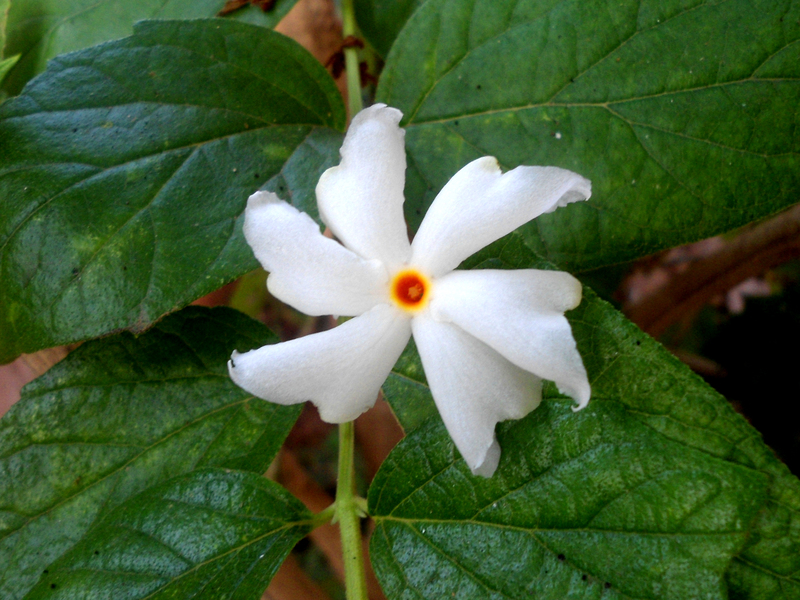
Nyctanthes arbor tristis
Nyctanthes arbor-tristis · Plant · Oleaceae
Nyctanthes Arbor Tristis suits patients with bilious constitutions presenting with remittent fevers, hepatic tenderness, and rheumatic or sciatic pains. It is particularly used in children's constipation. The remedy acts as a bitter tonic, expectorant, and mild purgative in its crude form.
Key symptoms
- Bilious and obstinate remittent fever with thirst before and during chill and heat
- Thirst better from vomiting as chill closes
- Sciatica and rheumatism
- Constipation of children
- Burning sensation in stomach better from cold application
- Tenderness of liver; profuse bilious stool with nausea
- Anxious and restless with dull headache and coated tongue
Better (amelioration)
- Cold application (stomach burning)
- Vomiting (thirst relieved)

Paghala-malli-Sad Tree
Bilious and obstinate remittent fever; sciatica; rheumatism. Constipation of children.
Head
Anxious and restless; dull headache. Tongue coated.
Stomach
Burning sensation, better cold application. Thirst, better vomiting.
Abdomen
Tenderness of liver. Profuse, bilious stool, with nausea. Constipation.
Fever
Thirst, before and during chill and heat; better vomiting as close of chill; sweat no marked.
Dose
Tincture, drop doses.

Nyctanthes Arbor-tristis. Sephalika (Sanskrit). Harsinghar (Hindi). (Forests of Central India.) Night-jasmine of India. N. O. Jasminaceæ. Tincture of fresh leaves, collected March to April.
Clinical
Fevers, bilious; remittent. Rheumatism. Sciatica.
Characteristics
Nyctanthes is a small tree of the jasmine family, having brilliant, highly fragrant flowers, white and yellow, which do not expand till evening and which fall off about sunrise. Thus during the day the tree loses all its brightness, and hence is called "The Sad Tree" (Arbor tristis). "Nyctanthes" means "Night-flowering." S. C. Ghose has given an account of the medicinal properties of this plant (H. W., xxxvi. 24). He has used it extensively in cases of bilious and remittent fevers, rheumatism and sciatica, and the constipation of children. It is "bitter, tonic, and expectorant, and a mild purgative." In the fever there is thirst before and during chills, and bitter vomiting at close of chill. Not much sweat. Ghose compares it with Eupat. perf. He has made a short proving of it.
Classical texts are in the public domain. Educational reference only — not medical advice.
