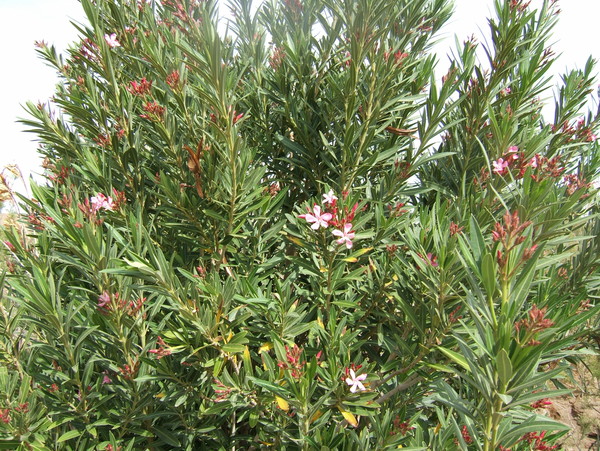
Oleander
Nerium oleander · Oleander, rose bay,Nerium oleander · Plant · Apocynaceae
Oleander is typically given to people with a dull, sad mental state. They are unable to think clearly, and lack self-confidence.
Skin symptoms are the main focus for Oleander, and it may be used to treat dry, itching, flaking eruptions, especially on the scalp: dandruff, cradle cap, eczema, and psoriasis may all be helped. The skin is violently itchy and burning, as if it is being bitten by lice. The slightest friction on the skin causes soreness and chapping. There may be trembling and weakness, and symptoms are generally made worse by eating oranges and other citrus fruits.
Key symptoms
- Paralytic conditions with cramp-like contractions of upper extremities
- Vertigo and diplopia when looking down or fixing gaze on an object
- Can see objects only when looking at them sideways
- Undigested feces; stool passes when emitting flatus
- Corrosive itching on forehead and edge of hair; worse from heat
- Humid, fetid spots behind ears and occiput
Worse (aggravation)
Better (amelioration)

Rose-laurel (NERIUM ODORUM)
Has a marked action on the skin, heart and nervous system, producing and curing paralytic conditions with cramp-like contractions of upper extremities. Hemiplegia. Difficult articulation.
Mind
Memory weak; slow perception. Melancholy, with obstinate constipation.
Head
Vertigo and diplopia, when looking down. Vertigo, when looking fixedly at an object, and on rising in bed. Pain in brain, as if head would burst. Numb feeling. Dull, unable to think. Indolence. Eruption on scalp. Humid, fetid spots behind ears (Graph; Petrol) and occiput, with red, rough, herpetic spots in front. Corrosive itching on forehead and edge of hair; worse, heat.
Eyes
Can see objects only when looking at them sideways. Eyes water on reading. Double vision. Sensation as if eyes were drawn back into the head.
Face
Pale, sunken, with blue rings around eyes (Phos ac).
Stomach
Canine hunger, with hurried eating, without appetite. Thirst. Empty belching. Vomiting of food; greenish water. Throbbing in pit.
Abdomen
Borborygmus, with profuse, fetid flatus. Gnawing around navel. Ineffectual urging. Undigested feces. Stool passes when emitting flatus. Burning pain in anus.
Chest
Oppression as from a weight; asthmatic when lying down. Palpitation, with weakness and empty feeling in chest. Dyspnœa. Obtuse stitches in chest.
Extremities
Weakness of lower limbs. Paralysis of legs and feet. Want of animal heat in limbs. Cold feet. Painless paralysis. Constant cold feet. Swelling, burning stiffness of fingers. Veins and hands swollen. Œdema. Stiffness of joints.
Skin
Itching, scurfy pimples; herpes; sensitive and numb. Nocturnal burning. Very sensitive skin; slightest friction causes soreness and chapping. Violent itching eruption, bleeding, oozing; want of perspiration. Pruritus, especially of scalp, which is sensitive.
Modalities
Worse, undressing, rest, friction of clothes.
Relationship
Compare: Con; Nat m; Rhus; Caust; Lathyr. Oleander contains Oleandrin and also Nerein which latter is said to be closely related if not identical with Digitalin. The pulse becomes slower, more regular, more powerful. Diuresis; palpitation, œdema and dyspnœa of valvular disease disappear.
Antidotes: Camph; Sulph.
Dose
Third to thirtieth potency.

Nerium Oleander. Rose Laurel. (South Europe, North Africa, West Asia. Thrives best in moist ground.) N. O. Apocynaceæ. Tincture of the leaves.
Clinical
Brain, affections of. Eczema. Fainting. Headache. Hyperæsthesia. Lienteria. Memory, weakened. Numbness. Nursing women, affections of. Palpitation. Paralysis. Perichondritis. Rheumatism. Scalp, eruption on. Spasms. Spine, affections of. Strabismus. Tongue, coated; parched. Vertigo.
Characteristics
Oleander, which is one of the remedies proved by Hahnemann, has been recognised as a powerful poison from antiquity. In the Cape de Verde Islands the petals of Olean. blossoms are used with dried orange-peel in all kinds of fevers to promote perspiration and drive out the rash. In animals poisoned by it, the heart becomes paralysed, first the auricles, then the entire heart. Goullon (H. R., xii. 402) refers to poisoning cases in which "anguish, inflammation of the stomach, diarrhœa, swoons," and even death had occurred. "Palpitation of the heart, anxiety, …
Hearing and Ears
Biting-itching on scalp, as from vermin, < on back part of head and behind ears.
Anus and Stool
Involuntary stool when emitting flatus; undigested food of the previous day.

Phatak's chapter on Oleander is available in the app.
Read Phatak in the appClassical texts are in the public domain. Educational reference only — not medical advice.
