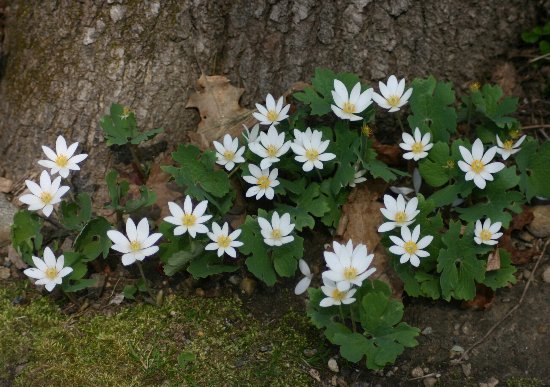
Sanguinaria canadensis
Bloodroot, red puccoon. · Plant · Papaveraceae
People who respond best to Sanguinaria are confused and full of dread, and feel very weak and stupid. Despite feeling heavy, languid, and drowsy, they cannot sleep at night and the slightest noise wakes them up. An uncomfortable sensation of prickling warmth sometimes spreads over the whole body.
The classic symptom picture for this remedy is of irritation of the mucous membranes, particularly those of the respiratory system. Sanguinaria may be given for hay fever accompanied by great sensitivity to grass, flowers, and scents, and by burning and dryness in the nose and throat. Other conditions that are typically associated with Sanguinaria include asthma with catarrh and raw, burning membranes. Symptoms tend to affect the right side of the body more than the left.
Key symptoms
- Right-sided remedy; periodical sick headache beginning in occiput settling over right eye
- Burning sensations throughout body like from hot water
- Circumscribed redness and burning of cheeks; hectic flush
- Hot flashes at climacteric with determination of blood to head
- Nasal polypi; ozaena with profuse offensive yellowish discharge
- Burning in palms and soles
- Influenzal coughs; phthisis
- Headache better lying down and sleep; distended temporal veins
- Sudden stopping of catarrh followed by diarrhea
Worse (aggravation)
Better (amelioration)

Blood Root (SANGUINARIA)
Is a right-sided remedy pre-eminently, and affects chiefly the mucous membranes, especially of the respiratory tract. It has marked vaso-motor disturbances, as seen in the circumscribed redness of the cheeks, flashes of heat, determination of blood to head and chest, distention of temporal veins, burning in palms and soles, and has been found very applicable to climacteric disorders. Burning sensations, like from hot water. Influenzal coughs. Phthisis. Sudden stopping of catarrh of respiratory tract followed by diarrhœa. Burning in various parts is characteristic.
Head
Worse right side, sun headache. Periodical sick headache; pain begins in occiput, spreads upwards, and settles over eyes, especially right. Veins and temples are distended. Pain better lying down and sleep. Headaches return at climacteric; every seventh day (Sulph; Sabad). Pain in small spot over upper left parietal bone. Burning in eyes. Pain in the back of head "like a flash of lightning".
Face
Flushed. Neuralgia; pain extends in all directions from upper jaw. Redness and burning of cheeks. Hectic flush. Fullness and tenderness behind angle of jaws.
Nose
Hay-fever. Ozæna, with profuse, offensive yellowish discharges. Nasal polypi. Coryza, followed by diarrhœa. Chronic rhinitis; membrane dry and congested.
Ears
Burning in ears. Earache with headache. Humming and roaring. Aural polypus.
Throat
Swollen; worse, right side. Dry and constricted. Ulceration of mouth and fauces, with dry, burning sensation Tongue white; feels scalded. Tonsillitis.
Stomach
Aversion to butter. Craving for piquant things. Unquenchable thirst. Burning, vomiting. Nausea, with salivation. Sinking, faint all-gone feeling (Phos; Sep). Spitting up of bile; gastro-duodenal catarrh.
Abdomen
Diarrhœa as coryza improves. Pain over region of liver. Diarrhœa; bilious, liquid, gushing stool (Nat sulph; Lycop). Cancer of rectum.
Female
Leucorrhœa fetid, corrosive. Menses offensive, profuse. Soreness of breasts. Uterine polypi. Before, menses, itching of axillæ. Climacteric disorders.
Respiratory
Œdema of larynx. Trachea sore. Heat and tension behind the sternum. Aphonia. Cough of gastric origin; relieved by eructation. Cough, with burning pain in chest; worse, right side. Sputum tough, rust-colored, offensive, almost impossible to raise. Spasmodic cough after influenza and after whooping-cough. Cough returns with every fresh cold. Tickling behind sternum, causes a constant hacking cough; worse at night on lying down. Must sit up in bed. Burning soreness in right chest, through to right shoulder. Severe soreness under right nipple. Hæmoptysis from suppressed menses. Severe dyspnœa and constriction of chest. Offensive breath and purulent expectoration. Burning in chest as of hot steam from chest to abdomen. Fibroid phthisis. Pneumonia; better, lying on back. Asthma with stomach disorders (Nux). Valvular disease with lung development, phosphates in urine and loss of flesh. Sudden stoppage of catarrh of air passages brings on diarrhœa.
Extremities
Rheumatism of right shoulder, left hip-joint and nape of neck. Burning in soles and palms. Rheumatic pains in places least covered by flesh; not in joints soles of feet burn. Right-side neuritis; better touching the part.
Skin
Antidotes: Rhus poisoning. Red, blotchy eruptions; worse in spring. Burning and itching; worse by heat. Acne, with scanty menses. Circumscribed red spots over malar bones.
Modalities
Worse, sweets, right side, motion, touch. Better, acids, sleep, darkness.
Relationship
Complementary: Tart em.
Compare: Justicia (bronchial catarrh, coryza, hoarseness; oversensitive). Digitalis (Migraine). Bell; Iris; Melil; Lach; Ferr; Op.
Dose
Tincture in headaches; sixth potency in rheumatism.

Generalities
Blood root is an old domestic remedy. A great many eastern farmers' wives will not go into the winter without blood root in the house.
In the cold winter days, when the coryzas come on, a "cold" in the head, throat and chest, then they get the blood root ready and make a tea of it. With them it is a routine remedy for "colds." They give it to combat all complaints, and there is no doubt but that even in this crude form it does break up "colds," because the provings show its relation to chest troubles and "colds" that go to the chest.
Head
Periodic headaches, when the headache comes once in seven days it begins in the morning on waking or wakes the patient up.

Sanguinaria canadensis. Blood-root. Puccoon. N. O. Papaveraceæ. Tincture of fresh root. (The resin, leaves, seeds, seed-vessels, powdered root, and expressed juice have also been used.) Acetum.
Clinical
Alcoholism. Aphonia. Asthma. Breast, tumour of. Bronchitis. Cancer. Catarrh. Chest, pains in. Climaxis. Cold. Croup. Deafness. Diphtheria. Dysmenorrhœa. Dyspepsia. Ear, polypus of. Flushes, climacteric. Gleet. Granular lids. Hæmoptysis. Headache. Influenza. Keratitis. Liver-cough. Menstruation, breasts painful during. Nails, ulceration of. Neuralgia. Œdema glottidis. Ophthalmia. Pharyngitis. Phthisis florida. Physometra. Pneumonia, acute. Polypus. Pregnancy, affections during. Pyrosis. Quinsy. Rheumatism. Rhus poisoning. Shoulder, rheumatism of. Smell, illusions of; loss of. Stomach, neurosis of. Syphilis. Tinnitus. Tumours. Vomiting. Whitlow. Whooping-cough.

Bloodroot. (Papaveraceae.)
The periodical sick headache; begins in morning, increases during the day, lasts until evening; head feels as if it would burst, or as if eyes would be pressed out; relieved by sleep. American sick headache, > by perfect quiet in a dark room ("tired headache" from over mental or physical exertion, epigea; sick headache < during rest > by rubbing, pressure, motion, Indigo). Headache begins in occiput, spreads upwards and settles over right eye (Sil., - over or in left orbit, Spig.). Headaches, return at the climacteric; every seventh day (Sabad., Sil., Sulph. - eight day, Iris). Neuralgia of face > by kneeling down and pressing the head firmly against the floor; pain extends in all directions from the upper jaw. Circumscribed red cheeks in afternoon; burning in ears; in bronchitis, pneumonia, phthisis. Rheumatic pain in the right arm and shoulder (left, Fer.); cannot raise the arm, < at night. Pains in places where the bones are least covered, as tibia, backs of hands, etc (Rhus …

Head
Sick-headache begins in the occiput, spreads upward and settles over the right eye, < by light and noise, > lying quiet, and sleep, or pressing head against something hard.
General Face
Circumscribed redness of one or both cheeks; cheeks livid (in typhoid pneumonia).
Respiratory Organs
Expectoration smells exceedingly offensive even to the patient himself.
Respiratory Organs
Continual and severe cough, with or without expectoration; always attended with circumscribed redness of cheeks.
Respiratory Organs
Cough compels the erect position and ceases on passing flatus up or down.
Respiratory Organs
Cough with circumscribed redness of cheeks, and pain in the chest.

Phatak's chapter on Sanguinaria canadensis is available in the app.
Read Phatak in the appClassical texts are in the public domain. Educational reference only — not medical advice.
