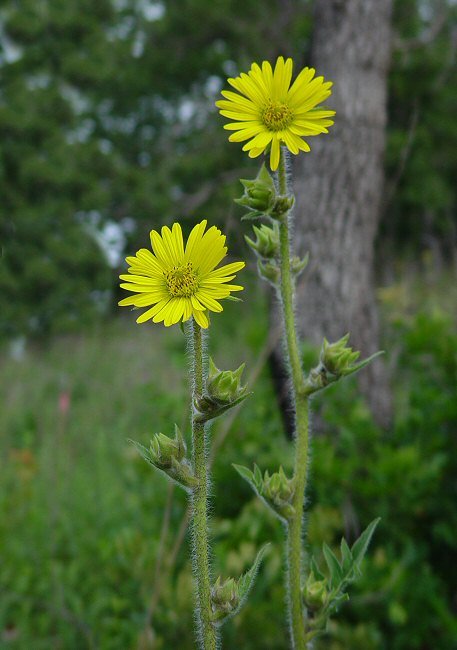
Silphium lacinatum
Silphium laciniatum · Plant · Asteraceae
Silphium lacinatum suits patients with chronic respiratory catarrh producing copious, stringy, frothy mucus, aggravated by drafts of air. It is indicated in asthma and chronic bronchitis with a constant desire to hawk and scrape the throat. Catarrhal conditions may extend to the bladder and bowels.
Key symptoms
- Cough with profuse, stringy, frothy, light-colored expectoration
- Cough excited by sense of mucus rattling in the chest
- Constriction of lungs
- Catarrh with copious stringy mucous discharges
- Desire to hawk and scrape the throat
- Irritation of posterior nares with constriction of supra-orbital region
- Catarrhal influenza; catarrh of bladder; dysentery preceded by white mucus-covered stools
Worse (aggravation)
- Drafts of air

Rosin-weed (SILPHIUM)
Is used in various forms of asthma and chronic bronchitis Catarrh of bladder. Catarrhal influenza. Dysentery; attack preceded by constipated stools covered with white mucus.
Respiratory
Cough with expectoration profuse, stringy, frothy, light-colored. Excited by sense of mucus rattling in chest and worse by drafts of air. Constriction of lungs. Catarrh, with copious, stringy, mucous discharges. Desire to hawk and scrape throat. Irritation of posterior nares, involving mucous membranes of nasal passages with constriction of supra-orbital region.
Relationship
Compare: Aral; Copaiv; Tereb; Cubeb; Samb; Silphion cyrenaicum (phthisis pulmonum, with incessant cough, profuse night-sweats, emaciation, etc); Polygonum aviculare (has been found useful in phthisis, when given in material doses of the mother tincture); Salvia (tickling cough). Arum dracontium (loose cough at night on lying down). Justicia adhatoda (bronchial catarrh, hoarseness, oversensitive).
Dose
Third potency. Lower triturations preferred by some.

Silphium laciniatum. Compass-plant. Pilot-weed. Polar-plant. Rosin-wood. Turpentine-weed. N. O. Compositæ. Tincture of fresh plant.
Clinical
Asthma. Bladder, catarrh of. Bronchitis. Cancer.
Characteristics
The leaves of this plant, when they first come up, present their faces uniformly north and south; later on, when the leaves become heavy, the winds carry them in different directions and the polarity is not to be observed. The stem of the plant exudes an abundance of resin, as some of its names indicate. Hale mentions that it has been used in all forms of asthma; and in chronic bronchitis with large quantities of stringy, frothy, light-coloured mucus, and in catarrh of the bladder. Hale made a proving of it, and his symptoms comprise the Schema. He gives this case: Mr. H., 55, had phthisis twenty years. On the slightest exposure or cold he would have congestion of mucous surfaces, followed with copious expectoration of stringy, frothy, light-coloured mucus (from one to three pints in twenty-four hours), …
Classical texts are in the public domain. Educational reference only — not medical advice.
