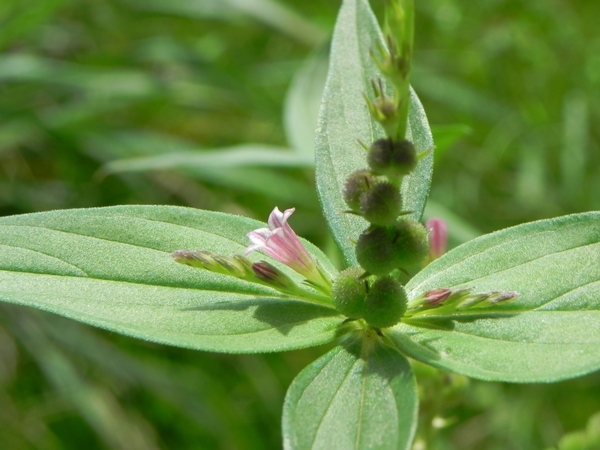
Spigelia anthelmia
Pink root, annual wormgrass. · Plant · Loganiaceae
A sad, forgetful, “blank” temperament is characteristic of those who respond most effectively to this remedy. They are responsible people who suffer intense pain, causing great nervous agitation.
It is given chiefly for problems of the heart and the nervous system, especially if symptoms affect primarily the left side of the body, and if there are intense, violent pains. Spigelia may be given for frequent palpitations that are violent, visible, and audible, for heart murmurs or valve disorders, and for rheumatic heart disease. It is also used for angina with constricting chest pains that extend down one or both arms, into the chest, and up to the throat. In addition, the remedy may be used for headaches, migraines, sinus infections, or neuralgic or rheumatic pain, especially if the symptoms are worse on the left side.
Key symptoms
- Violent pericarditis and heart affections; stabbing pains
- Severe neuralgic pain in and around the eyes extending deep into socket
- Pain beneath frontal eminence and temples extending to eyes
- Semi-lateral headache involving left eye; worse making a false step
- Very sensitive to touch; parts feel chilly sending shudder through frame
- Neuralgia of fifth nerve; ciliary neuralgia
- Pupils dilated; photophobia; rheumatic ophthalmia
- Child refers navel as most painful part; worm symptoms
Worse (aggravation)
Better (amelioration)

Pinkroot (SPIGELIA)
Spigelia is an important remedy in pericarditis and other diseases of the heart, because the provings were conducted with the greatest regard for objective symptoms and the subjective symptoms are by innumerable confirmations proved to be correct (C. Hering).
Has marked elective affinity for the eye, heart, and nervous system. Neuralgia of the fifth nerve is very prominent in its effects. Is especially adapted to anæmic, debilitated, rheumatic, and scrofulous subjects. Stabbing pains. Heart affections and neuralgia. Very sensitive to touch. Parts feel chilly; send shudder through frame. A remedy for symptoms due to the presence of worms. Child refers to the navel as the most painful part (Granat; Nux mosch).
Mind
Afraid of sharp, pointed things, pins, needles, etc.
Head
Pain beneath frontal eminence and temples, extending to eyes (Onos). Semi-lateral, involving left eye; pain violent, throbbing; worse, making a false step. Pain as if a band around head (Carbol ac; Cact; Gels). Vertigo, hearing exalted.
Eyes
Feel too large; pressive pain on turning them. Pupils dilated; photophobia; rheumatic ophthalmia. Severe pain in and around eyes, extending deep into socket. Ciliary neuralgia, a true neuritis.
Nose
Forepart of nose always dry; discharge through posterior nares chronic catarrh, with post-nasal dropping of bland mucus.
Mouth
Tongue fissured, painful. Tearing toothache; worse, after eating and cold. Foul odor from mouth. Offensive taste.
Face
Prosopalgia, involving eye, zygoma, cheek, teeth, temple, worse, stooping, touch, from morning until sunset.
Heart
Violent palpitation. Præcordial pain and great aggravation from movement. Frequent attacks of palpitation, especially with foul odor from mouth. Pulse weak and irregular. Pericarditis, with sticking pains, palpitation, dyspnœa. Neuralgia extending to arm or both arms. Angina pectoris. Craving for hot water which relieves. Rheumatic carditis, trembling pulse; whole left side sore. Dyspnœa; must lie on right side with head high.
Rectum
Itching and crawling. Frequent ineffectual urging to stool. Ascarides.
Fever
Chilliness on the slightest motion.
Modalities
Worse, from touch, motion, noise, turning, washing, concussion. Better, lying on right side with head high; inspiring.
Relationship
Compare: Spigelia Marylandica (maniacal excitement, paroxysmal laughing and crying, loud, disconnected talking, vertigo, dilated pupils, congestions); Acon; Cact; Cimicif; Arnica (Spigela is a chronic Arnica); Cinnab (supra-orbital pain); Naja; Spong (heart); Sabad; Teucr; Cina (worm symptoms).
Antidote: Pulsat.
Dose
Sixth to thirtieth potency for neuralgic symptoms; second to third potency for inflammatory symptoms.

Spigelia anthelmia. Demerara Pink-root. N. O. Loganiaceæ. Tincture of dried herb.
Clinical
Adenoids. Amaurosis. Angina pectoris. Ciliary neuralgia. Cold. Constipation. Depression of spirits. Diaphragm, stitches in. Exophthalmic goître. Eyes, pains in. Gastric catarrh. Glaucoma. Headache. Heart, affections of. Hernia, inguinal. Iritis. Jaw-joint, pain in. Neuralgia. Otalgia. Post-nasal catarrh. Prostatorrhœa. Pterygium. Rectum, cancer of. Rheumatism. Scarlatina. Sigmoid flexure, cancer of. Stammering. Strabismus. Tinnitus. Tobacco habit. Toothache. Worms.
Characteristics
Spigelia anthelmia is a common weed in South America.: S. Marylandica, "Pink-root" or "Worm-grass," is a native of the Southern States of North America. Spigel. anth. is an acro-narcotic. It was known in Europe in Hahnemann's time as an anthelmintic, this property of the drug having been learned from the negroes of the Antilles. Hahnemann's proving (M. M. P.) revealed many other virtues. He says of the plant that it has this …
-
Neuralgia of the fifth pair of nerves, tearing, shooting, burning into the eye, malar bone and teeth, periodical from morning until sunset, worse at noon, from noise, motion of jarring.
-
Intolerable pressive pain in the eyeballs, they feel too large for their orbits, worse in turning the eyes.
-
Rheumatic ophthalmia; pains are sharp and tearing, with pressure in the eyeballs.
-
Throbbing, tearing toothache, which is especially aggravated by cold water, disappearing when lying down.
-
Dyspnoea, can lie only on right side, with trunk raised, the least motion produces great suffocation, with anxiety and palpitation of the heart.
-
Purring feeling over the heart; wave-like motion not synchronous with the pulse.

Phatak's chapter on Spigelia anthelmia is available in the app.
Read Phatak in the appClassical texts are in the public domain. Educational reference only — not medical advice.
