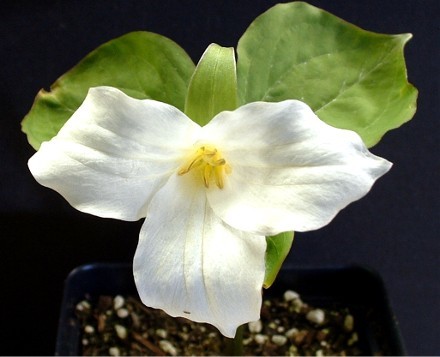
Trillium pendulum
Trillium cernuum · Plant · Melanthiaceae
Trillium pendulum is a leading hemorrhagic remedy, particularly suited to flabby women who flood profusely after every labor or at the climacteric. The cardinal keynote is copious bright red hemorrhage accompanied by a sensation of the hips and sacrum falling to pieces, relieved by tight bandaging. Flooding is accompanied by fainting, dim sight, and palpitation. The remedy covers hemorrhages from multiple orifices and is complementary to Calcarea phosphorica.
Key symptoms
- Hemorrhages bright red, profuse, from uterus, nose, lungs, or kidneys
- Flooding with fainting; excessive uterine hemorrhage with great faintness and dim sight
- Sensation as if hips and small of back falling to pieces; sacroiliac synchondroses feel apart
- Better from tight bandage applied to hips and pelvis
- Gushing of bright red blood from uterus at least movement
- Metrorrhagia at climacteric; menses every two weeks
- Haemoptysis with copious purulent expectoration in phthisis
- Chronic diarrhea with bloody mucus; dysentery with near-pure blood
- Craving for ice-water; everything looks bluish (blue vision)
- Great debility with restless tossing; anguish
Worse (aggravation)
- From motion (hemorrhage worsens)
- Sitting erect
- After eating
- Noise (headache)
- Walking; coughing
Better (amelioration)
- Bending forward
- Tight bandage (pelvic symptoms)
- Exercise in open air

White Beth-root
A general hæmorrhagic medicine, with great faintness and dizziness. Chronic diarrhœa of bloody mucus. Uterine hæmorrhage. Threatened abortion. Relaxation of pelvic region. Cramp-like pains. Phthisis with purulent and copious expectoration and spitting of blood.
Head
Pain in forehead; worse, noise. Confused; eyeballs feel too large. Vision blurred; everything looks bluish. Nose-bleed (Millef; Melilot).
Mouth
Hæmorrhage from gums. Bleeding after tooth extraction.
Stomach
Heat and burning stomach rising up in œsophagus. Hæmatemesis.
Rectum
Chronic diarrhœa; discharge bloody. Dysentery,; passage almost pure blood.
Female
Uterine hæmorrhages, with sensation as though hips and back were falling to pieces; better tight bandages. Gushing of bright blood on least movement. Hæmorrhage from fibroids (Calc; Nitr ac; Phos; Sulph ac). Prolapse, with great bearing-down. Leucorrhœa copious, yellow, stringy (Hydras; Kali b; Sabin). Metrorrhagia at climacteric. Lochia suddenly becomes sanguinous. Dribbling of urine after labor.
Respiratory
Cough, with spitting of blood. Copious, purulent expectoration. Hæmoptysis. Aching at end of sternum. Suffocative attack of irregular breathing with sneezing. Shooting pains through chest.
Relationship
Compare: Trillium cernum (eye symptoms; everything looks bluish; greasy feeling in mouth); Ficus (hæmorrhages; menorrhagia, hæmaturia, epistaxis, Hæmatemesis, bleeding piles); Sanguisuga-Leech--(hæmorrhages; bleeding from anus). Ipec; Sab; Lach; Hamam.
Dose
Tincture and lower potencies.

Trillium erectum. Purple Trillium. Bethroot. Birthroot. Lamb's quarter. Rattlesnake root. Wakerobin. Three-leaved nightshade. [According to Millspaugh T. pendulum is the white variety of T. erectum. Treas. of Bot. gives the names as synonymous. The symptoms of H. Minton, the original prover, are given in Allen under T. cernuum. Minton obtained the tincture from a botanic physician and did not himself verify the plant. His symptoms are marked (M) in the schema. Millspaugh considers T. erectum as the proper source of the homœopathic tincture.] N. O. Smilaceæ (or Trilliaceæ) of the Liliaceæ. Tincture of the fresh root.
Clinical
Bladder, catarrh of. Climaxis. Diabetes. Dysentery. Fainting, with flooding. Fibroma, hæmorrhages from. Hæmorrhages; post-partum; ante-partum. Menorrhagia. Metrorrhagia. Writer's cramp.

Wake Robin (Smilaceae)
Haemorrhage: copious, both active and passive, usually bright red; from nose, lungs, kidneys and uterus (Ipec., Mill.). Tendency to puterescence of fluids. Epistaxis; profuse, passive, bright red. Bleeding from cavity after extraction of a tooth (Ham., Kreos.). Menses: profuse, every two weeks, lasting a week or longer (Calc. p.); after over-exertion or too long a ride. Flooding, with fainting. Menorrhagia: flow, profuse, gushing, bright red; at least movement (Sab.); from displaced uterus; at the climacteric; every two weeks, dark, clotted (Thlas., Ust.). Haemoptysis: incipient phthisis, with bloody sputa; in advanced stages with copious, purulent expectoration and troublesome cough. Sensation as if hips and small of back were falling to pieces; as if sacro-iliac synhrondroses were falling apart, wants to be bound tightly; as if bones of pelvis were broken (Aesc.); with haemorrhage. Profuse uterine haemorrhage t climacteric; flow every two weeks; pale, faint, dim sight, palpitation, obstruction and noises in ears (Fer.); painful sinking at pit of stomach.

Female Sexual Organs
Mensesafter over-exertion or too long a ride.
Female Sexual Organs
Flooding, with fainting, faint, dim sight, palpitation, obstruction and noises in the ears.
- Hemorrhages; blood bright red, profuse; sacroiliac synchondroses full as if falling apart; better from a tight bandage.

Phatak's chapter on Trillium pendulum is available in the app.
Read Phatak in the appClassical texts are in the public domain. Educational reference only — not medical advice.
