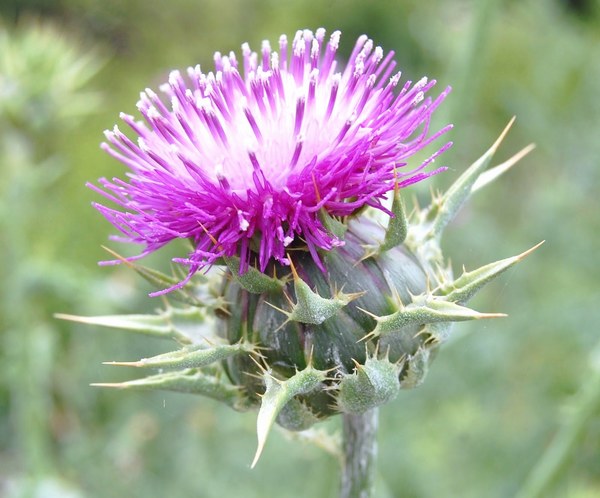
Carduus marianus
Silybum marianum · Carduus marianus, St. Mary’s thistle, milk thistle,Silybum marianum · Plant · Asteraceae
Carduus is most suitable for people who are completely run down, with the kind of total physical and mental exhaustion, blankness, and indifference that may arise following a hard life of physical labor, or that may be caused by alcoholism.
The classic symptom picture for Carduus is of acute or chronic liver problems and lung conditions such as asthma. The remedy may be used for severe liver and abdominal pain that is most marked when lying on the left side, or for gallbladder pain and gallstone colic. The stools are typically discolored and pale due to liver malfunction, or they may be dark due to internal bleeding in the digestive system.
Key symptoms
- Pain and soreness in region of liver with jaundice
- Vomiting of green, acid fluid
- Hard, difficult, knotty stools alternating with diarrhoea
- Stools bright yellow; liver-related hemorrhages
- Varicose veins and ulcers; portal congestion
- Gallstone disease with enlarged liver
- Haemorrhagic piles with prolapse of rectum
Worse (aggravation)
Better (amelioration)

St. Mary's Thistle
The action of this drug is centered in the liver, and portal system, causing soreness, pain, jaundice. Has specific relation to the vascular system. Abuse of alcoholic beverages, especially beer. Varicose veins and ulcers. Diseases of miners, associated with asthma. Dropsical conditions depending on liver disease, and when due to pelvic congestion and hepatic disease. Disturbs sugar metabolism. Influenza when liver is affected. Debility. Hæmorrhages, especially connected with hepatic disease.
Mind
Despondency; forgetful, apathetic.
Head
Contractive feeling above eyebrows. Dull heavy, stupid, with foul tongue. Vertigo, with tendency to fall forward. Burning and pressure in eyes. Nose-bleed.
Stomach
Taste bitter. Aversion to salt meat. Appetite small; tongue furred; nausea; retching; vomiting of green, acid fluid. Stitches in left side of stomach, near spleen (Ceanoth). Gallstone disease with enlarged liver.
Abdomen
Pain in region of liver. Left lobe very sensitive. Fullness and soreness, with moist skin. Constipation; stools hard, difficult, knotty; alternates with diarrhœa. Stools bright yellow. Swelling of gall bladder with painful tenderness. Hyperæmia of liver, with jaundice. Cirrhosis, with dropsy.
Rectum
Hæmorrhagic piles, prolapse or rectum, burning pain in anus and rectum, hard and knotting, clayey stools. Profuse diarrhœa due to rectal cancer. 10 drops doses (Wapler).
Urine
Cloudy; golden-colored.
Chest
Stitching pains in lower right ribs and front; worse, moving, walking, etc. Asthmatic respiration. Pain in chest, going to shoulders, back, loins and abdomen, with urging to urinate.
Skin
Itching on lying down at night. Varicose ulcers (Clematis vitalba). Eruption on lower part of sternum.
Extremities
Pain in hip-joint, spreading through buttocks and down thigh; worse from stooping. Difficult rising. Weakness felt in feet, especially after sitting.
Relationship
Compare: Card benedictus (strong action on eyes, and sensation of contraction in many parts; stomach symptoms similar); Chelidon; Chionanthes; Merc; Podophyl; Bry; Aloe.
Dose
Tincture and lower potencies.
This is one of the most important liver remedies, if a homoeopathic author can be excused for the expression. There are many pains, pressing, dragging, drawing, burning; worse from motion.
The patient is very sensitive to cold, and is subject to attacks of bilious vomiting at regular or irregular intervals. The author has cured many violent sick headaches ending in vomiting bile, and cases in the habit of taking calomel, with this remedy (Sang.).
Dropsical effusions with liver diseases. It is useful in hemorrhages and jaundice, when symptoms agree.
Sadness, irritability and weeping. Congestive headaches; pressing pains coming periodically. Fullness and heaviness in the head. Sensitiveness of the scalp to cold air. Pressing outward of the eyeballs.

Silybum. N. O. Compositæ. Tincture or trituration of the seeds.
Clinical
Bronchitis. Dropsy. Epistaxis. Fever. Gall-stones. Hæmoptysis. Hæmorrhages. Hæmorrhoids. Influenza. Intermittents. Jaundice. Liver, affections of. Metrorrhagia. Neuralgia. Phthisis. Pleurisy. Rheumatism. Sciatica. Spleen, affections of. Typhlitis. Varicose veins.
Characteristics
To Rademacher we are principally indebted for this remedy. It is with him primarily an hepatic: all its manifestations originating in some disorder of the liver. According to Burnett the greatest effect of Card. m. is felt on the spleen and liver, especially the splenic end of the liver. G. F. Laidlaw (H. M., xxxiv. 686) gives a condensed translation of Rademacher's remarks about Card. m.: He regards hæmatemesis as most frequently due to chronic disease of the spleen; less frequently to disease of the liver. People who have long suffered from pains in left hypochondrium are apt to vomit blood, after which they are relieved. Rademacher regards the bleeding as …

Phatak's chapter on Carduus marianus is available in the app.
Read Phatak in the appClassical texts are in the public domain. Educational reference only — not medical advice.
